India became Britain's crown jewel. Yet for Queen Victoria, it might have just been another title.
A Spectacle Amidst Sovereignty
The air of Delhi was alive with a peculiar electric tension on January 1, 1877. It was a day poised between extravagance and irony — a spectacle scripted to legitimize Britain's imperial ambitions under the veil of pageantry.
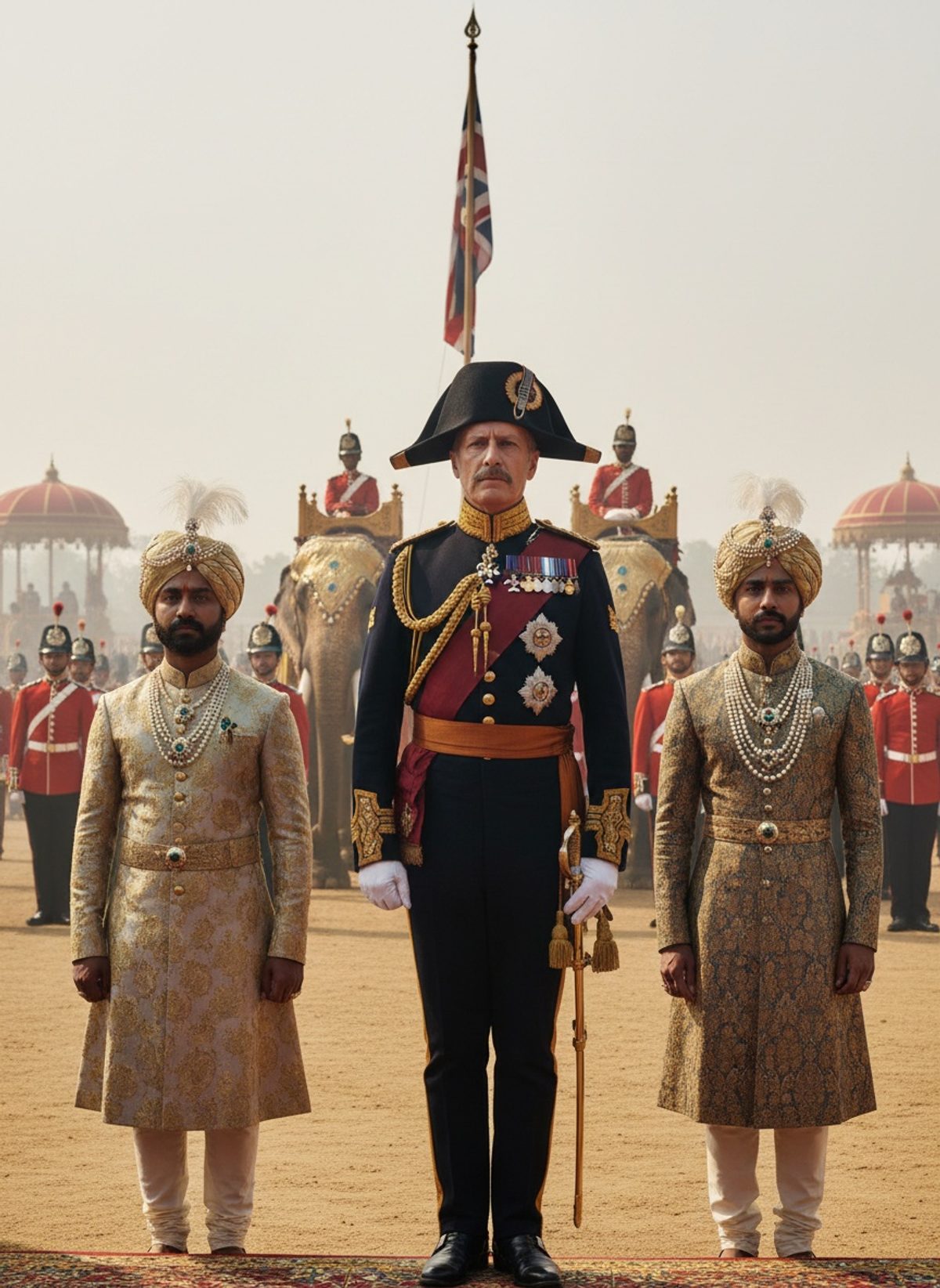
As dawn broke over the Indian plains, the dusty horizon was interrupted by the rigid steel lines of 68,000 British and Indian troops standing at meticulous attention. Their presence was more than ceremonial; it signified the administrative grip of an empire far from home.
Beneath majestically billowing canopies, lined with vivid colors fit for a queen, an eclectic assembly gathered. Indian maharajas adorned in silk and gems gleamed juxtaposed against the stark simplicity of British officers' uniforms. The cultural juxtaposition was as poignant as it was stark.
Read next: When John Nicholson Marched 400 Miles in 20 Days to Save Delhi
In that charged atmosphere, one could sense the tectonic shift of power, a deft pivot from symbolism to dominance. Delhi's grand durbar was not merely an announcement — it was a calculated overture and a new chapter in consolidating British hegemony.
Victoria’s Unseen Dominion
Queen Victoria's ascent to the title of Empress of India was rife with ironies. Over 3,000 miles away, the monarch had never stepped onto the subcontinental soil that now lay beneath her notional feet.
Her connection to India was abstract, woven more through the intricate correspondence with her Indian-born servant Abdul Karim than any personal experience or expedition. Yet, with the pronouncement of her title, she wielded power over an empire of 300 million, a staggering population scarcely imaginable to her Victorian contemporaries.
The title "Empress" was more than an embellishment of her sovereignty; it was engineered partly by her then-prime minister, Benjamin Disraeli. The Victorian era roared with colonial ambition, and Disraeli had masterfully maneuvered this proclamation to bolster British prestige both domestically and internationally.
It laid down a gauntlet for rival empires while reinforcing Victoria's status in a world where titles were accolades of tangible might and influence. But behind the pomp and political calculations, the true custodians of India — its people — found themselves passive observers in an elaborate charade designed as much for European audiences as it was for them.
Cultural Chasm and Silent Echoes
The grandeur of the Delhi Durbar typified the intricacies of colonial relationships, where outward pomp often masked underlying fissures. While royals and dignitaries reveled in festivities, the vast populace of India clung to a simmering tension beneath the surface.
The proclamation did little to alleviate the palpable disconnect between the colonial rulers and the ruled. The proclamation resonated more with British colonial elites than with the countless Indian inhabitants who would bear its repercussions. For many Indians, the new title was an echo of increasing cultural displacement and economic strain.
Read next: When John Lawrence Saved 8 Million Lives with One Telegraph Message
The rising tide of nationalist sentiment, imperceptible in the Durbar's opulent spectacle, quietly gathered strength among Indian intelligentsia. Newspapers cautiously critiqued the Durbar, hinting at the growing awareness and unease among educated Indians. The era foreshadowed greater upheavals, sown in the seeds of such imperial processes, that would eventually burgeon into India's struggle for independence. Yet on that fateful day, the clamor of Victoria's royal title hung heavily, a gilded crown atop an era of profound divide.
The Day and The Legacy
The spectacle of January 1, 1877, was emblematic of an empire at its zenith, yet fraught with the contradictions of imperial philosophy. The British Empire, seemingly at its most unassailable, cloaked its overreach in the trappings of civilizational duty and progress.
Queen Victoria’s imperial proclamation was not just a marker of royal expansion — it was a moment under which the weight of colonial arrogance pressed heaviest upon India. It created a fiction of cultural supremacy, a constructed narrative that would persist beyond the pages of Victorian history.
The announcement of Victoria as Empress of India doesn't just mark a historical chapter but serves as a fulcrum of lessons on empire, dominion, and the intricate dance of power. It reminds us that the grandeur of empires is invariably shadowed by the complexities of human aspiration and resistance.
In remembering that day, we peer into the heart of imperialism's duality — its ability to awe even as it oppresses. The story of Victoria's proclamation is a vivid reminder that beneath the grandeur of history, there lies the silent, potent spirit of those who lived in its shadow.