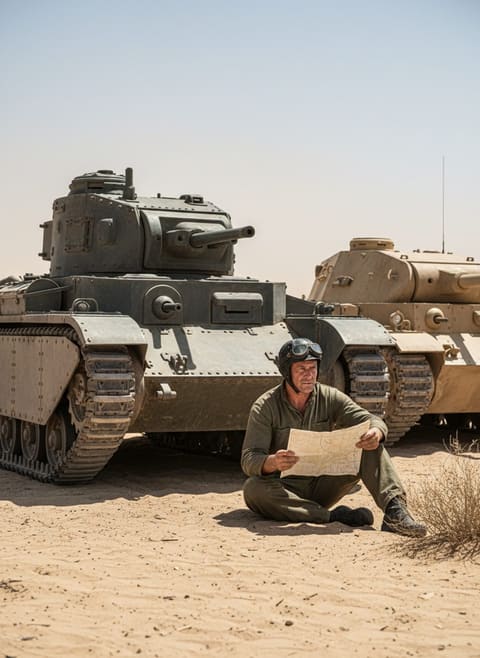
November 1937. The air hung thick with the scent of oil and steel at the Vulcan Foundry in Lancashire.
The Birth of a Titan
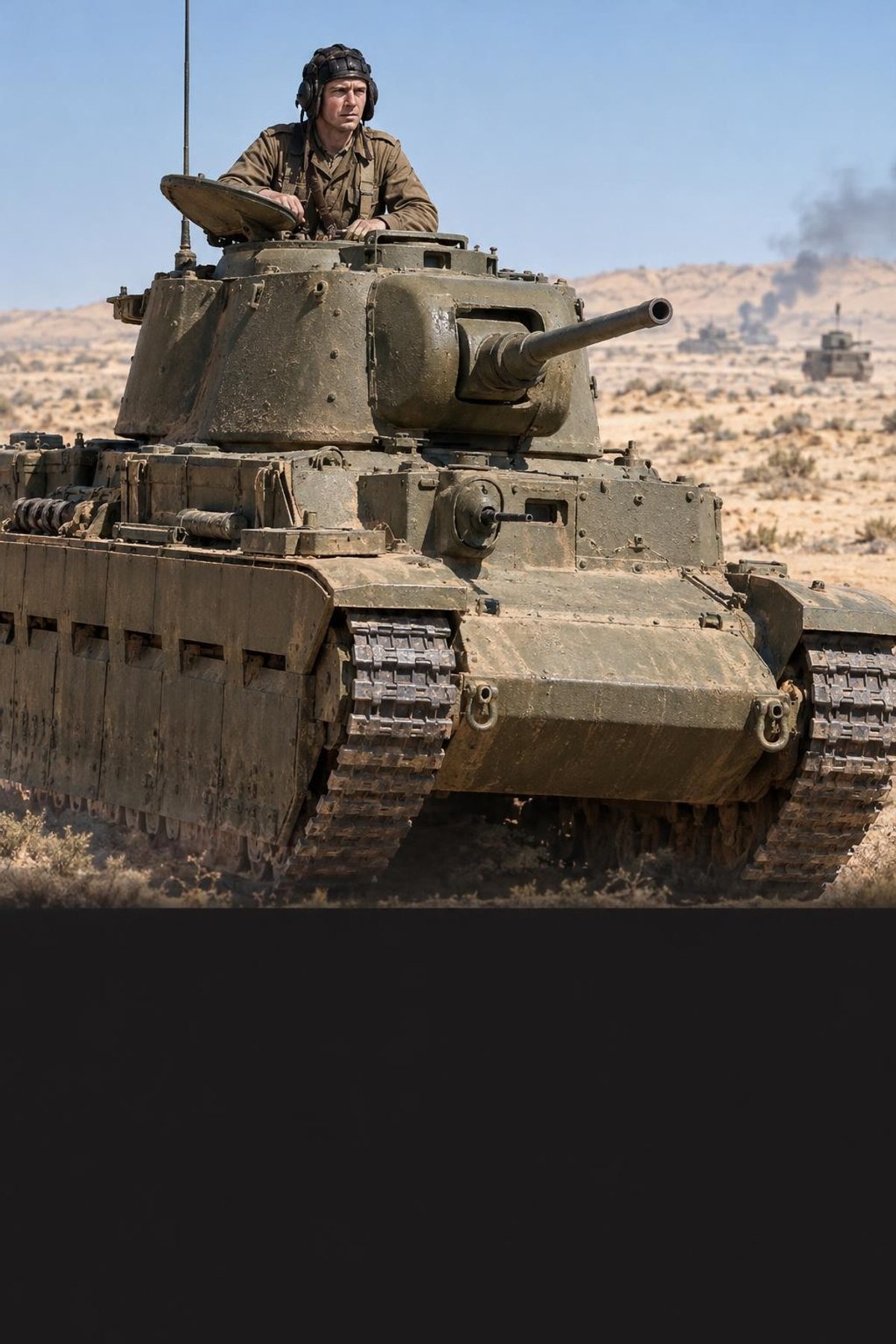
In the throes of industrial might, the Vulcan Foundry bustled with activity, its cavernous halls echoing the clang of metal upon metal. Here, amidst the spark showers and rhythmic thumping of machinery, a formidable beast was taking shape. The Matilda II, officially the Infantry Tank Mark II, was a paradox in plated form—slow and heavyset, yet almost impervious to an adversary’s blow.
This tank, squat and sturdy, was conceived to protect and support infantry on the battlefield. Armed with a QF 2-pounder gun, the Matilda II was not built for blitzkrieg tactics but rather to endure and respond with unerring precision.
Its armor, up to 78 mm thick in places, was practically impervious to the anti-tank weaponry of the late 1930s, granting it a near-mythic status among its crew. To see this mechanical titan pass was to witness an era's most promising protector unfold.
Read next: When Challenger Churchill Rolled Into the Kuwait Desert, 1991
A Star Turned Queen
In May of 1940, the Matilda II rolled into legend during the Battle of Arras, a frantic confrontation in northern France. There, the British sought to counterattack the advancing German forces with a bold maneuver.
With determination and grit, around two dozen Matilda IIs thundered to the fore, their presence striking fear into the hearts of two entire German divisions. Erwin Rommel himself, the Desert Fox who would become the scourge of Allied forces in later campaigns, momentarily paused in his tracks—an iron curtain manifest amid northern fields.
The Matilda II’s prowess lay in its almost comical defiance of conventional weaponry. German Panzers could scarcely scratch its robust armor, while anti-tank guns seemed to bounce off its sides. This episode elevated the Matilda from mere tank to battlefield icon, earning it the nickname “Queen of the Desert” as its legend spread and morale bolstered. Yet, while the Matilda excelled in this brief theater of war, the sands of a distant desert would soon tell another tale.
Desert Legacy
As World War II expanded to the harsh landscapes of North Africa, the Matilda II followed, maintaining its course through desert sands. The tank's armor, which had once seemed impregnable, continued to prove its worth against light calibers. However, the North African campaign introduced it to a new adversary—the German 88mm gun. This anti-aircraft weapon, repurposed as an anti-tank measure, unveiled the Achilles' heel of the Matilda II with ruthless efficiency.
Read next: When a Schoolboy's Doodle Nearly Unmasked D-Day's Secret
No longer invulnerable, the Matilda II’s reign as the Queen of the Desert faded. Though it continued to serve dutifully through various campaigns in the Second World War, the introduction of more advanced tanks began to eclipse its once-dominant presence. Nevertheless, in the retelling of its history, the Matilda remains a symbol of resilience and adaptation in the face of ever-evolving warfare.
The Echoes of War
Today, within the grand tapestry of military history that spans the abrupt and the apocalyptic, the Matilda II stands as a testament not to invincibility but to the iron willpower of those who built and deployed it. Far more than a series of technical specifications, each tank was a crucible of human ingenuity, its story woven by the men who fought—and fell—for its cause.
In reflecting upon the machines that shaped our past, we recognize their dual nature: invaluable yet fallible, powerful yet ultimately superseded. The Matilda II’s journey from the industrial cradle of Vulcan Foundry to the unforgiving North African desert encapsulates a broader narrative—a microcosm of human ambition met with relentless challenge. As we delve into the untold empires of history, we must ponder what might be learned from the legends that textbooks so often leave out.