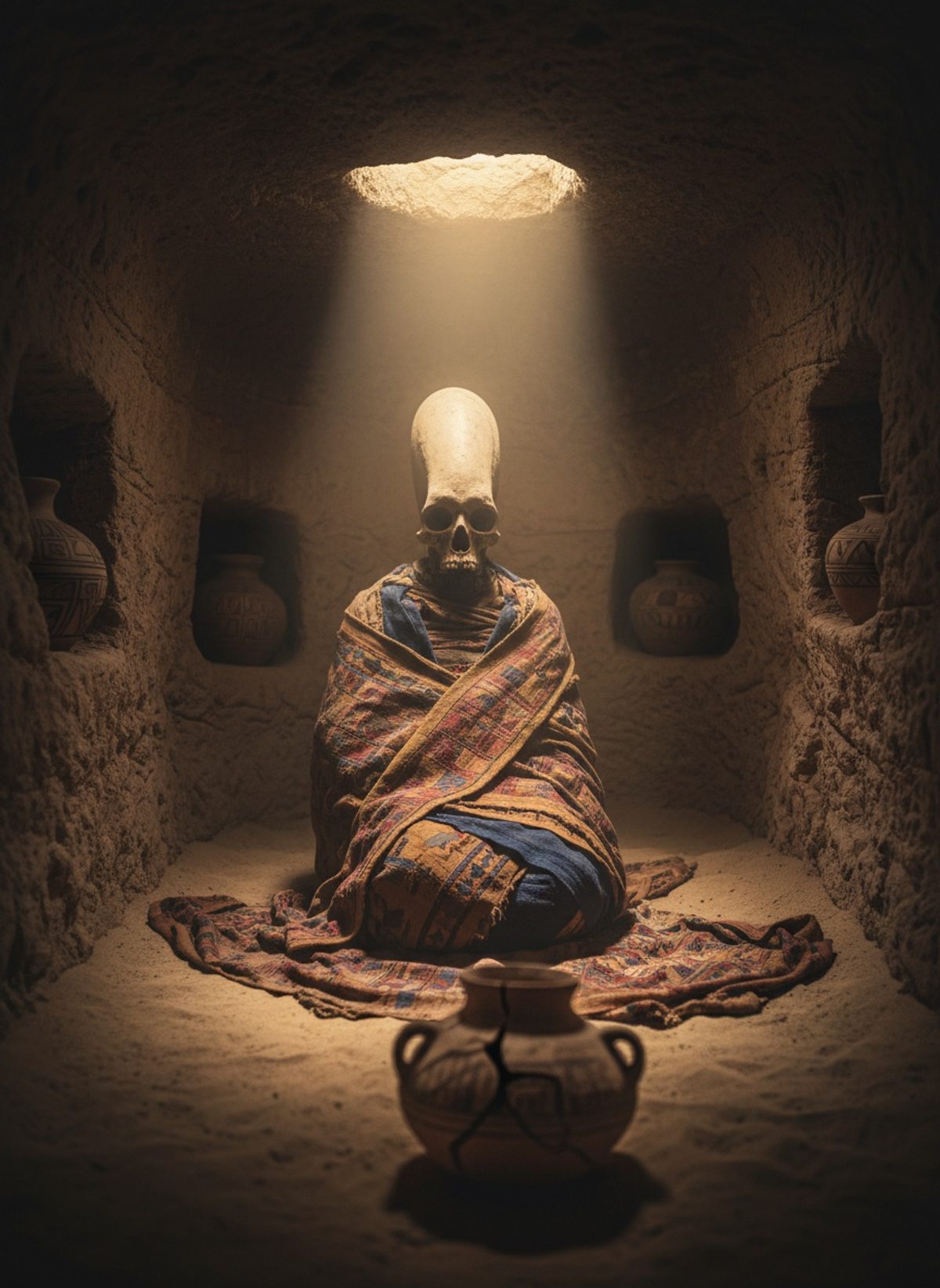
Far from being the work of futuristic science or tall tales of aliens, these elongated skulls were ancient human relics. They were real, with bone shapes that defied what many believed possible. The Nazca mummy, unearthed by the pioneering archaeologist Julio Tello, bore one of the largest human skulls ever recorded.
The Discovery of an Enigma
In 1928, with the unforgiving sun beating down, Julio Tello embarked on an expedition that would uncover one of the strangest archaeological finds of the century. Nestled on the Paracas Peninsula, a vast desert strip in the Ica Region of Peru, Tello and his team unearthed a series of tombs unlike any documented before. These burial chambers, steeped in the sands of time, housed the mummified remains of the Paracas people, an ancient civilization famed for their intricate textiles and pottery.
Yet, it wasn’t the beautifully woven fabrics or ceramics that captivated Tello. It was the skulls. Hundreds of them, with an elongation so pronounced it seemed to belong to another species. Measuring up to 25 percent larger and 60 percent heavier than a typical human skull, these remnants demanded explanation. Were they a result of intentional cranial deformation, a practice known to be employed by many ancient cultures? Or did they point to some biological anomaly that science had yet to understand?
Cranial deformation involves binding an infant's head with cloth or boards, altering the shape over time. This was a common rite among the nobility in many cultures, a distinct mark of status and identity. However, Tello’s findings at Paracas raised profound questions. The structural characteristics of these skulls were so unlike any others that even seasoned archaeologists and anthropologists found themselves at a loss. Unlike typical cases of skull modification where the bone structure remains consistent with human anatomy, some aspects of the Paracas skulls indicated anatomical differences.
Read next: The Phaistos Disc: 4,000-Year-Old Script No One Can Read
Unveiling the Paracas Culture
The Paracas culture, which thrived between 100 BCE and 800 CE, left behind enigmatic traces of their existence across the barren desert landscape. This civilization flourished in one of the driest regions of the world, yet they developed sophisticated techniques in textile production that astound even contemporary experts. Known for their vibrant and complex woven textiles, the Paracas people seemed both artistic and ritualistic.
At the heart of their society laid accomplishments that gripped the popular imagination, particularly their fascination with the human form — a fascination best exemplified through the practice of cranial deformation. Why they engaged in this practice remains speculative, as are much of the inner workings of their cultural and spiritual beliefs. For the Paracas people, the elongated head might have signified beauty, status, or closer ties to the divine.
Beyond the crania, however, Tello’s excavation revealed a wealth of insights into a people sophisticated in their environmental adaptations. They utilized the limited resources of their arid home with remarkable ingenuity, creating intricate irrigation systems to sustain agriculture and by extension, their society. The quality and quantity of their textiles also indicated economic networks and societal structures able to support specialized craftsmanship, implying a community more advanced than the skeletal oddities suggest.
The remains unearthed within the tombs of the Paracas Peninsula painted a vivid picture of life — and death — among these ancient people. Through the centuries, sand and time sealed away their secrets, waiting patiently to be rediscovered. Yet, the mystery of their elongated skulls continued to perplex even decades after Tello’s passing.
Read next: The Tablet Was Smashed. The Message Survived Anyway.
A Puzzle That Lingers
The elongated skulls of Paracas continue to stir debate and curiosity among modern scholars and laypeople alike. While cranial deformation accounts for part of their shape, certain features such as their reported volume and weight hint at more peculiarities that defy simple categorization. Was there a genetic component to this anomaly? Were these people subject to an obscure evolutionary trait now extinct or overlooked? The questions remain largely unresolved.
Some researchers have posited that natural mutations might supplement cultural practices, suggesting that the Paracas skulls may represent a unique confluence of hereditary traits and societal customs. Others argue that the skulls’ distinctly non-human characteristics may be exaggerated or misrepresented, a case of misinterpretation compounded by the storytelling allure of the unknown.
More recent DNA analysis of the Paracas skulls has provided mixed results. Tentative findings suggested that their genetic backgrounds may differ from other ancient inhabitants of the region, pointing to potential migratory exchanges or isolated lineage adaptations. Yet, definitive answers continue to elude the scientific community, as more research is needed to decode the biological signatures carefully preserved for millennia.
Despite the technological advances that empower today’s archaeologists, the elongated skulls of Paracas endure as a reminder of our planet’s rich tapestry of history yet to be fully uncovered. Perhaps these mysteries echo the limits of our current understanding, beckoning the curious to delve deeper. While Tello’s ground-breaking discovery on the parched landscape of the Paracas Peninsula may have been one man's daring venture into the ancient past, its implications resonate with the fundamental pursuit of knowledge shared across generations. The secret behind those enigmatic, elongated skulls remains a symbol of humanity’s unending quest to piece together the great jigsaw puzzle of our shared history.