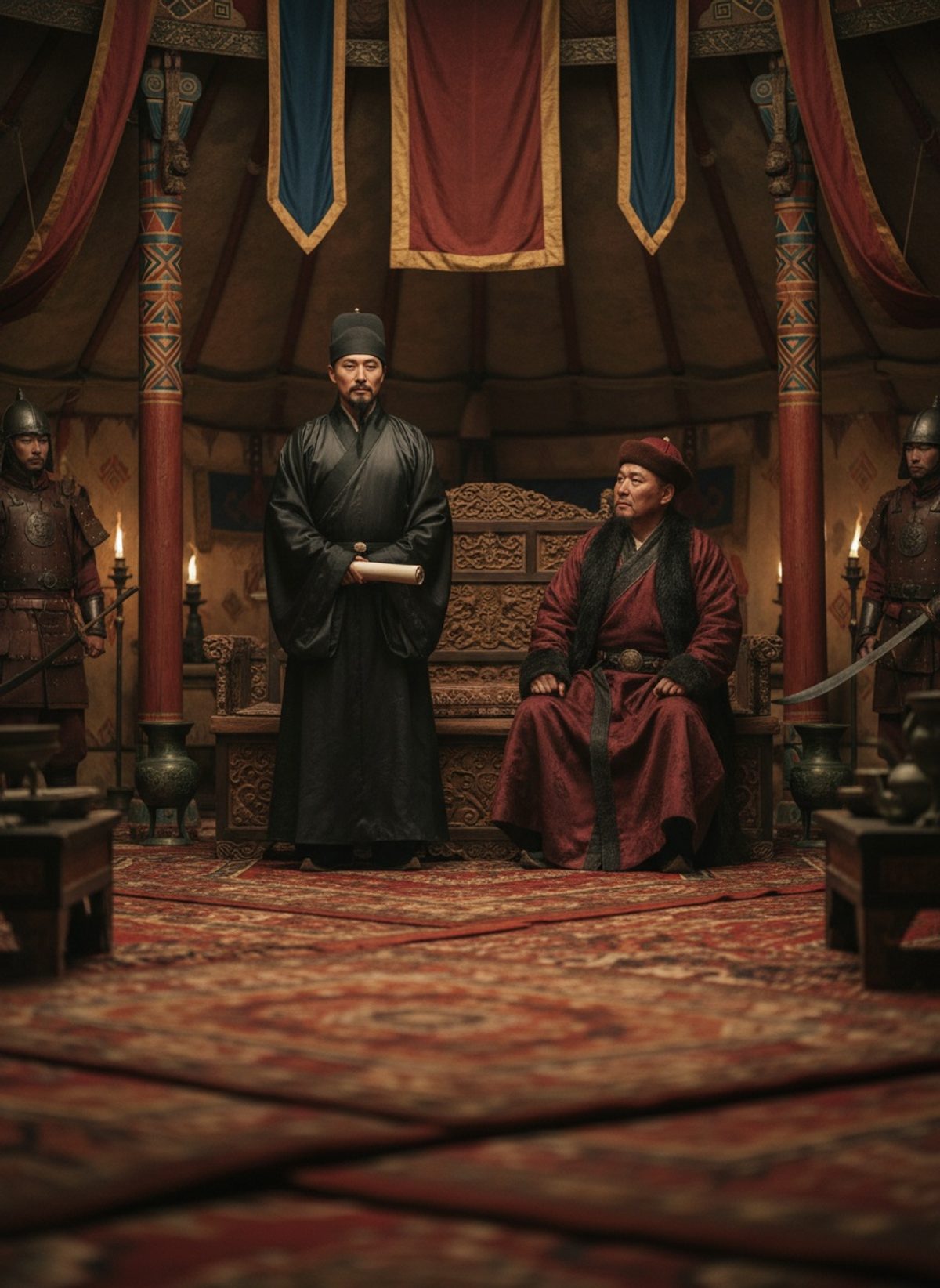
The Mongol court was supreme. Yet, the voices of the oppressed found sanctuary within its marble halls.
The Scholar Among Conquerors
In the formidable years of the 13th century, the Mongol Empire stretched across vast territories, its might felt from the steppes of Mongolia to the coasts of China. At the heart of this sweeping dominion stood Ögedei Khan, the son of the fearsome Genghis Khan. The Mongols ruled through fear, yet even within this iron fist, there were flickers of compassion. One such flame was ignited not by a Mongol warrior but by Yelu Chucai, a Chinese official whose influence struck a harmonious chord within the discordant realms of conquest.
Yelu Chucai, a man of intellect and culture, held a unique position as a scholar in the Mongol court. He was of Khitan descent, hailing from a lineage that witnessed the rise and fall of empires. Chucai’s keen intellect and adaptability placed him in proximity to the Khan, allowing him a rare opportunity to channel his insights into action. As a proponent of Confucian ideals, he saw potential not in the blaze of destruction but in the enduring foundation of governance and societal order.
A Court of Iron and Silk
The court of Ögedei Khan was no simple aggregation of nomadic chieftains. It was a complex tapestry interwoven with silk and iron, where administrators, merchants, and soldiers from diverse cultures vied for influence. In this milieu, Yelu Chucai distinguished himself not merely as an advisor but as a visionary whose gaze penetrated the veils of immediate power to see the enduring strength of a stable, prosperous realm. His education in Chinese classics equipped him to speak in tongues of diplomacy and economics, offering alternatives to perpetual plunder.
Read next: Yi Sun-sin Had No Fleet Left. He Built One Anyway.
Amidst the clamor of metallic armor and the whinnies of war horses, Chucai's voice rose with proposals for systematic governance. Administratively, he advocated for a tax system that could enrich the treasury more effectively than sheer conquest. Though his ideas challenged the conventional Mongol paradigm, it was his compassion that truly defied expectations, embodied in his appeal to Ögedei Khan to free one thousand enslaved Chinese.
The Day of Reckoning
In 1251, a crucial meeting with the Khan laid the stage for Chucai's most daring act of empathy. The Mongol court, usually a theater for strategies of domination, became a pulpit for his earnest plea. Yelu Chucai stood before Ögedei, flanked by advisors more accustomed to the sword than the pen. He carried with him not only scrolls of economic foresight but a list of names—a thousand lives bound in servitude awaiting their fate.
Ögedei Khan listened, his eyes surveying Chucai with the scrutiny of a ruler untethered to sentimentality. Yet Chucai's words carried the weight of truth, unvarnished and undeniable. His argument was not draped solely in compassion but also in pragmatism: free men contribute to the prosperity of an empire, while slaves are a resource drained.
The air hung heavy during those moments of negotiation, each second a silent witness to a struggle between custom and conviction. This was not just about freeing slaves; it was about shifting the course of the entire empire towards a more enlightened age. The Khan's eventual agreement was not just a nod to Chucai's wisdom but an acknowledgment of a new road for the Mongol legacy.
Read next: Ruth Lee Brought a Flag to the Beach. It Said Everything.
A Unlikely Victory for the Enslaved
In liberating the enslaved, Yelu Chucai's actions transcended a simple act of mercy. They signified a testament to the enduring power of humane governance. The release of one thousand souls was perhaps a miniscule ripple in the ocean of Mongol conquests, yet to those who lived it, it was a tide that swept away despair and ushered in the promise of freedom. It was a triumph that spoke to the human spirit—an undying testament that even amidst tyranny, the right amalgamation of intellect, courage, and compassion could shine through.
His advocacy for these enslaved individuals extended beyond their release. Chucai helped integrate them back into society, thus ensuring they were contributors to the very fabric of the newly established societal order. For these individuals, the scholar had not only granted liberation but dignity, steering their destinies away from oblivious servitude toward the light of self-determination.
Lessons from the Shadows of Empire
Why does Yelu Chucai's story resonate through the corridors of history? It is perhaps because it highlights a timeless truth: that the greatest legacies of power cannot necessarily be measured by the empires themselves, but by the lives of those they touch and transform. In an age where the clangor of swords often drowned out the whispers of peace, Chucai's voice offered a counterpoint to the cacophony of conquest.
By choosing to stand for a thousand strangers, he immortalized a lesson for the ages. It was a lesson in perspective—that true strength lies not merely in the command of armies, but in the courage to embrace the principles of humanity. This ancient tale from the Mongol court is a poignant reminder that even in times of great turmoil, there exists a place for advocates of change, those willing to step into the shadow of thrones and kindle hope with the light of their unyielding courage.