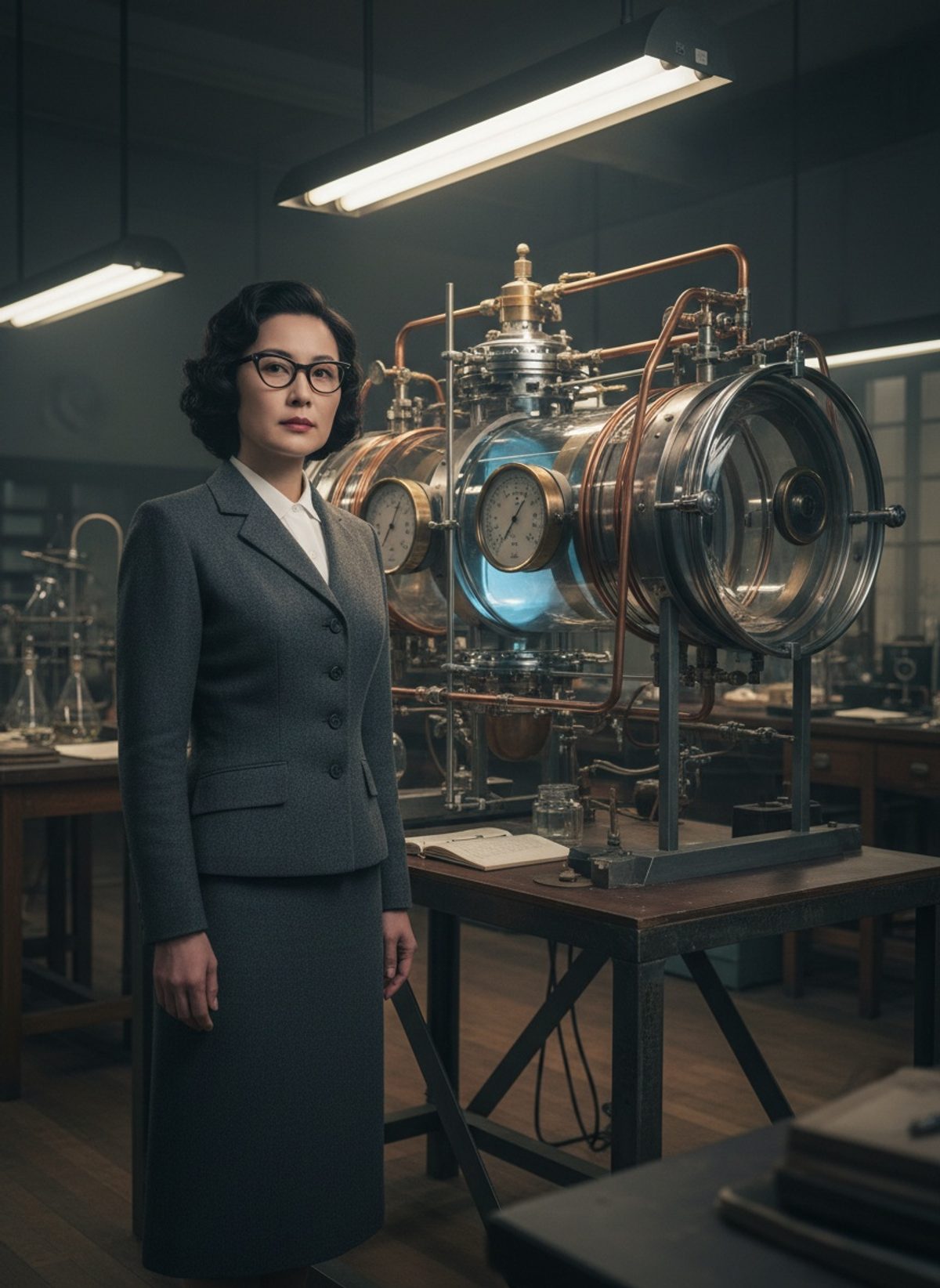
The evening air was crisp and biting on January 15, 1957, in the ice-coated environs of Columbia University. Inside an unassuming laboratory nestled on its sprawling campus, a quiet revolution was unfolding. The room buzzed with anticipation, each tick of the clock echoing against walls lined with looming apparatus.
Soon, the foundations of theoretical physics would tremble. With steely-eyed focus, Chien-Shiung Wu tirelessly orchestrated the experiment that would upend a thirty-year-old law of symmetry in physics, challenging orthodoxy in what was then a male-dominated bastion of science.
The Cocksure Certainties of Physics
Prior to the mid-20th century, parity conservation, a principle stating that the laws of physics are the same in a mirror image, was as intrinsic to the field as Newton’s laws. For three decades, it stood unopposed, regarded almost as a sacred tenet by the scientific community.
The whisper of skepticism came only when two daring theoreticians, Chen Ning Yang and Tsung-Dao Lee, proposed that perhaps parity conservation did not hold in the realm of weak nuclear forces. Instead, they posited, nature might harbor asymmetries that defied the mirrored symmetry revered by generations of physicists.
Read next: Anedjib Engraved His Name on a Jar 5,100 Years Ago
The idea was audacious, its implications staggering. If confirmed, Yang and Lee’s hypothesis would rewrite the textbooks and question humanity’s comprehension of the universe at the most granular level. What they needed now was a mind bold enough, meticulous enough, to design an experiment capable of validating — or invalidating — their radical proposal.
A Woman of Precision and Perseverance
Enter Chien-Shiung Wu, a woman whose brilliance cut through the racial and gender barriers of 1950s America to secure her place among the era’s scientific vanguard. Known affectionately as the “First Lady of Physics,” Wu was born into a family that defied tradition in a small town near Shanghai.
Those early days shaped her philosophy: to explore relentlessly, question continuously, even against societal expectations that would corral her into complacency. By 1956, her credentials were unassailable, her expertise in nuclear physics admired and sought after.
Wu accepted the challenge from Yang and Lee with aplomb, agreeing to test the principle of parity in beta decay — the process by which an unstable atomic nucleus loses energy by emitting electrons. Her design was nothing short of ingenious, demanding the highest levels of precision, as straightforward mistakes or overlooked complexities could derail outcomes and render results meaningless.
After months of intense preparation, in the dim quietude of that January night, Wu's patience met reward. Her experiment showed that parity, indeed, could be violated. Electrons emitted from decaying cobalt-60 nuclei preferred one direction over another, unraveling the assumption of symmetrical, mirror-like behavior.
The Echoing Silence of Recognition
The ripples of Wu’s findings reverberated quickly through the scientific world, heralding a paradigm shift. The notion that laws were symmetric in nature no longer held absolute sway. Physicists scrambled to reevaluate theories and reconcile longstanding beliefs with this new asymmetrical reality that Wu had illuminated. In historical terms, it was a moment not unlike Einstein’s theory of relativity unseating the notion of an absolute space-time framework.
In 1957, acknowledging the profound import of the breakthrough, the Nobel Committee awarded the Nobel Prize in Physics to Yang and Lee. The decision would etch a note of discord into the annals of the prize’s history; Wu, the architect whose experiment definitively shattered the dogma of parity conservation, was noticeably absent from the roll of honorees. Despite the pivotal role she played — without which the hypothesis would remain in speculative limbo — her contributions were relegated to the shadows.
In later years, an informal consensus arose positing that the nature of Wu's work, focused more on experimental application than theoretical framing, might have influenced the committee's oversight. Yet to many, this seemed a scant comfort and scantier justification.
Read next: Vivien Thomas Built the Blueprint That Saved Blue Babies
The Scandal of Selective Memory
The erasure of Wu's transformative role in the Nobel narrative transcends mere historical footnote. It begets contemplation of gender and racial biases in scientific accolades, where the laurels of discovery are often worn predominantly by men. Wu’s exclusion highlights broader systemic issues, a silent testament to the inequities that still endure today within scholarly domains.
This isn't simply an homage to scientific injustice. Instead, it challenges the entrenched perceptions of meritocracy within the hallowed institutions that arbitrate recognition. Wu exemplified the fierce intellect that drives science forward, yet her remarkable achievements were largely confined to marginal mentions and too-few commendations.
Through her undaunted spirit and pioneering work, Wu's legacy persists in every physics textbook that details the intricacies of weak interactions, her hand implicit in every academic step forward from that fateful night in 1957. It is a legacy of stolen glances where mirrors fail to reflect true parity, one where symmetry itself is appended by timely correction.
The story of Chien-Shiung Wu reminds us of the complex tapestry of discovery and recognition, a landscape where scientific triumph folds into human endeavor. Her experiment didn't just illuminate an overlooked asymmetry in nature; it lights the path for future generations — proving that sometimes, to make history, a mind must dismantle what once seemed immutable.
As the sun sets on the sacrifices of many unrecognized pioneers, Wu's message reverberates: only through acknowledging varied voices can true symmetry of achievement be realized.