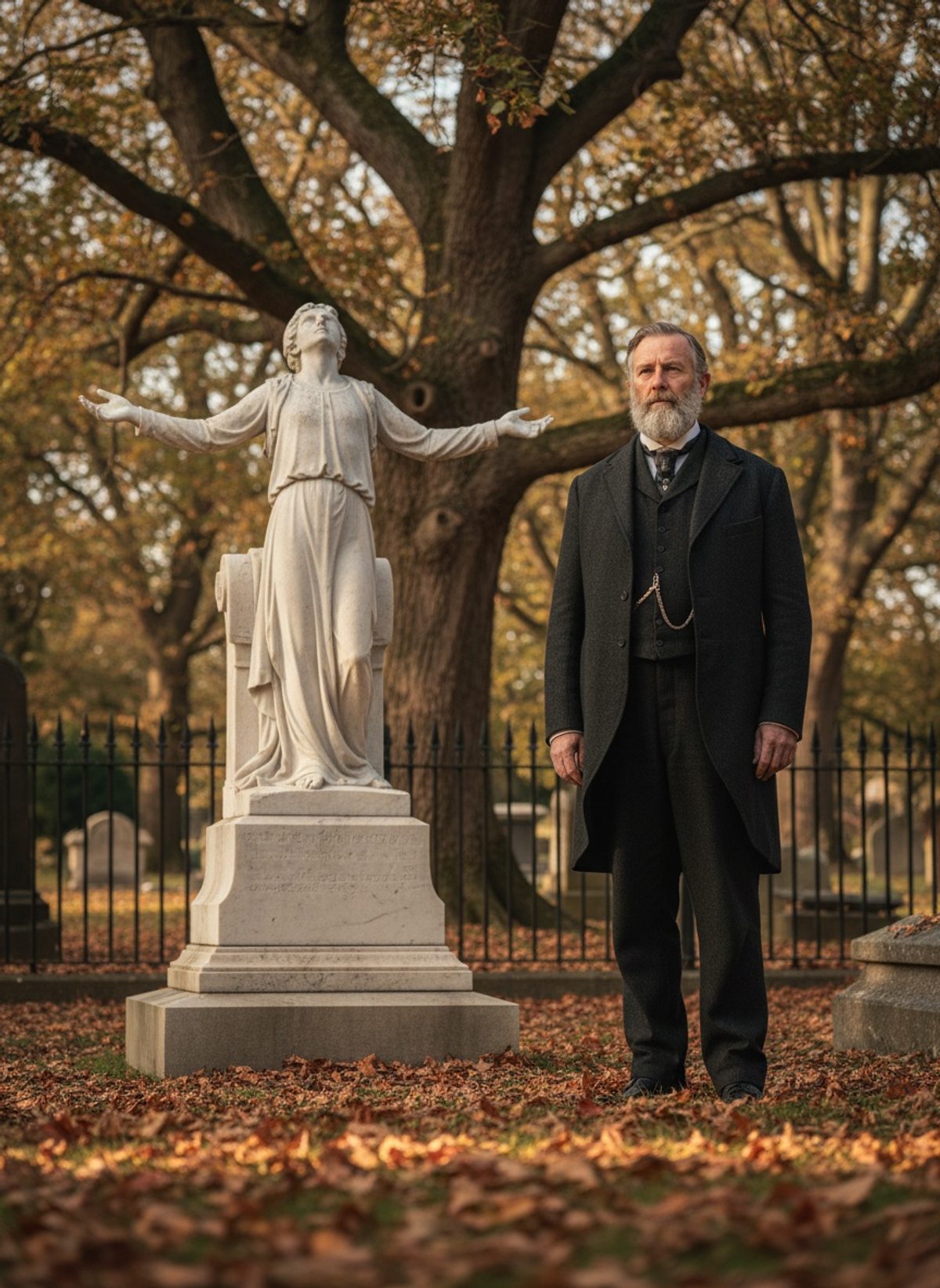
The afternoon sun cast long shadows across the manicured lawns of the Salt Lake City cemetery, each blade of grass a silent sentinel whispering secrets of those who lay beneath. A gentle breeze rustled the leaves of towering trees that dotted the landscape, their branches swaying like mourners in a solemn vigil. Amidst the rows of gravestones, a monument stood out — not because it was made of expensive marble or was adorned with gilded inscriptions, but because of the profound story it told. It bore the likeness of a young man, arms stretched wide, seemingly defying gravity as he rose from the stone that had, until then, confined him to a world of limitations.
This singular gravestone is eternal testament to Matthew Stanford Robison, a young man whose life was bookended by the constraints of his physical form. Born with severe disabilities that left him confined to a wheelchair, his life was one of profound challenges. Yet, thanks to a father's love and determination to honor his son's unyielding spirit, Matthew's story ascends beyond the earthly bounds that held him in place.
Matthew Stanford Robison never knew the sensation of walking along those windswept streets nor the feeling of grass brushing beneath his toes. His world was bound by metal and wheels, the view from his chair encompassing only the world at eye level. Yet, within him lived a spirit that soared, undaunted by the limits of a body that refused to cooperate.
Despite this pervading physical stillness, Matthew's life was hardly devoid of adventure or imagination. Encouraged by his family, who saw beyond what he couldn't do to everything he could, he engaged in a rich world of books, music, and conversation, absorbing every particle of knowledge and joy that the world had to offer. His sharp mind raced through the pages of novels and histories, his laughter a reminder of life’s simple pleasures, even when laced with complexity.
Read next: Archilochus Lost Everything. He Picked Up His Pen.
His father, Ernest Robison, watched his son grow into a young man, acutely aware of both Matthew’s silent strength and the harsh constraints of his existence. Throughout the years, the image of his son's struggle to rise, to reach out, and to live without restraint carved itself deeply into Ernest’s heart. So, he resolved quietly that Matthew would never be remembered solely for his earthly challenges, but for the boundless nature of his free spirit.
When Matthew passed at the all-too-tender age of twenty-two, his father's resolve took form in the commission of a gravestone unlike any other in the cemetery. The massive stone, at its base, shows not the wheelchair that confined Matthew in life. Instead, the monument captures movement, freedom, and the bursting forth of a spirit transcending the shackles of physical limitation. Matthew soars from the stone, wings invisibly spread behind him, his expression one of serene release. It is as though he is at last unbound by the chains of gravity, embracing his new realm among the skies.
The sculptor, entrusted with this poignant task, worked not only with chisel and hammer but with deep empathy and a profound understanding of what this monolith sought to convey. Hours turned into days and weeks, as the likeness of Matthew emerged from the stone with arms uplifted, as if soaring above the confines that once held him. The artistry spoke both of personal liberation and the universal human yearning for freedom.
Visitors to the cemetery are invariably drawn to the powerful imagery of this gravestone, often stopping to take in the sight of Matthew seemingly in flight. Many linger, surrounded by the murmurs of the breeze and leaves, contemplating the poignant story it tells — a narrative of a life that could not be measured solely by its physicality.
This gravestone, unconventional in its depiction, resonates deeply because it speaks to a common human experience. It is a reminder that even in moments of darkness and limitation, there exists an essential part of the human spirit that yearns to rise, to extend beyond boundaries. Matthew Stanford Robison’s gravestone embodies this, elevating him above mere remembrance to a symbol of hope and resilience.
In the quiet moments at the cemetery, as shadows lengthen, the figure of Matthew rising from his chair serves not only as a personal farewell from a loving father but as an emblem of eternal liberation — a poignant narrative that challenges us to see beyond what is visible, to seek the spirit that refuses to be confined. This is why it matters: it connects all who encounter it to the larger human story of struggle and transcendence, a testament not of stone alone, but of the intangible, indomitable flight of the soul.