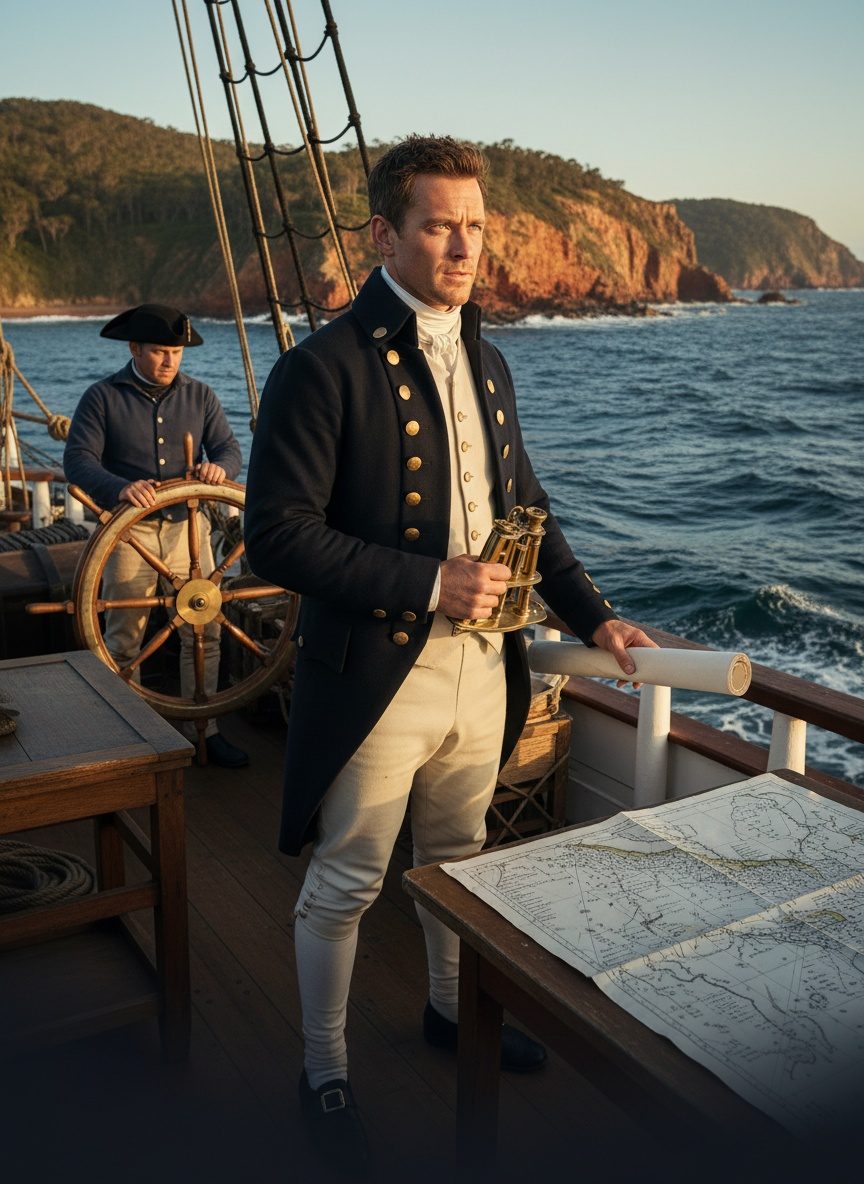
July 18, 1814. A book rustled quietly open on the polished wood of a drawing room table. A humble tome by appearance, yet one that embarked on a literary voyage nearly as remarkable as the journey it chronicled. Matthew Flinders lay still, unknowing that his life's work had finally seen the light of day even as he drifted away from it.
Charting the Unknown: The Determined Reach Beyond the Horizon
In the closing years of the 18th century, maritime exploration was still the key to mystery and opportunity. Possessing a spirit undaunted by the vast stretches of uncharted waters, Matthew Flinders was among those who felt the pull of the undiscovered. Born in Lincolnshire, he embarked on his naval career and soon found himself transfixed by tales of distant lands. The unfolding millennia-old secrets across oceans beckoned a young seaman eager to leave his own trail of cartographic clarity.
Flinders’ creed was simple—map every inch of the great unknown we call Australia today. Armed with navigational instruments, a thirst for knowledge, and a cat named Trim for company, he set sail on the HMS Investigator in 1801. With each wave that kissed the ship's hull, Flinders sketched the enigmatic outlines of a continent, providing the European world its first clear look at the Australian coastline. His meticulous work would cement his place in the annals of history, though such accolades were far from his thoughts then, swept aside by the immediacy of exploration.
The Naming of Australia: A Gift of Identity
In a simple yet profound gesture that resonated through the ages, Flinders bestowed upon the land its fitting moniker—Australia. Prior names such as “New Holland” did not capture the essence of the land he had diligently traced. Flinders recognized both the need and appropriateness of a name that would denote its nature as a single, cohesive landmass rather than a fragmented piece of the Dutch-colonized world. Drawing from the Latin “australis” meaning southern, his christening of the continent was a stroke of both sense and poetry.
Read next: The Day a Devon Captain Charted the Pacific and Changed the World
This act was not merely administrative; it symbolized the unity of the diverse ecosystems, the myriad of peoples and histories that danced beneath the expansive Southern Cross. It is a name that has endured because it speaks to the heart and essence of what was, to Europeans, a fresh slate of discovery and potential.
The Dark Turn: Betrayed by the Seas and Men
Yet, as the sun waned on Flinders’ exploratory triumphs, so too did fortune begin to vanish beyond the horizon. In 1803, the tired timbers of HMS Investigator creaked with betrayal, her seaworthiness compromised. Stranded on a rickety schooner, Flinders was forced to make the perilous journey back to England. But destiny had a cruel twist in store; he sought haven on the island of Mauritius, then under French control, only to be detained by them as a spy.
Here languished a mind accustomed to cuspate horizons, now cloistered within confines. For nearly six years, Flinders remained imprisoned, a victim of Napoleonic politics and maritime rivalry that saw the explorer’s achievements eclipsed by dark cloud of confinement. A captain held not by shackles, but by the hand of geopolitics, his navigational pursuits stolen by bars and bureaucracy.
Hard-won Freedom: Bringing the Vision to Print
When the tides of fate finally bore Flinders back to his homeland in 1810, he returned to a world little aware of his sacrifice—not just in geographic discovery, but in personal endurance and perseverance. Tirelessly, he set about committing his thoughts, maps, and observations to paper: a holistic vision of the land he had traversed mile by mile some ten years earlier.
Read next: The Day a Devon Sailor Mapped the Roof of the World Alone
Even as he fought failing health, each page he penned stood as a testament not only to the lands he had charted, but to the spirit with which he undertook the endeavor. Maps, observations on flora and fauna, indigenous customs—his was a narrative not confined to navigation but one that took in the textures of the land and its intrinsic worth.
The Silent Listener: A Legacy Almost Lost
Publication day arrived unheralded by fanfare or celebration. The man whose hands had drawn the lines that traced Australia’s shores passed away quietly as his book reached the world. Bereft of witness to its release, yet perhaps he found peace knowing his elemental work had finally arrived, like long-lost flotsam on a familiar shore.
This is a story of paradox—how a man charted an entire continent yet became a stranger in the narrative. How his name lived on in lines of maps but was for a long time muted in storied halls. Nevertheless, Flinders’ journey is crucial in our understanding of exploration, not as a mere physical conquest but as an intellectual voyage that enriches our relationship with the planet.
It posits an enduring question: in the silence of forgotten heroes, are we listening not only to their stories but to the unvoiced endeavors of those ensnared by time’s indifference? For in recognizing them, we pay homage to exploration that is as much about discovery as it is about embracing humanity’s place within that vast and vibrant tapestry of Earth.