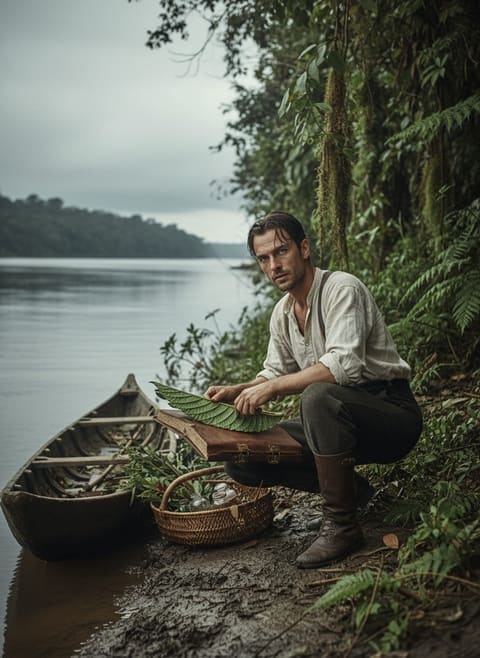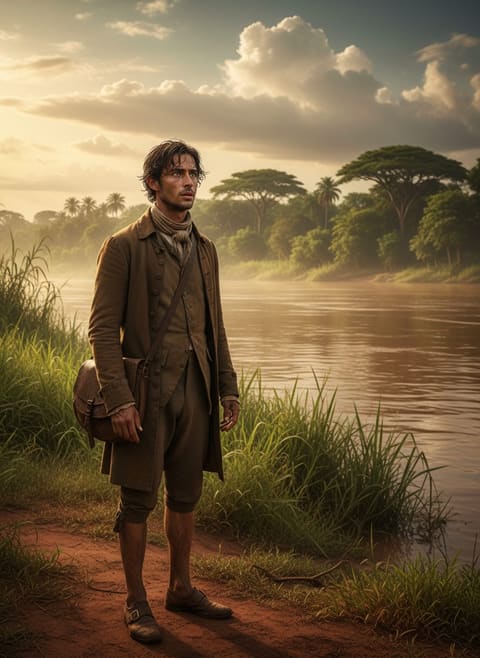
He was just forty years old. By then, he had traversed and charted more of the world's coastline than almost any man alive.
The Navigator's Early Days
Matthew Flinders was not the typical swashbuckling seafarer imagined when thinking of explorers who charted unknown lands. Born in 1774 in Donington, Lincolnshire, Flinders grew up far from the oceans he would one day navigate. The son of a surgeon, he originally intended to follow in his father's footsteps. Yet, inspired by Defoe's Robinson Crusoe, adventure's siren call led him to the sea. By the age of sixteen, Flinders joined the Royal Navy, and under the tutelage of renowned explorer Captain William Bligh, honed the skills that would carry him to the edges of the known world.
Charting Terra Australis
Flinders' greatest and most defining expedition came in 1801, when he set sail aboard the HMS Investigator with a mission that promised both danger and glory: to map the entire coastline of what was then known as Terra Australis, the land we today call Australia. This ambitious voyage was daunting in scope and filled with perilous conditions, from uncharted reefs to unpredictable weather. Flinders excelled at surmounting these challenges, meticulously charting over 2,000 miles of coastline and identifying many geographical features still holding his name. With painstaking detail, he discerned the great island continent's contours, a feat that effectively placed Australia on the modern map.
An Unforeseen Captivity
Having completed his mission, Flinders' return journey was not triumphant as one might expect. In 1803, while making his way back to England, he faced an unforeseen obstacle at the French-occupied Isle of Mauritius. England and France were embroiled in the Napoleonic Wars, and despite his official papers and scientific mission, Flinders was detained. Here, the explorer's life took a darker turn as months stretched into years. By the time of his release in 1810, six years of his life had slipped away, years filled with frustration and deteriorating health. His imprisonment was a profound injustice and a harrowing ordeal that took a heavy toll on his body and spirit.
The Race Against Time
Released from captivity, Flinders returned to England as a man transformed not just by exploration, but by adversity. His primary focus was now his great opus, an atlas of Australia, the description of his epic journey. He poured his dwindling energy into completing this work, titled A Voyage to Terra Australis, racing against an encroaching specter of illness. His health, irreparably damaged during his years of captivity, left him no more energy for future voyages. Instead, his study became his new battleground, where he spend the last of his strength documenting geographical precision and navigational brilliance.
Read next: The Day a Devon Sailor Mapped the Roof of the World Alone
A Final Victory, Arriving Too Late
The final chapter of Flinders' life offers a poignant juxtaposition of accomplishment and tragedy. On July 19, 1814, the precise day that A Voyage to Terra Australis was officially released, Flinders breathed his last. While he never lived to witness the magnitude of his influence, his work laid the foundation for future navigation. His developments in charting shaped the modern understanding of the region. Flinders' perseverance against insurmountable odds reminds us of the human spirit's capacity to explore, discover, and endure beyond one's personal limitations.
Flinders' untold story underscores the complex interplay of exploration and exploitation, bravery and fraught negotiation with the unknown. As we reflect on this Georgian-era navigator's odyssey, it urges us to consider the cost of discovery and the unseen resilience required to usher the past into an uncharted future. In a way, Flinders sailed not only into unknown waters, but into the depths of human perseverance and ambition, where legacy is crafted from both the triumphs and the trials.