She was not destined to wear the crown. As a young concubine, her future seemed sealed in the transient affections of an emperor and the shadowy confines of the imperial palace.
The Concubine in Waiting
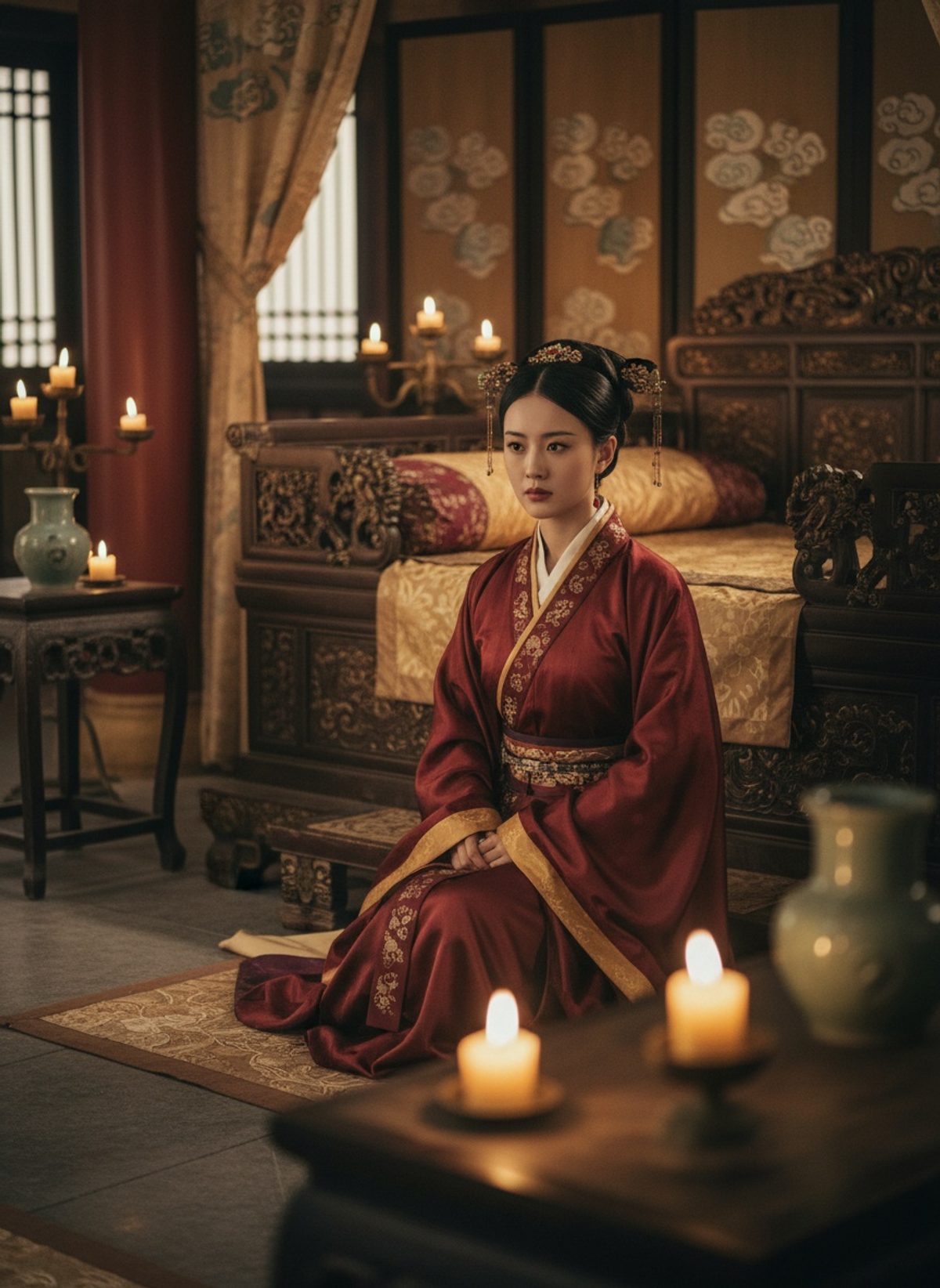
In the opulent halls of the Tang Dynasty's imperial court, the air was thick with the scent of incense and power. The walls, adorned with intricate silk tapestries, whispered stories of emperors past, while servants moved seamlessly around their lords. Here, in this world of privileged opulence and unyielding hierarchy, a young Wu Zhao was introduced as a mere child. She was a concubine in Emperor Taizong's expansive court, one among many, barely seen yet carefully trained in the arts, music, and poetry—skills that defined a woman's worth in this gilded cage.
As she served diligently, Wu Zhao observed the inner workings of the court and developed an incisive understanding of its politics. It was during Emperor Taizong's reign, nestled in the splendid yet suffocating confines of this world, that the seeds of her resilience were sown. When Emperor Taizong lay dying in 649 AD, Wu Zhao knelt respectfully by his bedside, a silent figure in the emperor's twilight. Yet, with his passing, she was expected to follow the tradition for concubines of deceased emperors: shave her head and live out her days in a Buddhist monastery.
The Return to Power
Fate, however, had different designs for Wu Zhao. Removed from the stifling bonds of imperial constraints, Wu Zhao found herself not in quiet submission but in a unique position to observe and plan. Her life took a dramatic turn when she caught the eye of Emperor Taizong's son and successor, Emperor Gaozong. Unlike the usual path of a concubine whiling away her days in obscurity, Wu Zhao engineered a return to prominence, one much to the chagrin of the court’s elite.
Read next: Fang Xiaoru Faced the Usurper. He Handed Him Nothing.
Gaozong, captivated by Wu Zhao's intelligence and charisma, brought her back into his court. Here, Wu Zhao’s journey truly began. She was not content to be a mere consort; her sights were set on higher ambitions. Far from being a passive participant in the political machinations at play, she actively influenced them, maneuvering through the court’s intricate dance of alliances and enmities with unmatched skill.
The Mother of the Empire
As Empress Consort, Wu Zhao carefully solidified her position. Her reign as Gaozong's partner saw her exert unprecedented influence over state affairs, sometimes even governing in his stead due to his frequent bouts of illness. Her influence was felt far and wide, as she deftly maneuvered herself from being a mother to the emperor’s children to becoming the indispensable force behind the throne.
Wu Zhao's rise, however, was fraught with challenges. The Tang court was no place for the weak-hearted, and her every move was scrutinized by ministers and courtiers who bristled at her unprecedented power. Navigating through plots and accusations with a keen intellect, Wu Zhao transformed adversaries into allies with diplomatic acumen and, when met with insurmountable opposition, a swift and decisive hand.
The Unprecedented Ascension
The empress's transformation from a concubine to a figure of ruling power culminated in an act never before achieved in Chinese history. In a bold move, Wu Zhao declared herself Empress Regnant, taking the reins of the empire in her own right. Her reign, spanning from 690 to 705 AD, marked her as the only woman to ever ascend the dragon throne of China officially.
Wu Zhao, as the Empress Regnant, ushered in an era of prosperity and cultural magnificence. She was a patron of the arts, a strategic military leader, and an advocate of policies that favored the peasantry, thereby strengthening the empire. Through her leadership, she secured the frontiers of the empire, emphasizing knowledge and governance over brute force. Her reign saw the flourishing of Buddhism, which she used to bolster her legitimacy.
The Legacy of Empress Wu
Empress Wu's story is not merely one of unexpected ascent but a testament to the capacities that lay beyond patriarchal expectations. Her life is a mosaic of strategy, resilience, and an indomitable will, reshaping the contours of feminine power in an era dominated by male authority. As history has remembered her in a mixture of admiration and vilification, her legacy prompts a reevaluation of how power, gender, and historical narratives intertwine.
The story of Wu Zhao matters today because it challenges the constraints of historical narratives. It asks us to reconsider how history celebrates the victors and condemns those who defy conventions. Her life, marked by triumphs and contentiousness, reminds us of the forgotten voices of history, encouraging a broader understanding of the complexities that shape our world. Wu Zhao broke the chains of convention to build her empire, inspiring countless others to transcend the boundaries of their circumstances.