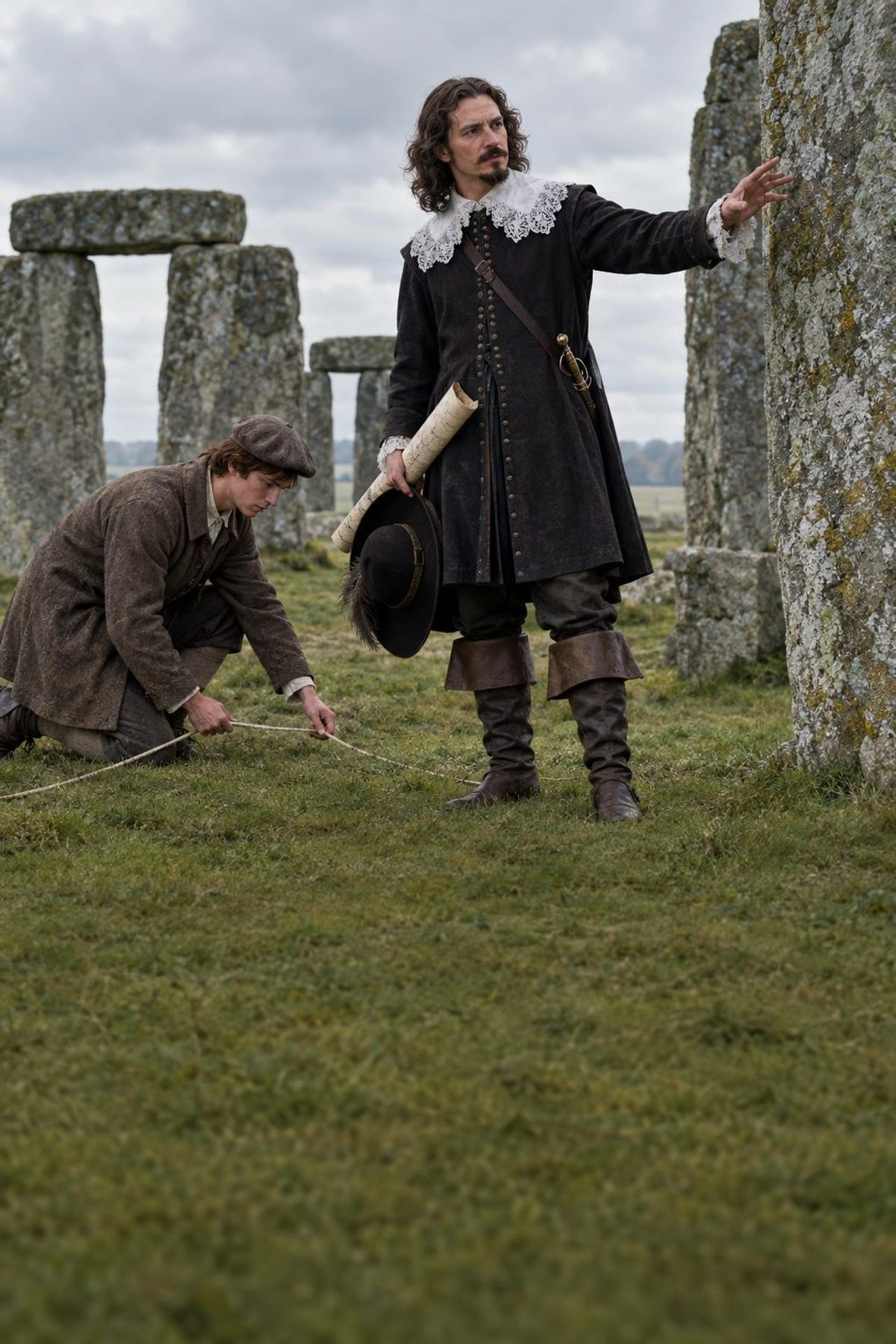
The wind whipped through the ancient stones, whispering secrets known only to time and the few souls brave enough to seek them out. Among the grey monoliths, a figure stood, his eyes fixed intently on the structure like a surgeon examining his patient.
Sir Christopher Wren, England's most formidable architect, found himself in the heart of mystery: Stonehenge. In 1663, King Charles II had personally tasked him with unravelling the enigmas of this prehistoric wonder. Wren's instrument-clad hands moved deftly as he took notes and measurements, each scratch of charcoal on parchment echoing the clack of history turning a page.
A Royal Commission in the Shadows
In the glittering yet tumultuous reign of King Charles II, England was a nation hungry for knowledge, seeking to ground itself in empirical understanding after the chaotic upheavals of civil war and republic.
It was under these skies that Christopher Wren, royal architect and scientific luminary, found himself summoned to the project of inspecting Stonehenge. The king saw in Wren not just a builder of palaces and cathedrals, but a man capable of bridging the chasm between ancient past and modernity.
Read next: The Girdle That Told Tudor England Who You Were
Yet, amidst the grandeur of his commission, one detail has stirred whispers through the annals of time: the possibility that Wren left more than just paper records. On Stone 52 — a venerable sentinel to millennia — initials, "CW," have danced tantalizingly on its surface.
The temptation is clear: did Wren inscribe his name here, marking his touch on history's canvas? Scholars debate the authenticity of the mark, aware that vandalism was as common in the 17th century as it might be now. Yet the question remains alluringly unanswered, a secret whispered only among the stones themselves.
The Eye of an Architect
Wren's approach to Stonehenge was methodical, grounded in the Enlightenment's burgeoning scientific rigor. He set himself to tasks not unlike those he would later undertake in designing the overwhelming dome of St. Paul’s Cathedral. The architect peered through his tools, geometric complexities unraveling under his gaze. Unlike the cathedral's grand temple to faith, Stonehenge presented a puzzle of function — its purpose lost to ages past — challenging any to divine its original intent.
Wren’s observations were among the earliest scientific standards ever applied to the ancient site. He recorded measurements of the sarsens and bluestones, pondering their placement and celestial alignments. This proto-archaeology laid foundations for later studies, cementing Stonehenge as more than just pagan myth or rural curiosity. Despite King Charles II’s informal yet invested interest, Wren’s survey remained largely undocumented outside circles of courtly intrigue, a fragment nearly forgotten amidst his more visible achievements.
On the Edge of Legend
The initials carved into Stone 52 sit heavy with potential implications. One must imagine the cold Salisbury Plain, a solitary Wren facing the monoliths, contemplating his own legacy within one that predated him by millennia.
To many, Stonehenge represented a mighty enigma, an architectural wonder beyond the scope of contemporary capability; for Wren, it may have been a quiet companion, echoing his own grand designs yet speaking solemnly from an unreachable past. In leaving his name, he might have sought to bridge personal genius with collective history, though no more than speculation glimpses into his mind.
Read next: The Man Who Wrote the Letter That Doomed His Own Brother
Whether through deliberate act or misplaced attribution, the initials offer a story both intimate and expansive — a mystery with no definitive answer. The abstract lines could easily be the additive work of a later visitor, another victim of human desire to engrave itself against the passage of time. Stonehenge tolerates such questions, unyielding in its silent imperviousness, asking more of us than we of it.
Today, Wren's exploration of Stonehenge is a testament to a period as rich in inquiry as it was turbulent. The encounter speaks volumes about 17th-century England's relationship with its past — a time when intrinsic value was being unearthed through emerging empirical sciences. For Wren, the venture underscored that whether on parchment or stone, illustrations of understanding were but transient captives of the larger, enduring narrative crafted by Stonehenge itself.
This story, lingering on the wind-swept plains, reminds us that history is ever a blend of fact, folklore, and tangible mystery. Whether or not Wren marked his name into Stonehenge, what remains is the palpable evidence of his curiosity.
The story serves today as a mirror, reflecting the ongoing human quest to connect our perceived present with the unaccountable depths of ages past. Through this royal commission in 1663, Wren’s presence at Stonehenge, in full view of King Charles II’s ambitions and England’s profound curiosity, crafted a chapter as mysterious and enduring as the stones themselves.