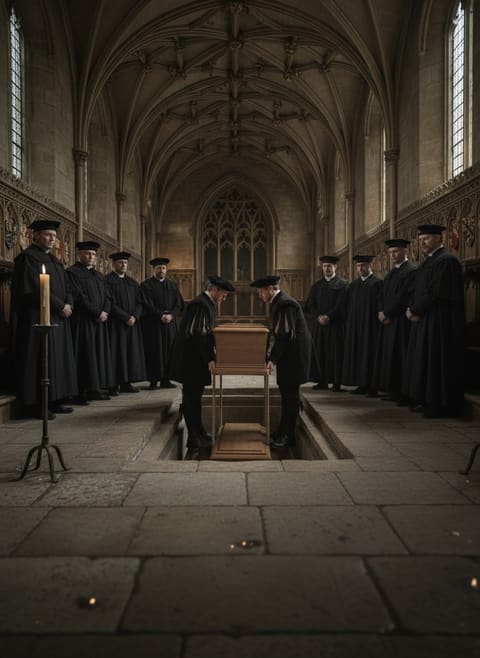
The chill of a November evening settles over the grounds of Hampton Court, mist curling up like ghostly fingers from the River Thames. The air is a cocktail of damp earthen scents and the distant aroma of roasting meat from the kitchens. As twilight bleeds into the silent expanse, the Great Hall's new hammerbeam ceiling looms overhead, a masterpiece of Tudor architecture. Beneath this impressive canopy, which Henry VIII himself proudly commissioned in 1532, the fate of England quietly transforms. Inside these walls, the seeds of a profound religious and political upheaval are being sown—an upheaval that will ripple like thunder through the very fabric of the nation.
The Cardinal's Folly
Cardinal Thomas Wolsey, the son of an Ipswich butcher, rose from humble beginnings to the apex of power, second only to the king. As Lord Chancellor of England, Wolsey had ambitions not to merely rise but to shine like the sun. Eager to craft a legacy as grand as his station, he undertook the construction of Hampton Court Palace around 1515. Envisioned as a glorious testament to his wealth and influence, the palace’s ornate brickwork and commanding presence were meant to rival even those royal lodgings at Eltham and Greenwich.
Yet, it was Wolsey's relationship with Henry VIII that once made him indispensable. The king, resplendent in youth and might, trusted Wolsey implicitly, entrusting him with the secular and religious reins of the realm. However, a king whose desires are thwarted swiftly turns his favor elsewhere. Wolsey, despite his convictions and cunning, could not secure the pope's consent for Henry's divorce from Catherine of Aragon. His elaborate Hampton Court suddenly became more than a symbol of ambition—it became the gilded handoff that placated a peevish king.
The opulent Great Hall, with its riotous stained glass and symbolic heraldic beasts perched on the hammerbeams, is the most tangible proof of Henry's intentions. It was here, within a space envisioned by Wolsey and expanded by Henry, that the transformation of England was plotted from the personal to the political. The hall, echoing with the sound of courtiers' footsteps and the murmurings of statecraft, became the informal birthplace of the English Reformation.
Read next: The Day Thomas More Refused to Bow and Chose the Block
The Battle for a Kingdom's Soul
Angered by the papal refusal to annul his marriage, Henry's insistent gaze turned inward, away from Rome’s authority and towards a vision of supremacy within his own realm. By 1532, the king’s respite from his marital and political frustrations was this great expanses of carved timber and echoing stones, where he could map out his break from the Vatican. It is within Hampton Court’s echo-laden halls that the machinations for England's ecclesiastical independence crystallized.
Behind thick walls, shrewd advisors such as Thomas Cromwell began to sketch out the legal frameworks that would become the Acts of Supremacy and Succession. These acts skillfully severed Rome's influence and positioned Henry as the Supreme Head of the Church of England. Every strategy formed within these halls smacked of audacity, of a king determined to mould church and state to reflect his desires. This labyrinthine web of legality and desire wove itself into England’s consciousness, changing not just the land’s governance, but the very nature of its faith.
The reverberations of this decision were colossal. Imaginations once bound to the traditions of Rome were now unmoored. Monasteries, which had existed for centuries, crumbled as property was seized. The English Bible, once clandestine, became a sanctioned symbol of the king’s sovereignty. Within Hampton Court's walls, Henry presided over not just a realm, but a re-formation of reality itself, realigning the hearts and souls of every man and woman under his sway.
Read next: The Secret Marriage That Shook the Stuart Throne
Legacy Echoes Through Timber Beams
Centuries have passed, yet the Great Hall of Hampton Court remains, a silent witness to that seismic shift. Today, light filters through brightly restored windows, casting rainbows upon the expanse of oak floors. Tourists tread where courtiers once conspired, but the weight of what unfolded beneath those beams remains as profound as ever.
Henry VIII's legacy is omnipresent, not only in the physical structure of Hampton Court, but also in the enduring cultural and spiritual landscape of England. While histories often paint Wolsey’s fate in terms of failure—a man who flew too close to the sun—it was his grand vision that inadvertently enabled Henry’s monumental change. It is a paradox, an irony wrapped in ambition and power. The Reformation, conceived in a palace not of royal origin, signaled a profound cultural metamorphosis, one man's quest for authority forever reshaping the nation’s course.
Hampton Court, in its timelessness, compels us to ponder the power of place in history. It stands as a testament to the relentless tides of ambition, betrayal, and daring that have defined human affairs. Here, where regal shadows blend with myths of old, we witness the birth of modern England—a peninsula cut from the continent, standing in stubborn independence against the sweep of history.