Winter solstice, 655 BCE. The sea murmured restlessly against the shores of Corinth, a timeless witness to the myths and mysteries that permeated this ancient city.
The Silent Gift at Hera's Sanctuary
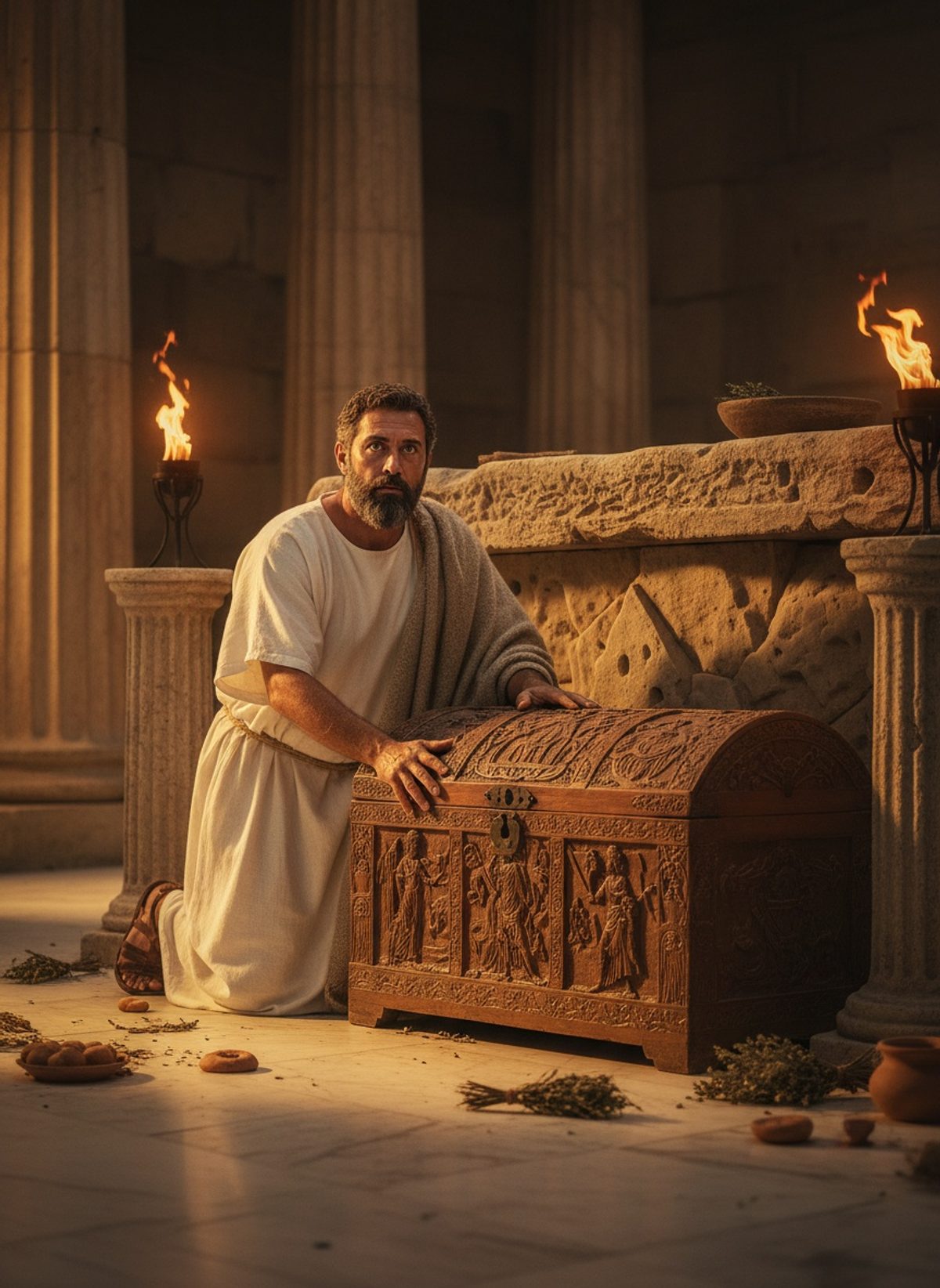
Amidst the tranquil chaos of the temple of Hera, there sat an enigma that captivated the minds of all who beheld it—a cedar chest, simple yet profoundly mysterious. Crafted by skilled hands that tempered raw wood into something sublime, the chest seemed to exude a humble majesty. Its surface, once just the smooth texture of cedar, was now adorned with the intricate carvings of nature and myth, its vines and figures unwinding stories unknown to the people who gathered at the temple's sacred precinct.
This chest hid a secret of monumental significance. Placed resolutely at the heart of the sanctuary, the chest kept silent as it guarded its precious contents. Whispered rumors and prophetic dreams alluded to the mysteries sealed within, yet no one dared disturb its peace. Here lay the infant Cypselus, the child who would defy the fates and ascend to power. The story of Cypselus, preserved in legend, was a journey—a path etched with destiny, ambition, and the inexorable clutches of power.
A Child's Ascent to Might
In Corinth, a city known for its prosperity and strategic significance, the political landscape was frequently as tumultuous as the Aegean Sea. Cypselus, the child within the wooden sanctuary, was the son of Labda and Eetion. Prophecy had foretold his rise, a future shrouded in ambition and the inevitable upheaval of political order. His mere survival as an infant was nothing short of a miracle, woven into the fabric of his city's fate by the divine hands that seemed to protect him.
Read next: The Jar Was Sealed. The Message Was 2,000 Years Old.
As Cypselus grew, so too did his influence. In a tale befitting the legends of Greek antiquity, he wrested control of Corinth during a time of unrest, his actions forever altering the trajectory of the city-state. His leadership as a tyrant, though fraught with the tensions of power, marked an era of significant growth and development for Corinth. Religious structures flourished; trade expanded; the city's prosperity reached new heights.
The chest that once concealed his vulnerability now became a symbol of his strategic genius and unyielding resolve. It contained not only his origins but also the intangibles of leadership and destiny. Through Cypselus, the once-forgotten chest transformed from a mere vessel of life-saving consequence to a relic of enduring power and influence.
The Carved Legend
With time, the chest itself became an object of fascination. It attracted not only the curious minds of Corinth but also the attention of travelers and scholars far and wide, one of whom was the famed geographer and traveler Pausanias. Centuries later, as he journeyed to document the marvels of Greece, he sought out the chest of Cypselus, his heart pulsing with the tales of its mysterious carvings.
Pausanias stood before the chest, astounded by the vivid scenes chiseled along its aged surface. The artistry spoke of ancient craftsmanship, a bridge between the worlds of men and gods, nature, and myth. The carvings depicted so much more than a lifeboat for Cypselus; they were a narrative of the human condition, embodying the triumphs and trials of rulers and commoners alike.
The chest defied simple interpretation, for its carvings were not merely ornamental. They conveyed a deep symbolic resonance, a reflection on the cyclical nature of fortune and fate. As Pausanias studied the interwoven depictions of divine and temporal, he realized that the chest was not just a relic of furniture, but a living testament to the complexities of human ambition and divine intervention.
A Timeless Enigma
Centuries passed, yet the legend of the chest and its contents remained vibrant, captivating the hearts of those who longed to touch a moment of intertwined myth and history. For the people of ancient Greece, the chest was more than an artifact; it was a repository of dreams and stories that resonated across generations, shaping their understanding of the world and their place within it.
Even today, the tale of Cypselus and his fabled chest speaks across the profound gulf of time. It reminds us of the enduring power of narrative and symbols, through which we continue to seek understanding, meaning, and our connection to those who came before. In the timeless dance of history, the sealed chest of Cypselus retains its secrets, forever holding onto mysteries that invite us to ponder the thin veil between myth and reality.