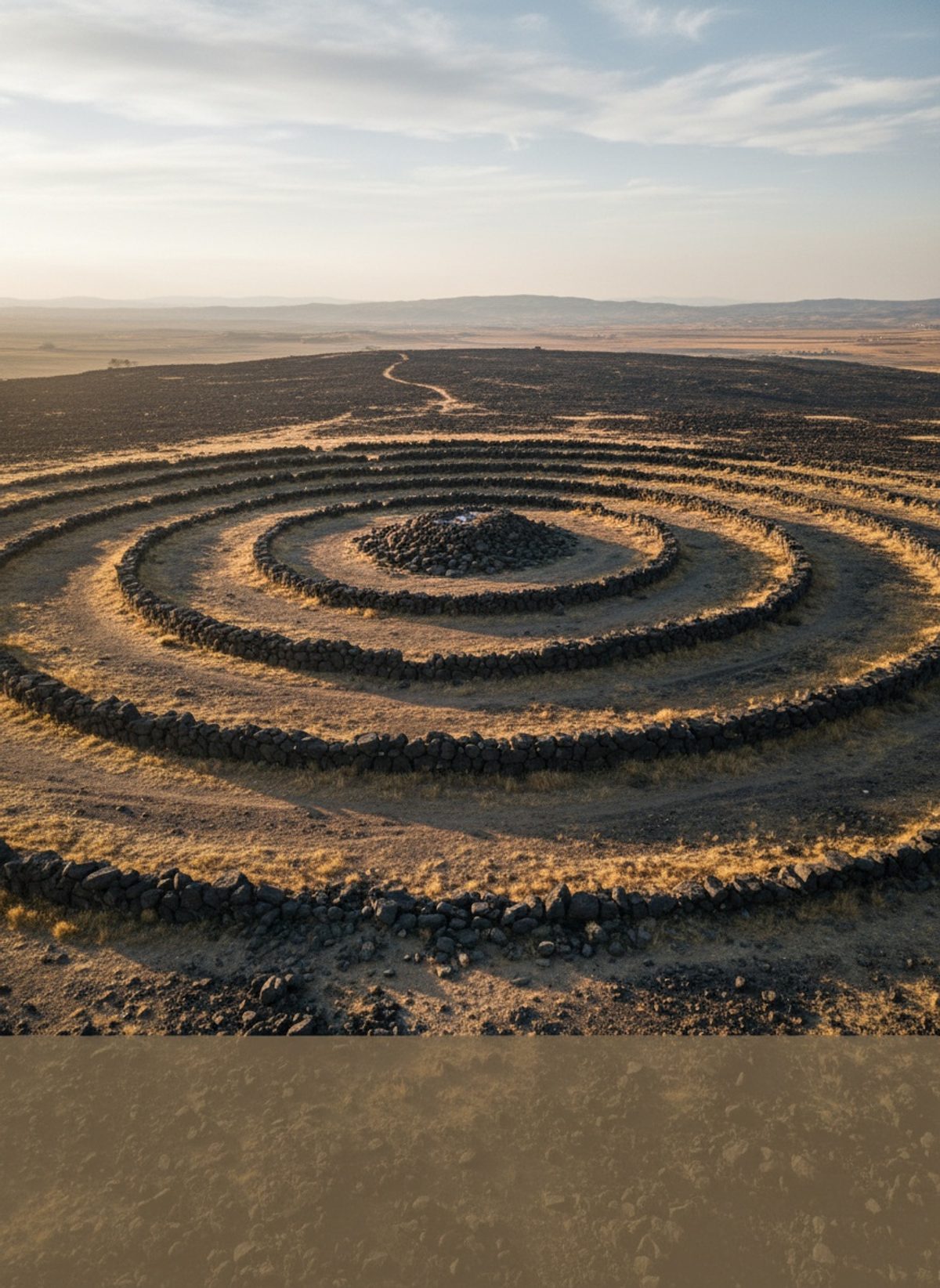
Winter Solstice, circa 3000 BCE. Cold sunlight strikes between the black basalt stones of Rujm el-Hiri.
A Silent Enigma on the Golan Heights
In the heart of the Golan Heights, a landscape carved by millennia of volcanic activity, stands a monument that defies easy explanation. Rujm el-Hiri, a sprawling megalithic structure composed of over 42,000 basalt boulders, forms four concentric circles with a central cairn. Older than the mysteries of Stonehenge, older even than the grandeur of Egypt’s pyramids, it presents a tantalizing puzzle to archaeologists and historians alike.
The very name, Rujm el-Hiri, translates from Arabic as "the stone heap of the wild cat," suggesting an untamed, enigmatic presence. Though its monolithic circles rest in stark solitude, the construction's sheer size suggests a monumental effort.
The rings stretch over 500 feet in diameter, their purposes shrouded in silence. There are no surrounding settlements, no inscriptions, and no clear evidence of who these ancient builders were. Yet from such isolation rises a whisper of intention, a beckoning call from across the ages.
Read next: The Yonaguni Monument: Japan's Underwater Pyramid Explained
It is only during the winter solstice that light pierces directly into the central cairn. This celestial alignment suggests Rujm el-Hiri was crafted by an astute, sky-watching society. Perhaps it served as an observatory, a place of ritual, or a calendar locked in stone. Yet, the true purpose of this ancient structure remains as elusive as the builders themselves.
The Labor Behind the Stones
Constructing Rujm el-Hiri must have been no small feat. The Golan Heights, with its rugged terrain, would have presented numerous challenges. Each of the 42,000 basalt boulders had to be meticulously selected, transported, and placed without the aid of modern technology. The basalt, though sturdy, is unforgivingly heavy, enhancing the wonder surrounding this Bronze Age accomplishment.
But who moved these stones? What tales swirled around campfires as people sweated and strained, hauling these massive rocks into place? No tools or artifacts have been discovered to definitively answer these questions, leaving space for theories and speculation. Some suggest a communal project by disparate tribes, a unifying effort etched into the land. Others see evidence of a religious or priestly class, directing laborers with vision and authority.
Amidst the modern fieldwork, there have been discoveries of burial sites dated to a later time, well after the initial construction. This may indicate the site's extended use or cultural significance, but it offers little in unraveling the original mystery. Rujm el-Hiri stands apart from the burial mounds and megalithic structures dotted across the Levant, challenging preconceptions about the people of this era.
Alignments and Theories
With no inscriptions or clear human remains in its central cairn, scholars ponder if Rujm el-Hiri serves as an astronomical calendar. The precise orientation towards celestial events like the winter solstice suggests a society deeply attuned to the cycles of the heavens. Perhaps this alignment holds the key to unlocking its purpose.
Some experts have posited that this enigmatic circle was a site for rituals linked to the agricultural cycle. At a time when understanding seasonal change was crucial for survival, the movement of the stars could dictate the sowing and harvesting of crops. Could it have marked stories told of triumphs, tragedies, or the mythology of the cosmos above?
Read next: The Antikythera Mechanism: A Computer Built 2,000 Years Ago
Others consider the possibility of Rujm el-Hiri as a communal gathering spot, a place where scattered tribes could unite under shared celestial events. This unity could have bonded groups through shared stories or religious ceremonies, weaving social fabric as tightly as the stones arranged around them. Whatever its original use, the monument invites a contemplation of human ingenuity and faith in the unseen.
Beyond the Basalt
Rujm el-Hiri is not just a relic of the past but a reminder of the mysteries that endure beyond the reach of written history. In a world where advances in technology often attempt to quantify older mysteries into neat solutions, Rujm el-Hiri stands resolutely as a reminder of ancient complexities. It tells us that answers to humanity's earliest questions are often more nuanced than a simple stone circle might suggest.
The swirling winds and open sky above this ancient marvel call upon us to imagine the echoes of a lost civilization. It challenges us to consider the ways in which our ancestors understood their world, and to realize that, for all our modern knowledge, some ancient mysteries remain stubbornly intangible.
The timeless mystery of Rujm el-Hiri asks us not only to seek explanations but to appreciate the beauty of the unknown, entrusting our imaginations to soar where facts remain silent. As the sun slips perfectly through those basalt stones each winter, one can envision a moment when the ancients celebrated in awe — much as we might today, in wonder at their achievements.