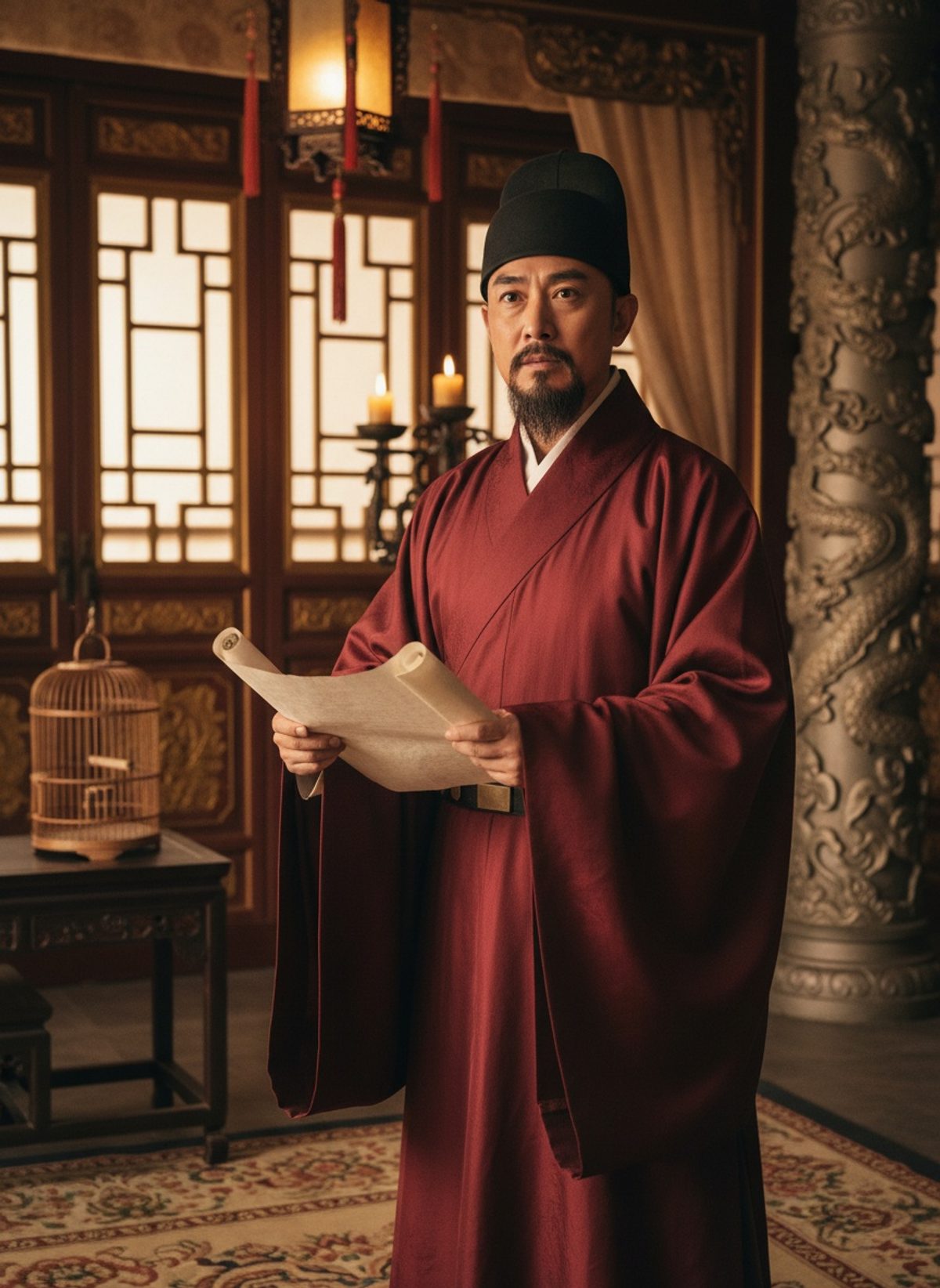
Bo Juyi was no stranger to controversy. Yet, even he probably knew few would expect him to turn the imperial court on its head over a single sparrow.
Whispers of a Compassionate Heart
Amidst the opulence of Tang Dynasty China in 820 CE, the imperial court was a kaleidoscope of silks and luxury. The bustling corridors of Changan, the capital, teemed with officials and courtiers, each more resplendent than the last. Here, within the gilded halls, echoed the calls of exotic birds, their multicolored feathers a testament to the empire’s vast reach. The emperor's aviary held creatures of every sort, symbols of power and the diversity of his realm. But among the extravagance, one incident struck a chord deeper than any political maneuver or diplomatic mission.
Bo Juyi, a revered court official and poet, was making his rounds when he noticed a seemingly insignificant event — a dying sparrow in a cage. For most, it would have been a fleeting moment lost to the whirlwind of courtly life. But for Bo Juyi, it was a manifestation of something much grander: the capacity for mercy within the heart of humanity, regardless of power or rank. The sight of the bird struggling in its confines was a stark contrast to the vast freedom it once knew, an echo of the kindness he believed should permeate the emperor's reign.
This was more than the plight of a bird. It was a symbol of the suppression Bo Juyi saw in courtiers, peasants, and even the emperor's duties weighed down by expectations and tradition. Writing about the dead sparrow was not merely about animal welfare or sentimentality; it represented a plea for empathy and moral reflection. He composed a letter to the emperor, although doing so was a risk. Critique of the imperial court could easily twist into an accusation of dissent, a consequence he knew well from previous exiles.
Read next: He Served the Khan's Court. He Freed a Thousand Slaves.
The Power of Pen Over Sword
In an empire where calls for reform were often met with silence — or worse — Bo Juyi’s letter was an anomaly. The moment his document reached the emperor’s hands, it was more of a gambit than a guaranteed victory. Yet, Bo Juyi's words carried a resonance not readily dismissed. The letter didn't rage at the establishment nor did it shout for rebellion. Instead, it whispered of compassion.
The emperor’s court, known more often for its bureaucratic entanglements and military strategies, was momentarily transformed by Bo Juyi's gentle challenge. Imagine the emperor pausing after a lengthy council on matters of state to consider the small, nearly overlooked life of a sparrow. What a stark contrast it must have been for a ruler whose ears were filled daily with reports of political intrigue and national defense.
The poignancy of the message lay in its universal appeal. Bo Juyi invoked a simple truth, accessible even to the mightiest men: mercy needed no grand stage. Its worth was not diminished by directing it towards a creature as small as a sparrow. If mercy and compassion could be employed so easily, so readily, then why not extend it further, to the emperor’s people, to the procedures of governance, to life itself?
Such thoughts must have trickled through the court, spreading a quiet contemplation among its members. The conversation shifted, if only slightly, towards introspection and moral accountability. Opening the cages became an act that resonated beyond its immediate implications. It symbolized a renewal, a choice to engage with empathy and kindness amid the authoritative weight of leadership.
Read next: Copenhagen Fed Its Poorest Children Like Kings. Europe Watched.
Emancipation in Unexpected Forms
In a profound gesture that rippled through the imperial palace and beyond, the emperor ordered the opening of the cages. The flutter of freed wings became a chorus of liberation, echoing with the potential for change and rejuvenation. For Bo Juyi, such an outcome from a simple letter emphasized the transformative might of the written word when imbued with earnest conviction.
As the last of the sparrows lifted into the skies above the emperor’s residence, witnesses might have thought of it as a fleeting spectacle. But the results lingered far longer, etched into the chronicles of the Tang Dynasty. It demonstrated an acknowledgment of the virtues Bo Juyi heralded, an imperial nod to the values often obscured by the machinations of rule.
This one act spoke to the deep-seated cultural and ethical foundation within Chinese society of cherishing life in all its forms, a philosophy embedded in Confucian thought and Buddhist teachings. Furthermore, it shone a light on an oft-untouched facet of history: personal, humane decisions that hinted at the souls of those who governed empires. Rather than a grand political realignment, it was about an emperor becoming momentarily human, stepping away from the throne to reflect on the tenderness of life.
In commemorating such a small, seemingly mundane moment, history unveils its ability to inspire not through grandeur but through simplicity. The narrative of Bo Juyi, a scholarly voice softened by the feathers of a sparrow, reminds us that compassion has no era or boundary. It’s a sentiment that transcends time and authority, compelling rulers and citizens alike to consider the smaller echoes of existence around them. At its core, the tale of Bo Juyi and the sparrows offers a lesson on how sometimes, the mightiest transformations begin not with a sound, but with a whisper.