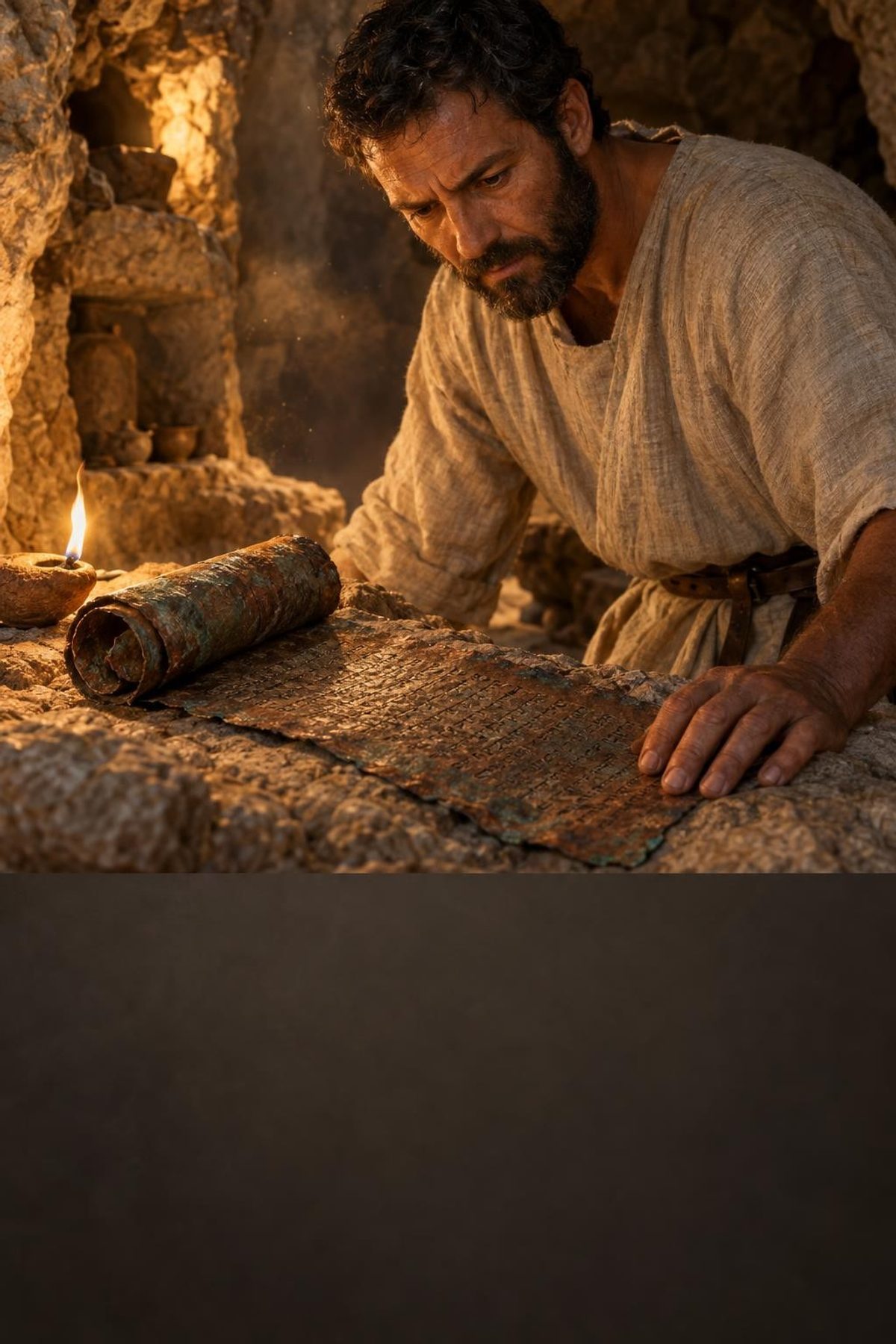
The Copper Scroll was neither holy nor poetic. It was a list, stark and metallic, etched with completely unexpected promise. In 1952, archaeologists discovered this anomaly among the ancient texts hidden in the Qumran Caves near the Dead Sea—a catalog of treasures, detailing sixty-four locations scattered across Judea that were said to hold staggering quantities of gold and silver, and vessels from the Temple. While most of the Dead Sea Scrolls brought insights into ancient religious practices and beliefs, this particular find sparked dreams of buried fortune and explorations as elusive as the scroll's hidden loot itself.
In the dramatic landscape of the Judaean Desert, with its scorching heat and rugged cliffs, the discovery of the Copper Scroll marked a momentous shift. Since the first Dead Sea Scrolls were stumbled upon by a Bedouin boy, searching for a stray goat, these caves had captured imaginations and ignited the curiosity of scholars worldwide. Until then, these scrolls told tales of rituals and community rules of a mysterious Jewish sect. Found in what is now called Cave 3, the Copper Scroll was different—an enigma penned not on papyrus or parchment, but on two sheets of copper, made all the more mysterious by its material and its message.
The Copper Scroll’s contents seemed tantalizingly clear. The text lists specific hiding places where treasures from the Second Temple period were concealed. Sites described in the scroll are precise, mentioning tombstones, water conduits, and even the locations of specific cisterns to guide would-be seekers of these hidden fortunes. The amounts were indeed impressive, amassing almost 65 tons of silver and gold, according to interpretations. Yet, for all its clarity, the Copper Scroll is shrouded in mystery. For decades, its treasures have remained undisturbed, seemingly mocking those who venture to unearth them from their ancient rest.
Experts and treasure hunters alike have pored over its inscriptions with fervor. Some postulate that the scroll was compiled by some of the Temple's priests, attempting to safeguard the treasury during turbulent times as Roman forces closed in on Jerusalem. Others suggest it stems from a different sect, maybe the Essenes, renowned for their ascetic lifestyle and likely inhabitants of Qumran. Although no other artifact found in the caves comes close to such an inventory, this scroll continues to intrigue as much by its differences as by its promise.
Read next: The Voynich Manuscript: 600 Years and No One Can Read It
The list's meticulous account of hidden treasures is not a simple inventory but one veiled by time's passage and the erosion of ancient landscapes. Despite extensive excavations and the best efforts of historians and archaeologists, no one has definitively translated the locations into modern geography. The lingering tantalization rests not only in the riches it describes but in the quest it incites—transforming scholars into detectives and explorers in a timeless hunt through the desert's clifftops and cavities.
The search for the Copper Scroll’s treasures is as much a journey through the pages of history as it is a physical quest. Those captivated by this scroll weave through a tapestry of time—from the might of the Roman Empire bearing down on Judea to the spiritual retreats of the Essenes. The discovery of such a trove would undoubtedly shed new light on ancient Jewish life, presenting a direct link to the past and potentially shaking up historical narratives.
Read next: The Nazca Mummy With the Elongated Skull No One Can Explain
Our modern involvement with the Copper Scroll reveals a facet of humanity seemingly unchanged by time—the mythos of treasure and the thrill of discovery. Much like the cursed tales of Egyptian tombs warning off intruders, this copper whisper from the past remains fiercely guarded by the sands of the Judean Desert. It is perhaps fitting that a scroll born from such an ancient culture should remain shrouded in mystery, yielding its secrets and treasure only as history decides.
Today, the Copper Scroll continues to lure adventurers and scholars alike, its promise tested against time and reason. With every unfolding year, the realization deepens that solving this mystery may not simply lie in deciphering its cryptic directions but in understanding the context and world from which it emerged. For each dusty layer of soil and rock peeled back, there seems to be a deeper layer of history waiting to envelop and intrigue us anew.
Beyond the promise of riches, the Copper Scroll matters because it invites us to examine and reconnect with a distant chapter of our collective human journey. Its allure lies not just in the potential unveiling of treasures but in challenging our understanding of history, of religion, and even of the cultural value we place on artifacts from ancient eras. Whether or not the treasures of the Copper Scroll are ever unearthed, the true value may lie in the renewed intrigue and exploration that continue to illuminate long-dormant corners of our past. Here lies the enduring treasure—the invitation to adventure, discovery, and understanding that stretches across the millennia.