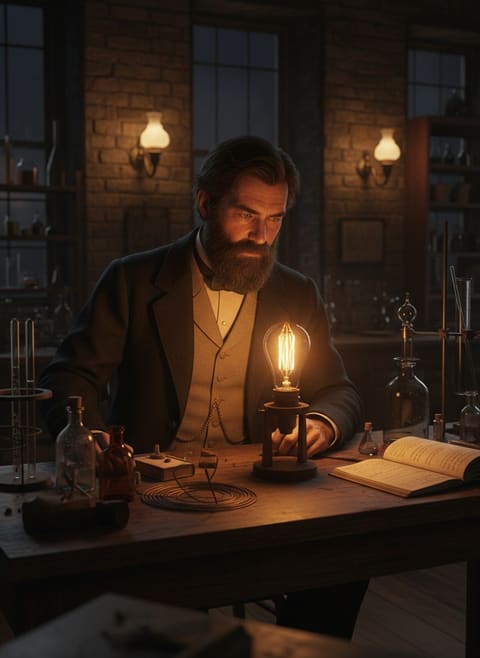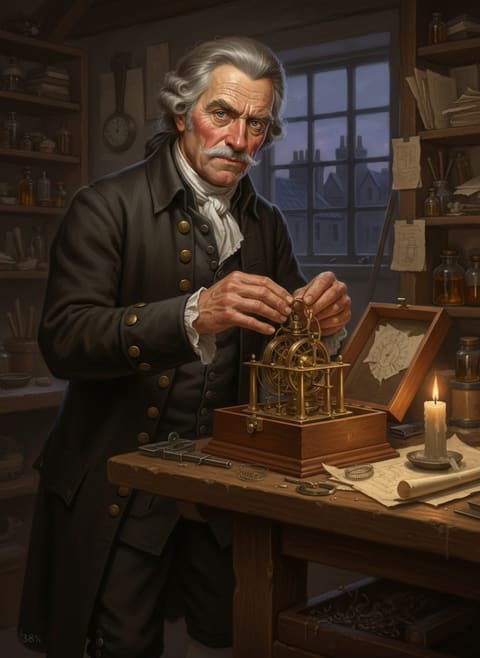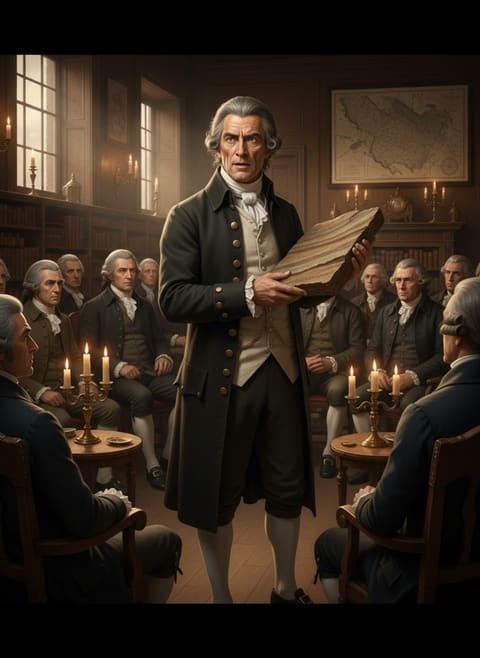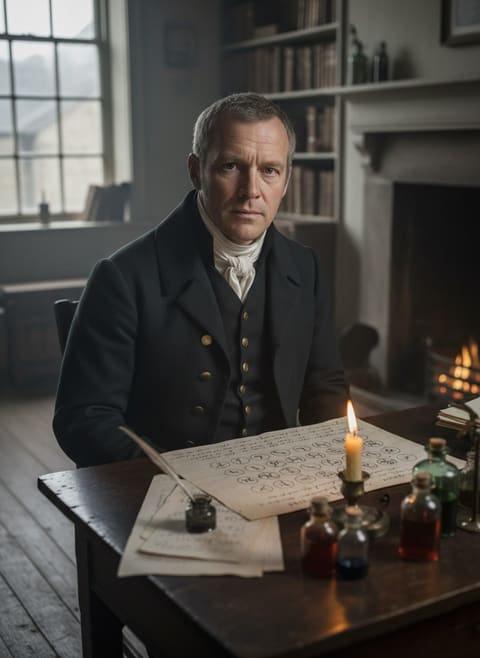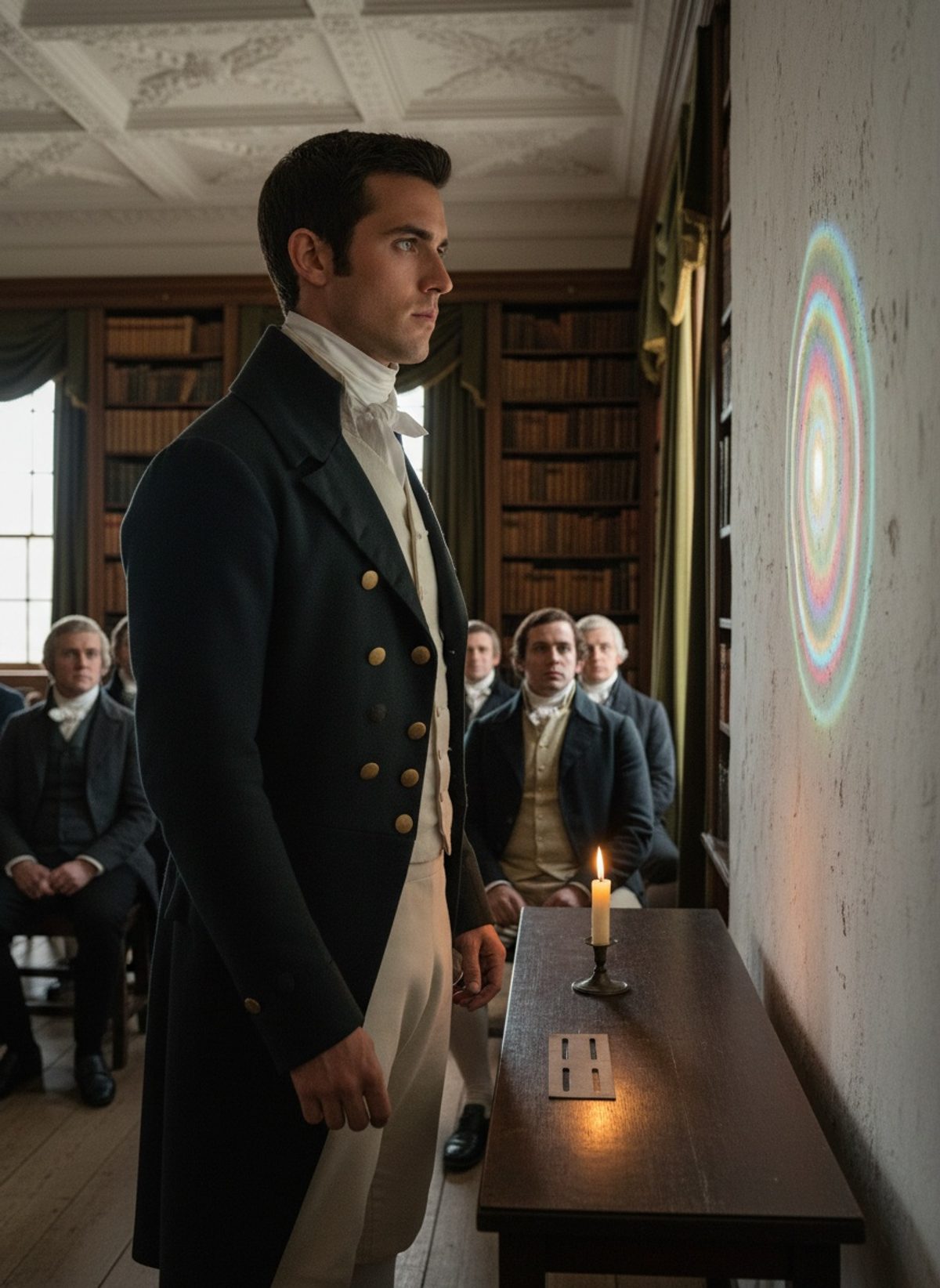
January 16, 1801. A single candle flickered on the oak podium under the scrutiny of London’s scholarly eyes.
The Quiet Revolution Begins
On this crisp January evening, the Royal Society was abuzz with curiosity. Among the erudite crowd in their high-collared coats and powdered wigs had gathered to witness something extraordinary. The anticipation in the air was palpable, accompanied only by the gentle rustling of paper programs. At the center of it all stood a 28-year-old physician, Thomas Young, who held a modest candle aloft. This London venue, steeped in centuries of scientific pedigree, now played host to a young man on the brink of changing how humans understood vision itself.
The practice of splitting light was not novel. Ever since Sir Isaac Newton had demonstrated the spectrum with a simple glass prism, the true nature of light had been one of physics’ greatest enigmas. However, what Young signalled was different—a technique to dissect not just light, but the human ability to perceive it. It wasn't the ostentatious demonstrations of electricity or the dramatic findings of celestial bodies. In fact, it was quietly simple, yet immensely profound.
The Light Cone: Young's Ingenious Insight
Thomas Young was nothing if not relentless in his pursuit to delve deeper into the mysteries of light. A polymath by nature, Young’s numerous endeavors spanned various fields, from linguistics to hydraulics. However, it was the nature of light and vision that captivated him most. The key, Young proposed, lay within the eye itself. His theory, often disbelieved at first, suggested that the eye transformed light into thousands of colors through just three receptors.
Read next: The Day a Potter's Son Decoded the Language of the Rocks
Young’s theory might have sounded audacious—how could three receptors explain the rich spectrum humans could perceive? Yet his simple experiment that night put skeptics’ minds in a spin. By passing light through two minuscule slits, what should have been straightforward circles of light instead morphed and merged into a symphony of colors. This phenomenon, known now as interference, whispered truths about the complexity of light and the eye, dismissing the previous idea of it behaving strictly in particle form.
For many traditionalists, this was sacrilege. To dismiss centuries-old axioms was not taken lightly. Yet, in a meticulously constructed tableau of light and shade, Thomas Young unwrapped the luminance and colors nature herself had so masterfully wrapped. His work hinted that everything individuals believed about sight was only a piece of a much grander mosaic.
The Skeptics' Struggle
The immediate reaction to Young's findings was not unanticipated. Established scientists who had sworn by Newton's theories did not readily accept Young’s ideas. While Newton had rightly opened a vastly new comprehension for mankind by explaining how bright white light could diverge into myriad colors, Young's proposal added a layer detailing how human perception was no passive observer but an active participant in this process.
The opulence of Young’s insight was matched only by the skepticism it engendered. Yet, as with all revolutions, dissonance eventually leads to transformation. Over the years, Young’s triple receptor theory laid the groundwork for our modern understanding of color vision, although it was decades before his ideas were fully appreciated.
Read next: The Day a Tanner's Son Gave the World Its Smallpox Cure
Interestingly, Young was a precursor of what would later be understood as modern interdisciplinarity. Despite the late endorsement of science, his steps traversed into realms even further afield—his decipherment contributions to the Rosetta Stone being just one acclaim.
Legacy of Light and Perception
As the candle's light dimmed in the lecture room, the spark ignited by Thomas Young continued to blaze. Over time, Young became recognized not for a single revelation but for opening a myriad of doors to probing science’s scope. Indeed, his work on light paved the way for successive wave theories and optics developments, even touching realms of quantum physics, long after Young himself had faded into the somber chapels of history.
The tale of Thomas Young is as much about human curiosity as it is about light. It exemplifies a relentless drive to rethink and reshape the very fabric of understanding, be it dealing with the invisible waves of light or intangible perceptions of the mind. For the modern reader, Young's legacy extends beyond a simple scientific breakthrough; it challenges one to consider how much of what is perceived is not merely seen but interpreted through our lenses of experience and understanding.
Indeed, as you walk through London streets or gaze at a spectral array in a late afternoon sky, consider how a single candle, a flicker of insight, transformed into a beacon illuminating how humanity reads the world.