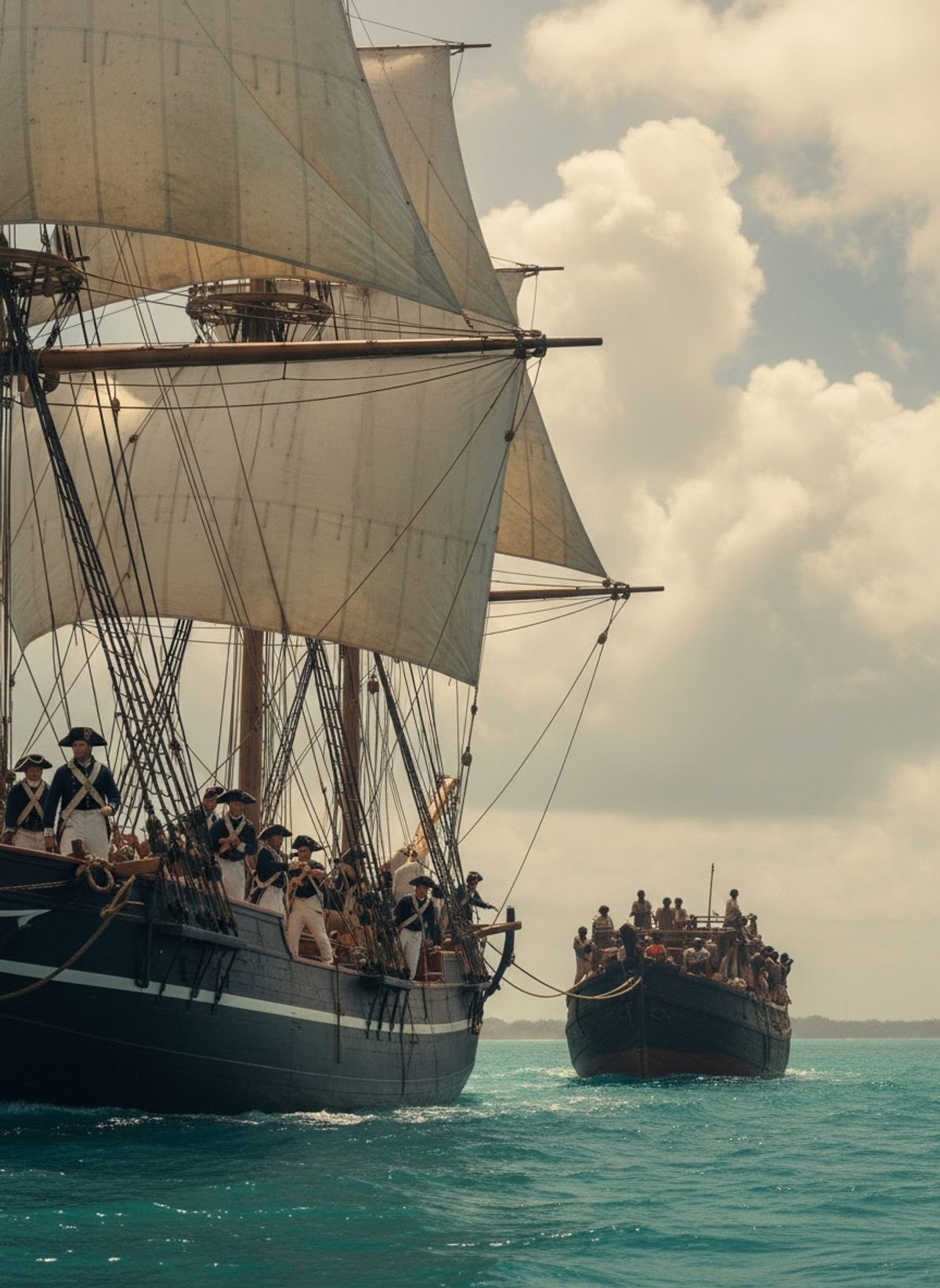
The sea hissed around the warship HMS Black Joke, as its crew braced against the relentless sun and a rising sense of urgency. A distant shape on the horizon—a slave schooner laden with human cargo—was their target.
The men tightened lines, barked orders, and prepared to make history under sweltering skies and dangerous waters. To the sailors of the West Africa Squadron, every chase was a battle against time—a race to save lives from the clutches of a trade that persisted despite its abolition.
The Birth of a New Form of War
When the Slave Trade Act was passed on March 25, 1807, the fight against the transatlantic slave trade did not end with mere legislation. Britain took an unprecedented step, dispatching the Royal Navy to West Africa’s unhospitable coast to form a powerful force: the West Africa Squadron. These men and resources were directed not at a foreign power, but against their own past and the pernicious trade routes that crisscrossed the Atlantic.
This mission was fraught with challenges unseen in conventional warfare. Instead of battling armies, the adversary was a thriving, shadowy trade, its operators adept at avoiding and outmaneuvering captors. The enslaved were secreted away in hidden holds, concealed by deceptive manifests and false decks. In its fight, the Squadron would intercept over 1,600 slave ships, an achievement that brought freedom to over 150,000 Africans.
Read next: When English Law Became the Spine of a New World, 1788
The Dangers of the West African Coast
The iron-framed ships of the Squadron faced a formidable foe even before they set their sights on the slavers: nature itself. Sailors considered deployment to West Africa as a near death sentence; they faced a climate so unforgiving it seemed to conspire with their human enemies. Disease claimed more lives than battles ever could. Accounts from the period detail the grim toll of malaria and yellow fever, diseases that decimated the ranks with ruthless efficiency.
Out of 1,600 sailors who perished while patrolling those tropical waters, reports are stark in their depiction of the worst-hit period between 1830 and 1865. Men fell ill and died on a scale that rivals the great conflicts of their time. The agony of grievous fevers, the sweltering, stifling air—these carved as many casualties into the Squadron's history as any engagement. Yet even then, the mission endured, a testament to unwavering moral resolve.
A New Era of Enforcement
The Squadron didn’t merely hunt slavers in open sea duels. Its men faced grueling tasks of interpreting maritime laws and treaties with a newly vested authority. Often, these encounters required split-second decisions about the legitimacy of each vessel's cargo. Many a captain found himself on trial, both literal and metaphorical, for the actions he took at the helm.
Read next: When Britains Toy Soldiers Went to War With the Empire
In time, a quasi-alliance emerged. Former slave ships, like the aforementioned Black Joke, became integral tools by transforming into nimble interceptors. Captured slaver crews, too, might find themselves offered a reprieve, exchanging the shackles of maritime nooses for service aboard these very vessels. Battles on these terms often devolved into micro engagements, where the pinpoint accuracy of decisions both mundane and monumental could tilt the fate of hundreds.
The Silent Legacy of the Squadron
The achievements and sacrifices of the West Africa Squadron unfold beyond the terse chronicles of history books. This determined maritime force concretized an ethical stance against a moral affront. By wresting tens of thousands from the jaws of a grotesque commerce, they delivered a powerful message to the world about Britain's new legacy—a legacy written not just in ink, but in blood and in battle.
What remains as evocative as the Squadron's heroics is the price they paid and the questions their actions pose to us today. They were the improbable, often unsung champions of human rights, crusading at vast and deadly odds for a belief in a greater good. Their story is one of costly but unwavering commitment—raising uncomfortable reflections about what it truly means to act against injustice when words and laws alone prove insufficient.