William Britain Junior never intended to start a toy revolution. Like most makers of his time, he'd always worked with solid metal. In 1893, that changed forever — not only for him but for children across the British Empire.
The Accidental Innovator
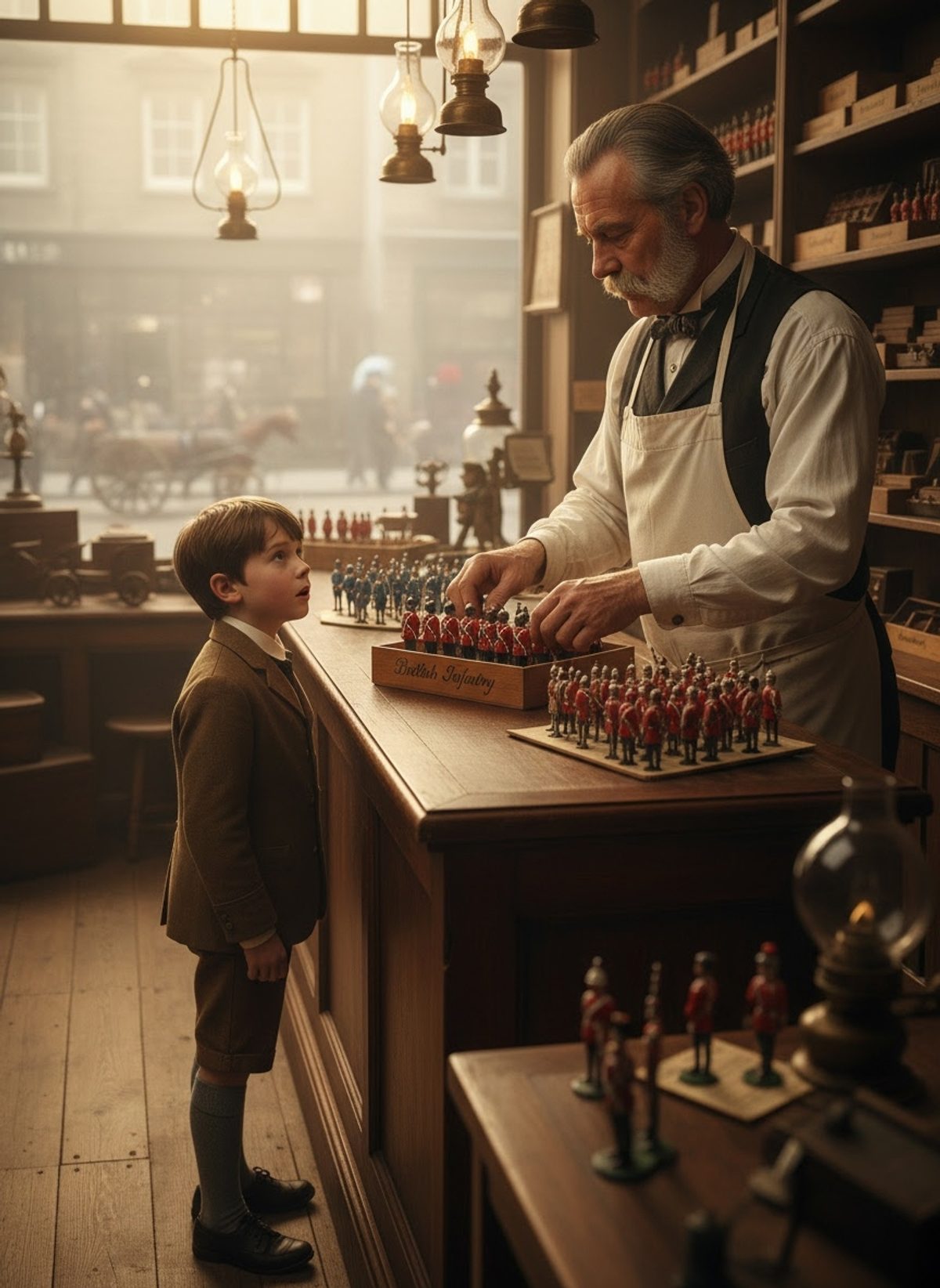
The scene begins in a modest workshop in London. William Britain Junior, a toy maker captivated by the possibilities of intricate design, faced a logistical challenge. Transporting heavy toy soldiers was cumbersome and expensive. In pursuit of a solution, he discovered a casting technique that would change the industry. By using hollow-cast lead, he crafted lighter, affordable soldiers. Britain’s innovation quickly became a fascination among children, fueling the imaginations of young generals everywhere.
This accidental breakthrough not only solved Britain's immediate shipping dilemma but set the stage for a cultural phenomenon. Suddenly, regiments of infantrymen, cavalry, and artillerymen were obtainable for every young tactician. With figures measuring just over two inches tall, they made grand battles possible on the bedroom carpet.
Commanding Armies from the Bedroom
The streets of London transformed in the late 19th century, toyshops stocked to the brim with Britain's soldiers. Each child could now afford to build their own army, modestly priced and perfectly crafted. These figures captured every detail, each mustache and braid meticulously painted, each uniform piece perfect down to the last button. Boys in cramped urban apartments and country estates alike could command their own corner of the Empire.
Read next: When English Law Became the Constitution of a New World
This was more than play. It was an education in strategy, a deep dive into the history and hierarchies that built the world's largest empire. Children learned about the Duke of Wellington, the Battle of Waterloo, and the vast landscapes of India and Africa — all through miniature narratives they controlled.
The Empire in Miniature
William Britain’s soldiers mirrored the diversity of the British Empire itself. Within tiny regiments were not just redcoats and dragoons but Highlanders in kilts, Indian Sepoys, and African soldiers from the far reaches of Britain's holdings. Each figure served as a reminder of a faraway place, a pixel in the vast tapestry of Victoria's world-spanning rule.
Britain's miniature armies became a collector's dream. New lines were awaited eagerly, each release a chance to expand the narrative. For some, this hobby lasted into adulthood, with figures lining shelves as cherished artifacts of a storied childhood. They carried memories of strategic victories and epic battles fought on dining room floors.
The Second World War and Beyond
The onset of World War II marked another chapter, both in history and in British toy culture. Amidst the reality of conflict, Britains model figures continued to inspire young minds, serving as proxies for the heroic feats of Allied forces. This was a generation taught through tin: that courage and duty would prevail against tyranny.
Read next: When Princess Charlotte's Death Nearly Broke an Empire, 1817
As peace returned, so did the imperial themes that had fueled Britain's miniature worlds. Yet by the mid-20th century, societal changes began to shape the narratives of play. The Empire itself was shrinking, and with it, the focus of Britain's collections expanded to reflect more diverse and inclusive themes. This could not overshadow, however, the indelible mark the original collections had made on generations past.
An Enduring Legacy
By 1966, after seventy stirring years, the production of these iconic soldiers came to an end. But their legacy lived on, immortalized in the youthful memories of millions. They were not just toys in a box but a foundation for life’s adventures; they inspired the leaders, thinkers, and dreamers of a time when the sun never set on the British flag.
The story of William Britain Junior's little lead soldiers holds a unique place in history. They were born of necessity, thriving on imagination, and became an integral scaffold upon which countless stories were built. In understanding this tale, we glimpse the powerful draw of play as a way to connect with cultures and histories older than our own. As we reflect on their significance, it becomes clear that sometimes, the profound emerges from the simplest of ideas.