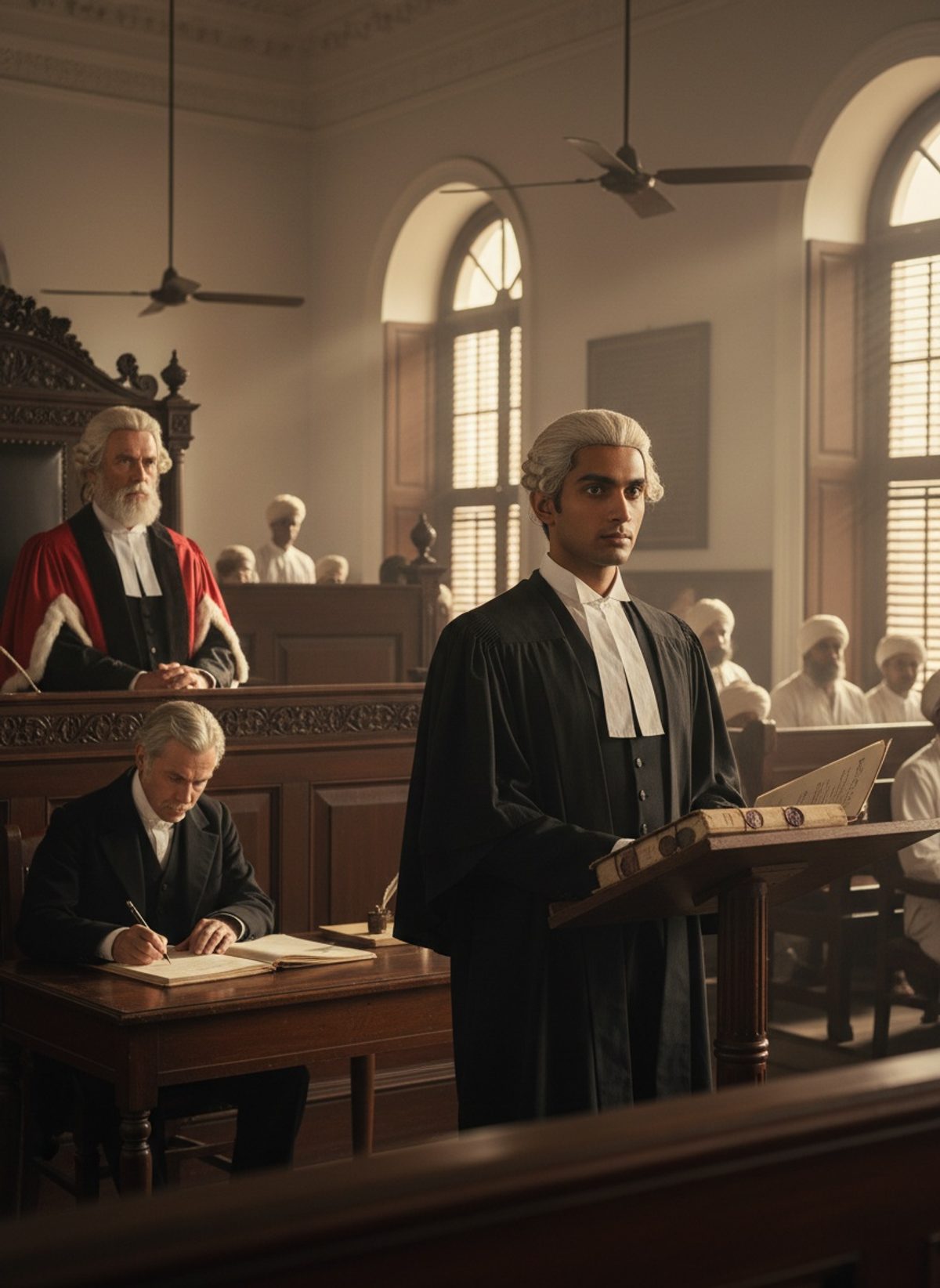
The monsoon winds had settled over Calcutta, rolling endlessly across the bustling city streets in warm, wet breaths. Beneath the arches of the High Court, a resolute silence hung, woven from more than just the weather. This was a juncture of history — the intricate rhythm of English legal doctrine was about to find a new beat on Indian soil. It was 1858, and as the British Crown assumed control from the East India Company, the steel-grey edifice of English law prepared to root itself in an ancient land rich with its own legal traditions. Beyond the red brick bayonets of Victoria-era architecture and the rhythmic chants of hawkers, a cultural negotiation of colossal magnitude was about to unfurl.
Gavel Meets Ganges: Planting the Seeds of Common Law
Picture this: the sun casts an amber veil over the Ganges, its glittering ripples muffled by the smoke of nearby cooking fires and the soft lament of distant temple bells. Against this backdrop of age-old rituals and traditions, a new kind of governance was taking root — one moored in the pages of English common law. The British, notorious for their rigorous administrative systems, had decided to extend Britain's reach not just through force, but through the law itself. It was a harbinger of modernity steeped in the language of justice and equity.
The year was 1858 — the East India Company's rule had ended in catastrophe, and responsibility for governance transferred to the British Crown. But the queen’s subjects across the seas were not content to simply impose their rule; they carried with them the principles of English common law. In the halls of newly-established courts, Victorian judges entrenched legal doctrines such as habeas corpus and trial by jury, fundamentally reshaping Indian jurisprudence.
Imagine the first sessions, held under the heavy summer air of Indian cities; here, vested English judges sat on wooden benches, relics of British craftsmanship, to dispense justice in a land seemingly as different from England as the pebbles of Dover Beach to the sands of the Thar Desert. The imperial logic might seem monolithic, but what unfolded was the beginning of a complex hybridization. The common law system began to intermingle with local statutes, melding the customs of the land with doctrines born thousands of miles away. This was not merely an imposition, but a synthesis that would bloom into a uniquely Indian legal tapestry.
Read next: When English Law Gave the World Its First Courtroom, 1215
The Knight in Tattered Robes: Trials and Transformations
The path was not simple, nor uncontested. This imposition was not the unyielding march of an army, but rather the work of rigorous debate and reluctant concession. English common law began to trickle into India's legislature like water through a sieve, changing its texture and substance. Traditional practices interwoven with codes of law lingered beneath this legal veneer, often clashing spectacularly with the new rules of trial by jury and procedural justice.
The narratives told in those colonial courtrooms were not just affairs of the legal elite; they reverberated through the bazaars, amidst the rhythm of rickshaws and the cries of chai sellers. Legal reforms rippled out to affect every aspect of society — from property disputes in rural sub-districts to the handling of criminal cases that now took center stage in public consciousness. The blend was as much an evolution as it was a compromise. English law lent an air of modernity, yet it was the ingenuity of Indian practice that ensured it would be lasting, adaptable.
Through generations of practice and adaptation, local reformers and visionaries grew adept at interpreting and at times resisting this imported system. Revolutionary minds emerged, not as rebels against a foreign system, but as vanguards for making this system work for Indian society. The law was used to challenge the very empire that had brought it. Trials became stages for political struggle, for wrestling control back from colonial oversight. Here, the courtrooms doubled as arenas of resistance and reform.
Read next: When English Law Made a Slave a Free Man, 1772
A Legal Legacy: The Eternal Dialectic
As the early 20th century dawned, English law had not only endured in India — it had transformed into a local idiom. It was no longer merely the language of colonial rule but had become an integral part of the independent India's legal identity. The intellectual seeds planted by Victorian judges had grown into towering pillars, each courtroom echoing the ancient and new, the familiar and foreign. Some came to view this dichotomy not as a defect of colonial imposition but as a feature of a hybrid society.
Today, India's supreme legal institution, the Supreme Court, still wields English common law within a framework of constitutional governance. Decisions delivered from its benches resonate with the past, yet speak acutely to the issues of the present — economic legislation, fundamental rights, and international relations are debated in language reminiscent of both Blackstone and Gandhi. The peculiar fusion has allowed the judiciary to serve not only as an overseer of the law but as a guardian of democracy in the world's most populous republic.
In the grand annals of history, what the British exported was not merely governance but an elaborate conversation, one that still murmurs through the corridors of power in New Delhi and echoes in discussions held around the globe. The British Empire’s retreat left behind a tapestry of law and culture, an astounding paradox of continuity and change. The gift — or burden — of English common law in India asks us to consider how we inherit the past from imperial legacies and how we reshape them to define the freedoms of our present and the contours of our future. In this ebb and flow, an enduring question remains: what shall we choose to inherit, adapt, and ultimately, leave behind?