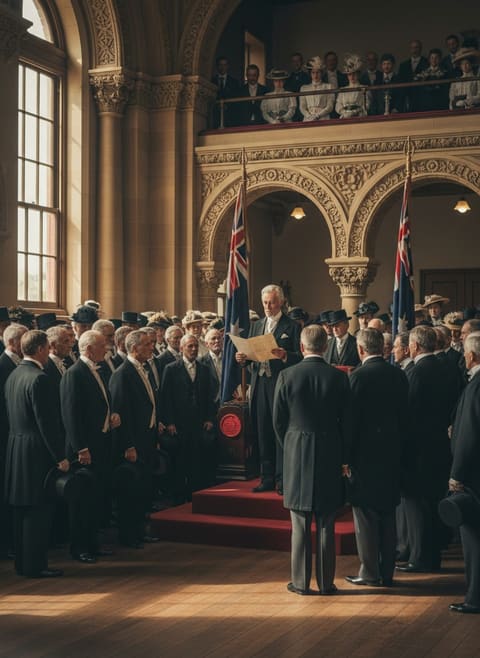
The meadow at Runnymede is a place where the air often seems to hang with an ancient gravity, as if the Thames itself holds its breath. Over eight centuries ago, on a day where clouds rolled like silent witnesses over green fields dampened by the morning’s mist, a momentous drama began to unfold. In that quintessentially English landscape, with the quietude broken only by the restless rustling of leaves and the distant call of waterfowl, a reluctant monarch was about to be compelled into changing the course of history itself.
Before the Ink Dried
On a morning in 1215, England was a land rife with discontent. A king who demanded much and gave little faced barons who grew weary of his whims. This was more than a hunger for influence; it was a cry for justice. The armed nobles gathered at Runnymede were not merely seeking to curb royal power; they were demanding safeguards against tyranny, a hope that resonated with a sense of something foundational: the right to liberty.
The signing of the document that would later be known as Magna Carta was little celebrated in its time. It was compelled by duress, a peace treaty to avoid civil war, and a parchment penned in the vernacular of Latin. Yet, enclosed within its lines was a revolutionary seed, a principle that "no man shall be imprisoned without lawful judgment," creating a rippling assertion that fairness could, and should, stand above all.
The Document That Outlived Its Time
Magna Carta was born out of conflict, swiftly annulled by the Pope, and nearly forgotten in the decade that followed. But the essence of its demands lived on like an ember, occasionally kindling to life in the hearts of those who longed for equity. The concept of due process buried in its clauses would travel far beyond the boundaries of England, enduring through reinterpretations and renewals.
Read next: When English Law Made the Whole World Speak Its Name
Its influence was seminal in shaping common law traditions that recognized people's rights. From the embryonic stages of English law, the promise of just treatment — a trial of peers, a defense heard — would evolve into a cornerstone of civilized society. In Britain, the echoes of Runnymede’s agreement found a resonant harmony with future charters and declarations, forging a path for the legal rights many now take as unassailable truths.
A Global Legacy Planted in Soil
The significance of Magna Carta outgrew both the men who signed it and the soil upon which they stood. As English law spread across the world, enforced and encouraged by imperial reach, the principles born out of necessity at Runnymede became invaluable exports. Today, echoes of these rights are found in the judicial frameworks of forty-six nations across continents. From India’s bustling courtrooms to New Zealand’s tranquil legal discussions, an original promise made by the Thames filters through resilient institutions worldwide.
In the American colonies, the spirit of Runnymede resonated fiercely and personally. When the fledgling republic crafted its Constitution, the principle that no one should be deprived of liberty without due process became enshrined in its Fifth Amendment. This transfer of ideals across oceans and generations exemplifies how a singular historic compromise could bloom into a universally cherished promise.
Runnymede Reconsidered
Modern visitors to Runnymede might find little more than serene landscapes and quiet paths. But if they peer beyond the present-day stillness, they might imagine the charged throngs of men, the whispered urgencies carried by horsemen, the stained pledges made under duress. These fields were witness to the dawn when a king's loss of absolute power yielded a people's gain.
Read next: When English Common Law Became the Law of the World
Among the willows, standing stones and occasional way-markers reflect the ongoing journey of justice. Runnymede remains a place of pilgrimage for many who seek to understand the underpinnings of their freedoms, a site where the seeds of due process are constantly proven meaningful from one generation to the next.
Why History’s Courtroom Matters
In a world where the scales of justice are still delicately balanced, the enduring influence of that rain-soaked meadow continues to inspire and instruct. Runnymede’s lesson is a powerful reminder: the roots of lawful judgment may be complex and ancient, yet their growth is perpetual and demanding of guardianship. As new challenges to fairness and equity emerge on global stages, the story of Magna Carta remains a vital touchstone.
It cements the significance of insisting on accountability and the human right to stand fair trial. So as we move forward, crafting tomorrows from our ever-fracturing todays, the legacy of Runnymede is that conscious insistence that justice must not be left behind in the pages of history, but carried boldly forward. The meadow, oft bending with history’s breeze, still speaks — will we continue to listen?