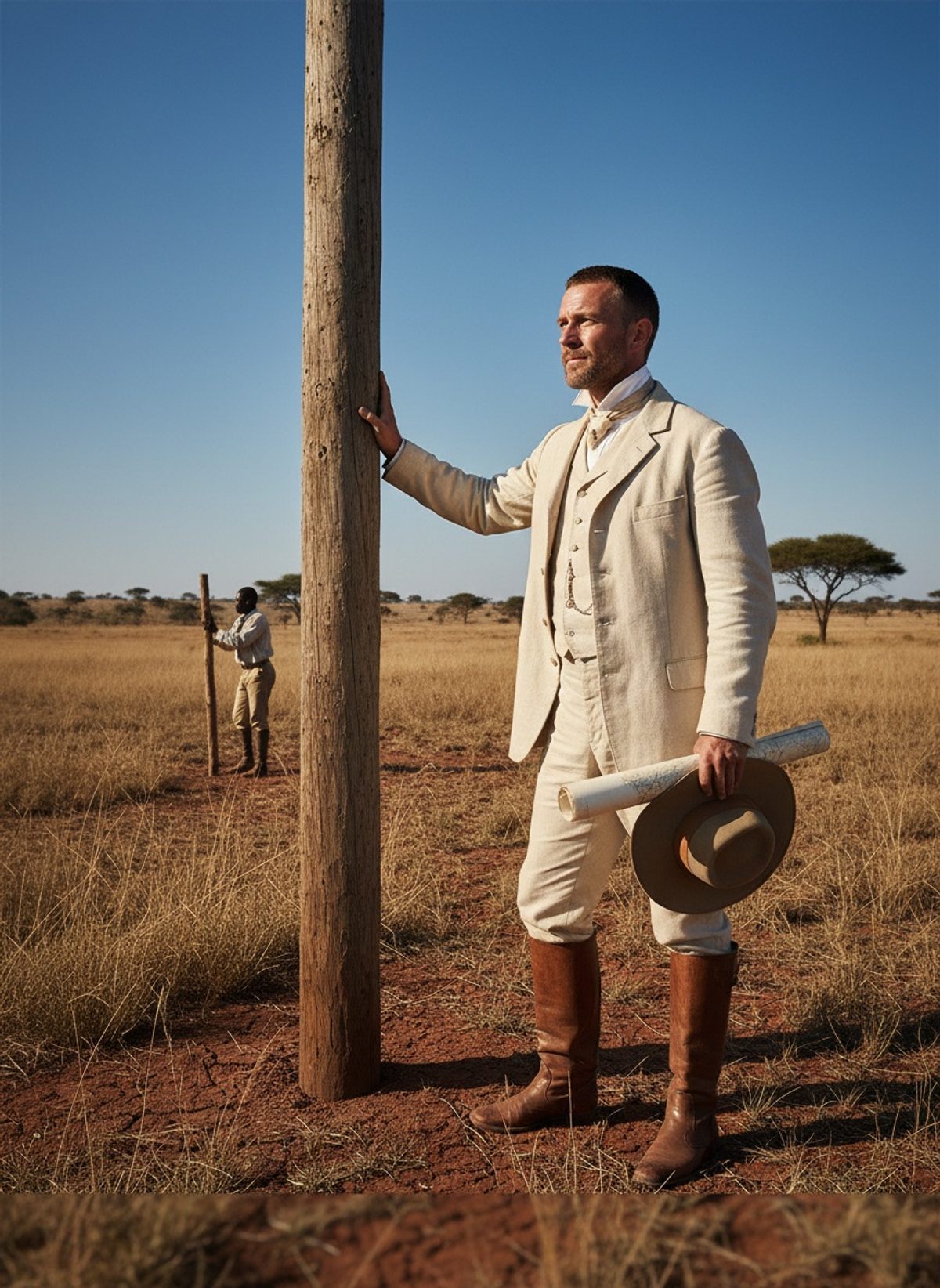
The crack of an axe echoed through the dense African bush, the sound mingling with the calls of unseen creatures and the soft rustle of the breeze as it danced through the grass. Cecil Rhodes stood nearby, his face set in determination as he watched his workers clear a path for the first telegraph pole that would thrust upwards towards the sky, marking the beginning of what others called his folly—an audacious attempt to stitch an entire continent together with a single line of copper wire.
It was 1892, and to many, Africa was still a mystery wrapped in untamed wilderness and tribal boundaries as complex as the myriad languages spoken across its vast lands. Yet, when Rhodes looked at his maps, he saw opportunity, a grand unifying vision that his contemporaries could scarcely comprehend. From the southern tip of the continent in Cape Town, he envisaged a line stretching north, slicing through the arbitrary borders drawn by European powers, directly to the ancient city of Cairo. To connect the Cape to Cairo by telegraph was more than a logistical undertaking; it was to thread together disparate territories, bringing them into the fold of what he viewed as civilisation.
Rhodes, whose name still resonates through history as an empire builder par excellence, was no stranger to risk. His wealth, garnered from the diamond mines of Kimberley, afforded him the resources to pursue dreams others would deem impossible. He had already left his mark on Africa through the creation of the British South Africa Company, which governed vast tracts of land at the behest of the British Crown, and now he yearned for a communication network that could facilitate the expansion and administrative efficiency of his empire.
As Rhodes watched the workers hoist the first pole into position, the importance of this simple act was not lost on him. It was the moment when vision began to transform into tangible reality; a testament to his belief in the power of communication to transcend borders, cultures, and barriers. He understood, perhaps better than most, that the ability to communicate swiftly and reliably across distances was the key to maintaining control, to fostering development, and ultimately, to civilising—albeit through a distinctly Victorian lens—what he saw as a fragmented continent.
Read next: When Stamford Raffles Drew a Map and Named a City, 1819
The enormity of his task, however, was matched only by the challenges he faced. Africa's rugged terrain and often hostile climates were just the beginning. Political tensions simmered beneath the surface, not only between indigenous populations and European colonisers but also among the latter who eyed Rhodes's ambitions with suspicion and envy. The threat of interception by rival powers constantly loomed over the project, as did the logistical nightmare of laying down thousands of miles of telegraph line through jungles, deserts, and savannahs.
The British Empire understood the strategic advantage that a unified telegraph line could bring, and yet bureaucratic support was tepid and funding scarce. It was not an era where grand projects could move forward on vision alone; they demanded perseverance and often a single, driven individual who could push through the wave of scepticism. For Rhodes, that drive was innate, almost a stubborn refusal to submit to the petty limitations others perceived as obstacles.
As the telegraph line crept northward inch by inch, the magnitude of the endeavor became more apparent. Scores of men laboured to build this artery of empire, enduring harsh conditions and exhausting labor. They hacked paths through thick forests and drove poles into the sun-baked earth of open plains, overcoming the relentless challenges that each new environment presented. For many, these efforts represented more than work; it was participation in something grandiose and unprecedented.
Rhodes’s journey to connect Cape to Cairo was as much a physical feat as it was an ideological one. The telegraph wire, a slender and unassuming thread of copper, symbolised a binding force in a land so often delineated by division. Yet, beneath its simplicity lay tensions and complexities that extended beyond administrative convenience. Questions lingered about the rights of indigenous peoples, the ethics of empire, and the legitimacy of authority imposed from afar. Each new pole driven into the ground served as both a marker of progress and a reminder of the contentious dynamics at play in Africa during the colonial era.
The unyielding pursuit of his vision meant that, even when Rhodes could not see the literal end of the line, he pressed forward, driven by the knowledge that everything great is achieved through persistence and time. Decades would pass before the full line would finally realize his dream. But each segment pressed into the earth was a step towards what he believed to be an unassailable goal: progress made tangible by the hum of silent signals passing through slender wires.
Rhodes’s telegraph initiative stands as a testament to what can be achieved when ambition meets sheer tenacity. While his vision was overtaken by the less romantic realities of maintaining an empire, the legacy of his telegraphic ambition still reverberates today. The notion of creating unified systems of communication, despite the daunting challenges of distance and environments, echoes in the global connectivity we now take for granted. In many ways, Rhodes's dream laid the groundwork for modern networks that transcend continents, shaping the world we know today.