Caroline Herschel was nothing more than an assistant. Her discoveries forced the world to pay attention.
From Singer to Stargazer
Caroline Herschel's journey to the stars began in a manner that few would have predicted. Born in Hanover in 1750, she spent her early years constrained by the domestic expectations of the era, overshadowed by the accomplishments of her elder brother, William Herschel. It seemed her destiny was to bask in the reflected glory of his achievements rather than forge her own path. Yet, destiny had other plans when Caroline arrived in England in 1772, a country that was as foreign to her as the night sky she would soon explore.
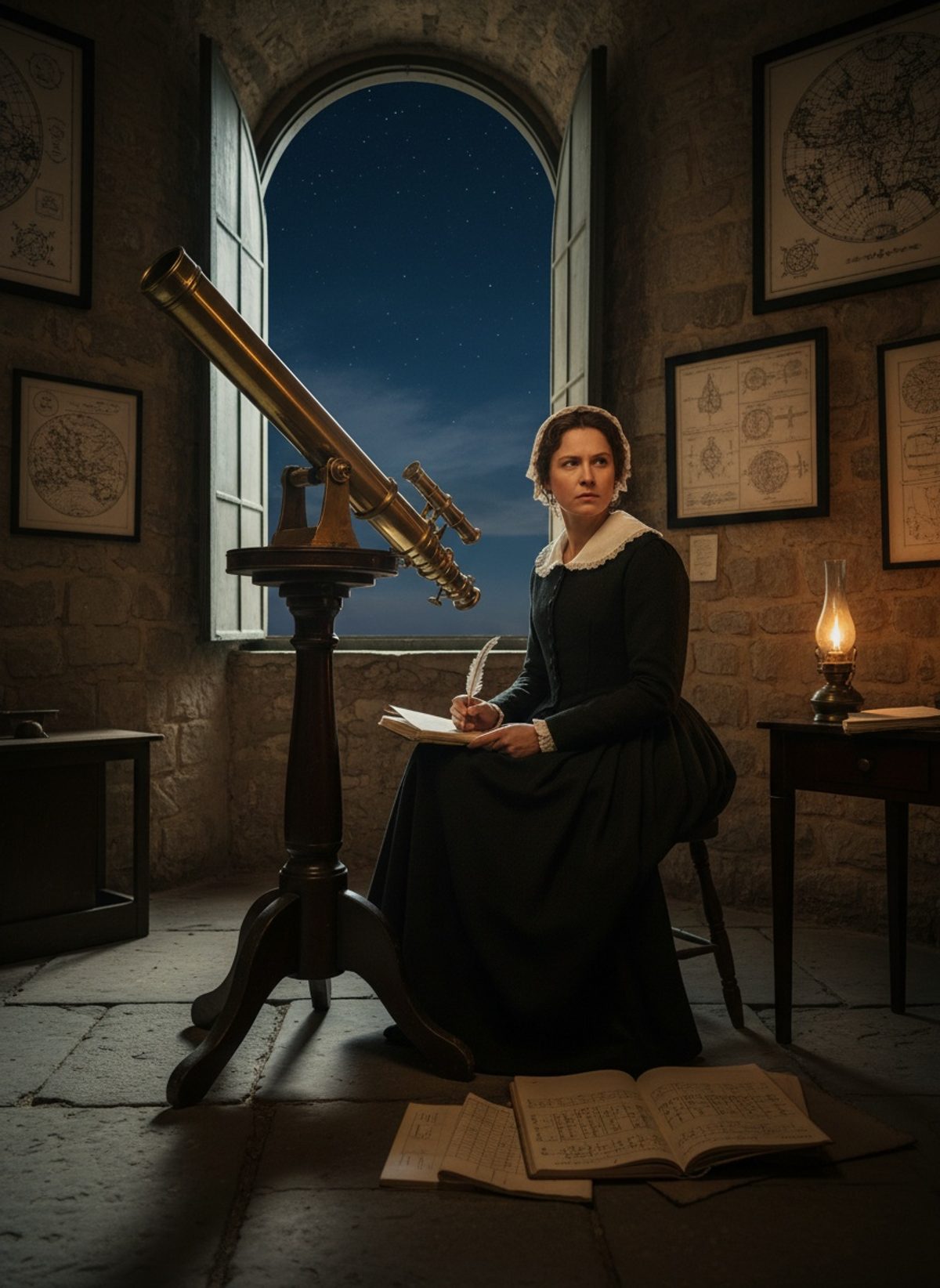
Initially trained as a singer, Caroline's musical talents were overshadowed by the pragmatic demands of assisting William with his burgeoning interest in astronomy. The task seemed menial: helping grind telescope mirrors, meticulously recording observations, and conducting the necessary but tedious calculations. However, each night as the velvet sky unfurled its mysteries, Caroline's fascination with the cosmos grew.
The sky was an unending expanse waiting to be discovered, and Caroline began her nightly vigils with growing determination. Her grasp of the landscape above expanded beyond her brother's shadow, and the seeds of her own astronomical career took root. With discipline reminiscent of her musical training, Caroline committed to mastering the language of the stars, undeterred by the language barrier that England had initially posed. Her decision to fashion her own telescopes marked a turning point. Armed with her instruments, Caroline embarked on sweeping the heavens, her eyes fixed beyond the limitations of Earthly expectations.
Read next: When Younghusband Rode Into Lhasa and Wept Alone, 1904
Discovering Celestial Wonders
Caroline's persevering gaze soon uncovered what others had missed. In 1786, she discovered her first comet, a cosmic traveler that blazed a path through the star-studded evening like a tale spun from ancient myths. This celestial revelation was a ripple in the fabric of science — a moment that began to unravel the conventional roles assigned to women. Caroline's determination and acumen placed her steadfastly among the great discoverers of her age, yet society hardly knew what to make of a woman charting paths across the cosmos.
Her subsequent discoveries followed in rapid succession, with meticulously recorded observations that would eventually catalogue a total of eight comets by 1797. Every new comet bore her name and garnered increasing attention from both the public and scientific communities. Caroline's findings were no longer solitary marvels; they heralded a shift in the perception of women in scientific fields. Her exemplary work resonated far beyond the confines of the scientific community, challenging preconceptions about women's capabilities in critical inquiry and the pursuit of knowledge.
The British Crown took note, a testament to the merit of her discoveries. Caroline became the first woman to receive payment for her scientific contributions — a groundbreaking acknowledgment that echoed the true value of her work. This unprecedented act signified a quiet revolution: the official recognition of a woman's intellect and her contributions to science.
Read next: When John Rae Brought Home the Truth About Franklin, 1854
Sweeping Skies and Changing Tides
As the 18th century drew to a close, Caroline Herschel's influence had shifted the very landscape of astronomy. Her role as both a collaborator and a luminary in her own right was undeniable. She opened doors that had long been shut to women, proving that excellence and perseverance could transcend societal boundaries. Herschel's meticulous cataloging and observations enhanced our understanding of the universe, laying groundwork that would support future astronomers in mapping the heavens.
Yet, her story is more than a tale of scientific triumph. It is an enduring reminder of the power of tenacity and the courage it takes to break free from prescriptive roles, to gaze into the unknown, and to allow curiosity to triumph over convention. The comet-chasing Caroline Herschel serves as an emblem of possibility, an eloquent statement against the confines of her time.
In her journey from singer to stellar observer, Herschel did more than discover comets; she illuminated a path for future generations, showing that the vast sky was available to anyone with the audacity to look up and the courage to see. Herschel's life incites reflection on the intricate dance between determination and discovery — a dance that continues to inspire those who dare to sweep the skies, seeking the unseen. Her legacy is etched in the stardust, a testament not just to what she achieved, but to the worlds she opened for those who followed.