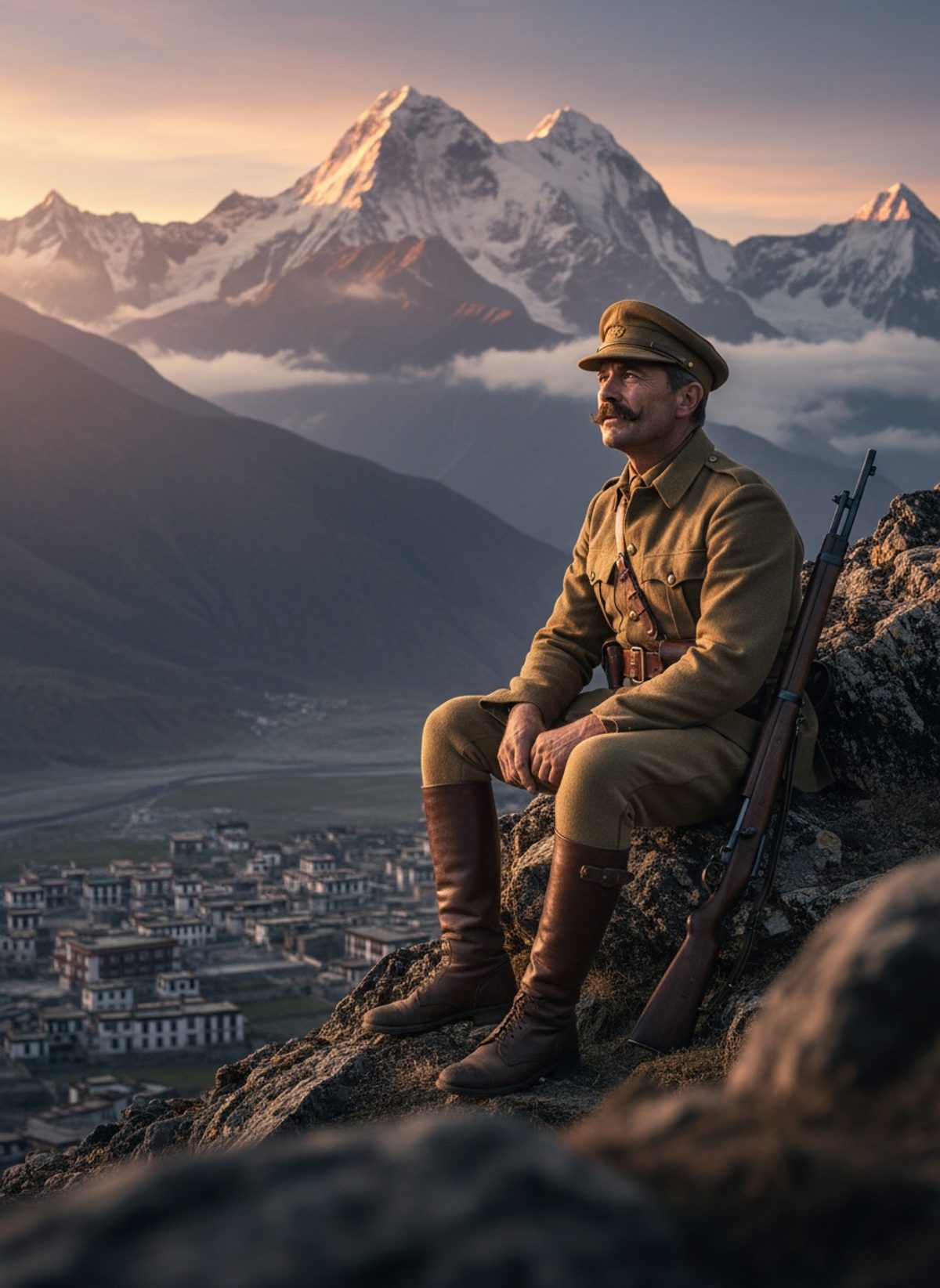
August 3, 1904. A lone figure sat atop a desolate Himalayan peak, the chill winds whispering past him.
The March to the Forbidden City
In late Victorian Britain, the exotic lands of Tibet remained shrouded in mystery—a vibrant tapestry hidden behind the towering Himalayas. The British Empire, ever thirsty for dominance and trade, plotted its incursions into this veiled realm. At the vanguard of this venture was an extraordinary figure, Francis Younghusband. His mission: to enforce British communication routes with India and counter perceived Russian influences.
With an army outfitted with rifles and the determination of empire, Younghusband's expedition advanced through treacherous terrain. The untamed landscape and high altitudes, some over 5,000 meters above sea level, presented dangers of their own. Yet it was the human resistance they met that marked this journey. Tibetan defenders wielding rudimentary weaponry designed more for ceremony than combat attempted to hold their ground. However, diplomacy was futile; the British forces, under Lieutenant-Colonel Herbert Brander, crushed opposition and persevered toward their prize: the enigmatic city of Lhasa.
As Younghusband and his troops approached Lhasa in early August 1904, anticipation and anxiety filled the air. The British expedition was entering a sacred city, closed to outsiders for centuries. Younghusband, clad in the uniforms of empire, was about to collide head-on with history. His arrival in Lhasa marked the first time a Western power's military had breached its gates, forever altering its legacy.
Read next: When Arthur Phillip Raised the Flag at Sydney Cove, 1788
A Treaty at Gunpoint
Tibetan negotiators, faced with the imposing presence of British firepower, begrudgingly accepted Younghusband's terms. The resulting treaty forced upon these mountains was a stark quota of geopolitical power. Lhasa's monks and political leaders sought to preserve their revered traditions, clinging to what little autonomy remained.
The treaty carved its way into history, much to the distaste of its participants. It stipulated trade concessions and ensured British oversight—terms dictated by the muzzle of a rifle more than mutual agreement. The echoes of gunfire had barely faded from memory when Younghusband put pen to paper, his heart heavy with the responsibility of imperial design.
Yet for Younghusband, despite fulfilling his ostensible mission, the allure of this ancient city and its spiritual resonance began to tug at the edges of his consciousness. The Himalayas had secrets, ones veiled in the whispers of discernment and introspection—a world apart from the political machinations he represented. The contrast between duty and destiny hovered in the rarefied air over Lhasa.
A Solitary Revelation
On that fateful day, August 3, 1904, Younghusband stole away from the clamor of military victory. Alone in the stillness of the Himalayas, he sat on the edge of the world, where the air thinned and the spirit found space to breathe. It was here that a transformation took hold, one as profound as the jagged peaks surrounding him.
In that solitude, Younghusband wept, releasing a torrent of emotions held tightly within the facade of colonial ambition. An epiphany swept over him like the snows that dusted the mountaintops—a mystical, spiritual awakening that overwhelmed him. He was immersed in a unity of soul and eternity, unlike any he had anticipated when setting out from the heart of the empire.
Read next: When George Goldie Drew Nigeria From a Boardroom, 1886
This intense spiritual realization profoundly altered his understanding of the world and his place within it. Where once stood an agent of imperial ambition now emerged a man seeking unity and acknowledgment of the deeper currents of human experience. The conqueror had become the seeker, forever changed by his encounter with ancient mountains and timeless echoes.
The Discordance of Empire and Spirit
Upon his return to Britain, Younghusband's newfound paradigm clashed spectacularly with the rigid confines of imperial expectation. The transformation from imperial enforcer to spiritual seeker marked a contentious pivot that puzzled and inspired in equal measure. He recounted his experiences as "a realization of unity with the universe," sowing the seeds of a lifetime dedicated to exploring spirituality rather than expanding territory.
The once-ardent embodiment of Victorian England's imperial ambition became an advocate for spiritual unity and peace. This metamorphosis was in stark contrast to the rigid politics defining his earlier career. Younghusband's latter years were devoted to facilitating dialogue among the world's faiths and cultures, championing a deeper understanding of humanity's shared spiritual heritage.
This tale of transformation serves as a reminder of the unpredictable nature of human experience. Encounters in foreign lands are not confined to tales of conquest but can become avenues to rediscover one's soul. Younghusband's journey to Lhasa was not simply a geopolitical maneuver; it became a personal crusade of spiritual awakening, urging future generations to find balance amidst the tumult of power and peace.