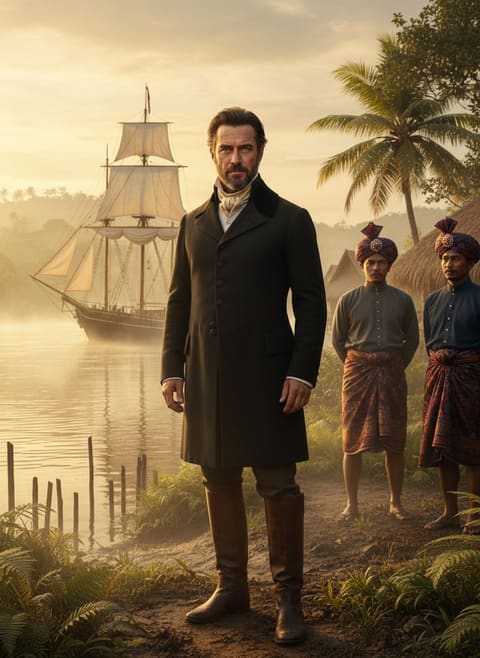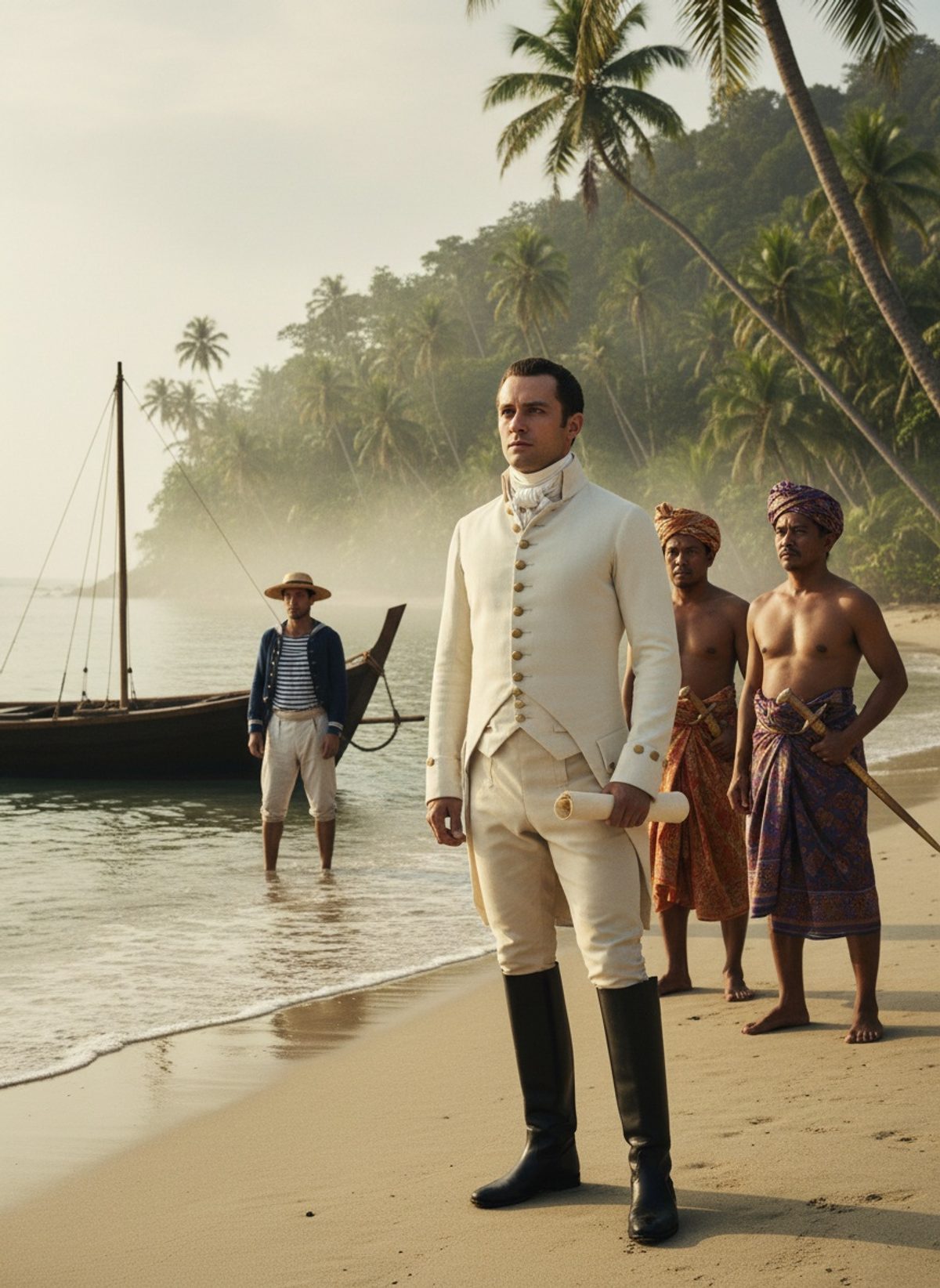
As the first light of dawn ghosted across the choppy sea, a humble vessel, inconspicuous against the vastness of the ocean, found its anchor. The air was thick with the perfume of salt and earth as the young official's boot crunched onto the gritty shore of a jungle island at the tip of the Malay Peninsula. He had no army, no caravan, just the sheer scope of his ambition. By the day’s end, his name would be immortalized as the architect of one of history’s greatest trade cities. This was the dawn of Singapore, and the dreamer was Thomas Stamford Raffles.
The Visionary's Arrival
The calendar read January 1819, yet on that forgotten shore, the year seemed an afterthought to the immense task at hand. Raffles, at age 37, was an individual driven by boundless vision rather than resource. A servant of the East India Company, his title offered little in the way of solid authority in those jungled wilds. An official of the largest corporation the world had known, he stood distinct from the soldiers and gunpowder that typically accompanied empire builders. Instead, a narrow, creased map and a keen eye to harness geography’s gifts were his companions.
The island of Singapore caught his eye for one singular reason: it was at what could become the heart of maritime trade between the Indian Ocean and the South China Sea. Here was a deep-water harbor unmarred by the silty inlets and treacherous shallows of the surrounding regions—a featureless canvas amid the tangle of lush tropical surroundings. To Raffles, this wasn't just a potential port; it was a linchpin for commercial empire.
Strategic Diplomacy Under Looming Palms
Raffles’ day would not be spent in contemplation. At his core, he understood the unparalleled value of expedience and strategy over prolonged negotiations. As morning gave way to the sun’s zenith, he orchestrated a meeting with the island's ruler, the local Temenggong, as well as the Sultan Hussein Shah, whose ownership was more nominal than actual.
With swift negotiations, carried out under the broad leaves of the jungle canopy, gold and silver exchanged hands. In a masterstroke, Raffles balanced delicacies of diplomatic tact with pragmatic forthrightness that became his signature. By the time the sun dipped low, leaving the sky a blazing script of crimson, a treaty was penned to establish a British trading post on the island.
Read next: When Two Explorers Vanished Into the Congo, 1887
This day of deliberate action was as much about gesture as it was about geography. Establishing Singapore not only secured the area for future British trade endeavors but challenged the omnipresent influence of the Dutch in Southeast Asia, making it a node of British—or rather, company—power, in a regional game of chess.
A City From Cloth and Heart
Even Raffles could scarcely have imagined the whirlwind of transformation that would follow this humble start. The East India Company, sensing opportunity in the territory secured without diplomatic friction, began pouring resources into development. A mere outpost grew into bustling activity center as goods soon flowed through Singapore’s burgeoning port. Though the scene remained simple in those initial months, marked by tents and makeshift huts, visions of urban grandeur stirred beneath the commerce-laden horizon.
A focus on trade made Singapore into an intercontinental mosaic. Merchants flowed in along river routes and from far shores, bringing with them wares that crossed cultural and geographic barriers. These early textures laid the groundwork for what would become one of the busiest trade hubs the world would ever know.
The Unsung Footsteps of the Ambitious Bureaucrat
While Raffles might not have carried armies, his intellectual might moved foundations. Education and cultural development became focal points alongside economic expansion. Despite his subsequent assignments and eventual return to England, his mark was indelible. The seeds he planted grew into an unquenchable thirst for learning and governance amidst the island’s growing populace. This era of Raffles’ dream was to be characterized by administration shaped deeply by British order yet distinctly flavored by regional cultures.
Read next: When Edmund Halley Sailed Into the Storm to Chart the Stars
Overshadowed by larger scopes of empire, Raffles’ work in Singapore sometimes seems nothing more than a footnote in history’s broader narratives. Nevertheless, his vision became iconic, a singular nucleus of modernity amid an era that often saw more destruction than development.
The Harbinger's Legacy
Today, Raffles’ name graces not just street signs and institutions in Singapore but stands memorialized in the evolution of an entire world economy. This single figure, with a day's work and a gambler’s resolve, harnessed forces that set a future momentously apart from its past. Such is the continual reminder in the heart of Singapore—a city sprung from nothing and shadow in a matter of hours.
While some call it the luck of foresight, others recognize the subtle orchestration of combining vision with opportunity. What Raffles achieved was not the mere founding of a city, but the conception of an enduring crossroads of the modern world, all from a compass point of ambition that outshone its Himalayan surroundings. For a man with no army, the realm he conjured became far more powerful: the city that came to the world’s stage, all in a day’s endeavor.