He vanished like smoke upon the water. For Captain Henry Every, eluding the greatest manhunt of the seventeenth century was his final act, ensuring his legendary status among pirates for centuries to come.
It all began in the summer of 1695. The world then was in the throes of empire building, with the seas teeming with vessels under different flags. The English ship, Fancy, once a part of the Royal Navy, now flew the Jolly Roger under Captain Every's command. Known to his crew as "Long Ben", he was a master of the art of piracy, blending cunning with charisma. Every wasn't just any buccaneer; he was one who had served the Royal Navy, and his knowledge of naval operations was a double-edged sword that made him both a formidable opponent and a traitorous villain in the eyes of the English crown.
With ambition riding the tide, Every steered the Fancy into the Red Sea, a realm controlled by the Mughal Empire, whose treasure fleets were as tempting as they were legendary. The Mughal Empire, at its zenith under Emperor Aurangzeb, commanded vast wealth, and its ships, richly laden with silver, gold, and precious jewels, drew every pirate's envy. However, no pirate before had dared to challenge the might of the Mughal navy in the Red Sea's daunting waters.
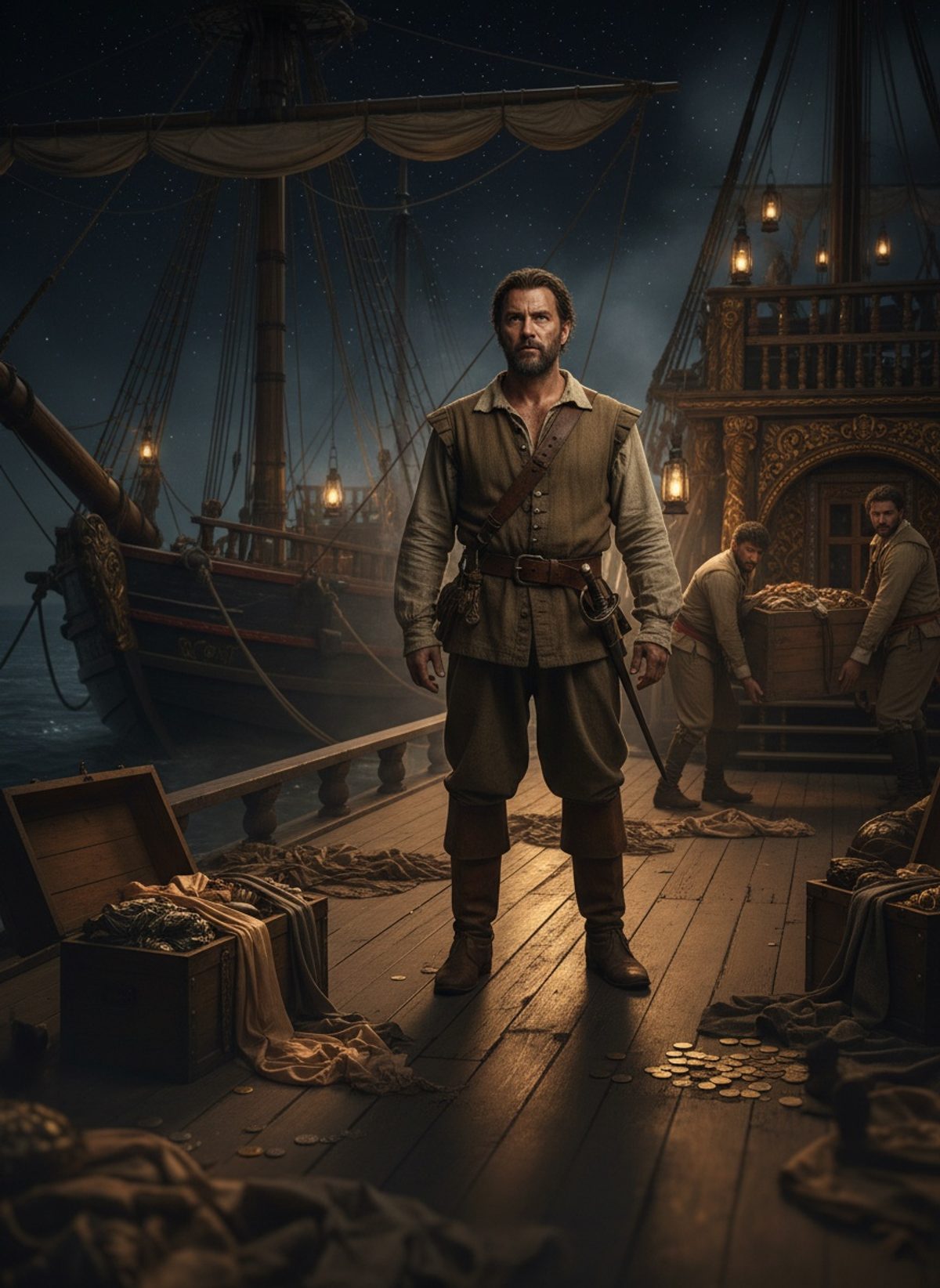
In September 1695, under cover of darkness, the scene was set for a daring plunder. The Fancy intercepted a Mughal treasure fleet convoy returning from the Hajj pilgrimage. Among these ships was the Ganj-i-Sawai, the Mughal flagship, fabled for both its incredible bounty and its formidable defenses. The Ganj-i-Sawai was possibly the most renowned Mughal trade ship of its time, rumored to be carrying treasure beyond any seafarer's wildest imagination.
Read next: When Henry Every Vanished and England Couldn't Find Him
The attack was swift, brutal, and thoroughly orchestrated. Although the Ganj-i-Sawai possessed a crew and complement of cannons that would typically outmatch any pirate vessel, Every's own audacity caught the ship off guard. As his skilled gunners engaged the Mughal defenses, Every's men, seasoned by previous encounters and desperate for fortune, boarded the ship. The chaotic melee that ensued was one for the ages, a clash of swords, blood, and desperation beneath the watchful gaze of the stars.
When the tumult subsided, the haul confirmed the myths. Every and his crew had seized one of the richest scores in piracy history, with treasures so immense that legends speak of rubies showering the decks, piles of gold being tossed between hands like common currency, and exotic silks draping over the arms of grizzled men who had never before touched such fine fabrics. The fortune was staggering, igniting the imaginations of many and worry among the powerful East India Company, the crown's merchants and vessel pilots who watched India's trade as a cornerstone of English ambitions in Asia.
But this bountiful crime did not go unnoticed. The Mughal Empire was incensed. The fury of Emperor Aurangzeb resonated across the seas; he demanded justice and reparations, blurring the lines between a criminal endeavor and an international incident. At home, fallout from this brazen assault reached England's shores like a tumultuous wave. The East India Company saw their carefully negotiated relationships with the Mughal administration crumble. Trading privileges hung by a thread, dependent upon the prompt and assured capture of Every and his marauding crew. Thus, Henry Every became the most wanted man not just by law but by empire decree.
The reward for his capture was unparalleled, and the great hunt began. Notices flapped in the winds at ports from the Americas to Europe, detailing the King's promise of wealth and pardon for those who could deliver Every to justice. Nonetheless, Every vanished. With the kind of elusive behavior more commonly documented in ghost stories than in official maritime records, there were whispers that spoke of him assuming a new identity, living out his days in peace amid the lush green hills of Ireland or somewhere along the remote coastlines of tropical islands, never to face the gavel's weight.
Henry Every's legacy is not just one of extraordinary wealth, cemented in pirate folklore and romanticized tales of the sea. His impact resonated within the very corridors of power, significantly straining the tenuous relations between the burgeoning empires of Europe and the established kingdoms of the East. His escape emphasized the era's tumultuous balance between law and lawlessness, where imperial ventures collided with personal fortunes navigated by men who knew only risk and reward.
In reflecting upon his story, we confront not only the eternal allure of treasure and adventure but also the enduring struggle against impunity and the obstinate hunt for justice amidst oceans that know no man’s name. Every’s plunder was more than just a theft; it was a seismic ripple through the annals of piracy and empire alike, a cautionary tale of how one man could sway the tides of diplomacy with a single ferocious act upon the high seas. Yet, in the end, it raises a quieter, more personal question: in an age of heroes and scoundrels, where does one's name truly find its rest?