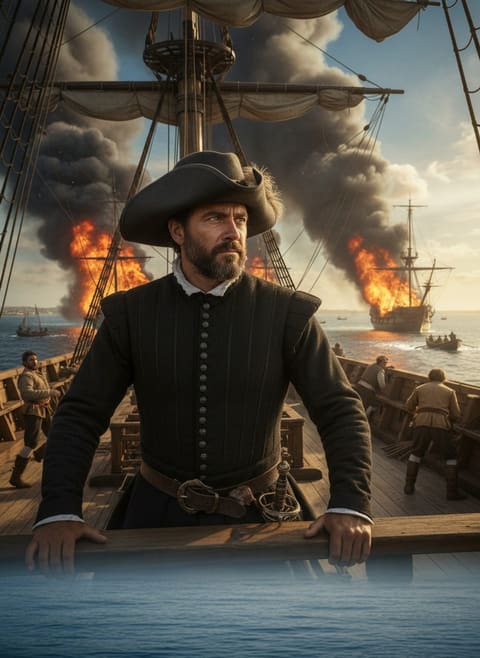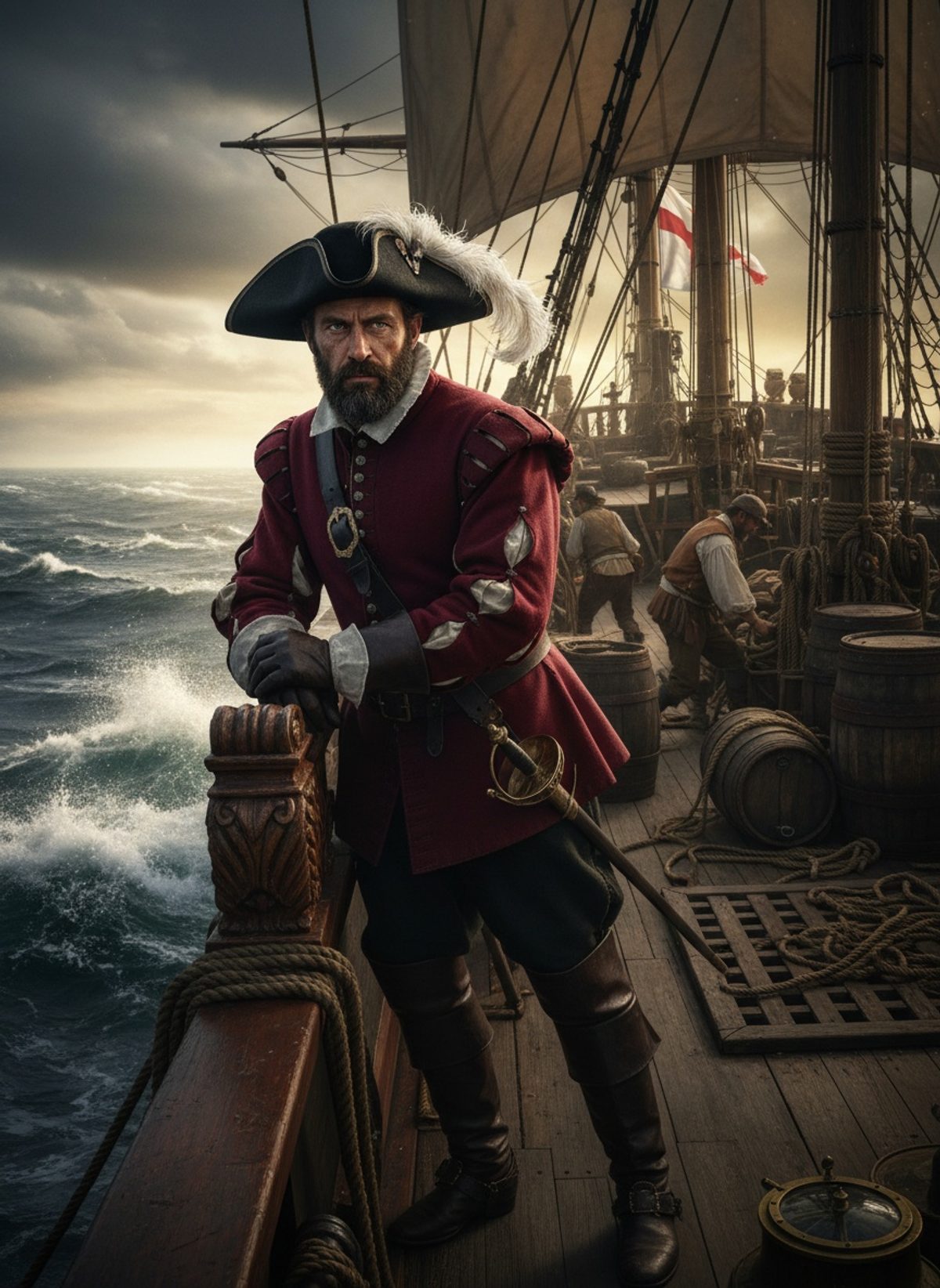
Francis Drake was just another sailor. But his choices carved new paths on the world's oceans and in the minds of his countrymen.
Through the Strait into the Unknown
September 1578 marked the culmination of a daring endeavor that would etch Francis Drake’s name into maritime legend. His ship, the Golden Hind, weathered and weary, managed the seemingly impossible — it navigated through the notorious Strait of Magellan. This feat alone signaled an audacious departure from the known maritime routes. For many, the waterways of the globe were static and foreboding, boundaries set by the mastery of Spain and Portugal. Yet, with the squalls and swirling currents echoing against the wood of his ship, Drake proved a different narrative was possible.
As the Golden Hind breached the Pacific, it was more than a geographical crossing; it was a bold proclamation. No Englishman had tread this water before, a testament to both the peril of the voyage and the neglect of fortune that favored his Spanish adversaries. This was not only a navigational challenge — it was an untamed wilderness of strategic opportunity. Here, Drake’s prowess as a navigator and a tactician united into an unyielding drive that propelled him forward into the vast, uncharted reaches of the Pacific Ocean, a stage set for conflict and plunder but promising untold wealth and glory.
The journey was fraught with danger. The Pacific is deceptively serene in name; its waters were unpredictable with storms as treacherous as the souls who dared to navigate them. Here, in these fierce currents, Drake's mettle was tested as he maneuvered this solitary ghost-like ship ever northward, away from the familiar embrace of European waters.
Read next: When Hugh Willoughby Sailed Into the Arctic and Never Came Back
The Unseen Spanish Coast
Drake’s northward path carried him along the spine of what was then unaffordable Spanish territory, an unexplored coastline by most accounts. His odyssey was not a mission sanctioned by the crown; it was a gamble of desperation and cunning, a bid to unravel the tightly woven fabric of Spanish maritime dominance. The Spanish, secure in their complacency, had not girded this coastline with the elaborate defenses they had established on their Atlantic side. And it was this absence of defense that Drake exploited with precision.
With each port raided and each Spanish vessel commandeered, Drake sowed both confusion and fear. The Spaniards, previously unchallenged masters of these waters, were suddenly vulnerable, their fleets outmaneuvered, and their strongholds infiltrated. The wealth he seized surpassed mere gold and silver; it was a message of audacity and a harbinger of English ambition. Engendering whispers and tales of another, fairer-skinned pirate prince haunting the coastlines, Drake peeled back the illusion of Spanish invincibility.
Less known than the tales of his captured plunder was Drake’s keen eye for geographical knowledge. He meticulously charted these unexplored areas, identifying potential locations for future ventures and exploration. This mapping was as much a treasure as the physical spoils he gathered, further challenging the worldviews of Europeans about the breadth and variety of coastal resources.
Read next: When Francis Drake Knelt in a Stolen Ship, 1580
Changing English Horizons
By the time the Golden Hind turned her prow back across the seas, Drake carried more than the riches of silver and gold aboard; he carried a precursor to empire. The echoes of his voyages reached Elizabethan England’s shores, offering tangible proof of broader horizons and untapped potential marred by Spanish ignorance or inability to protect every expanse of their claimed world. England was not just a minor nation on the fringe of Europe; it held the potential to be a seafaring power, rivaling or even exceeding its Iberian counterparts.
This particular voyage redefined what English sailors regarded as possible in terms of navigation, conquest, and opportunity. It outlined a framework that would transform England's wooden vessels into agents of Empire. The adventurous spirit Drake embodied seeped into the national consciousness, sparking a wave of exploration that would cast its net across the globe, from the New World to the Spice Islands of the Indonesian Archipelago.
The tale of Drake’s crossing into the Pacific is not just a maritime adventure. It is a narrative about seizing the unseen opportunities in a world starkly divided by colonial power. In framing the English view of what was achievable on the grand oceans, Drake offered more than victories; he shaped a legacy of discovery, dissent, and, ultimately, the birth of the British Empire. His salty expeditions still whisper to us a warning and a promise — realms of possibility lie only a horizon away, waiting for those brazen enough to sail into the unknown.