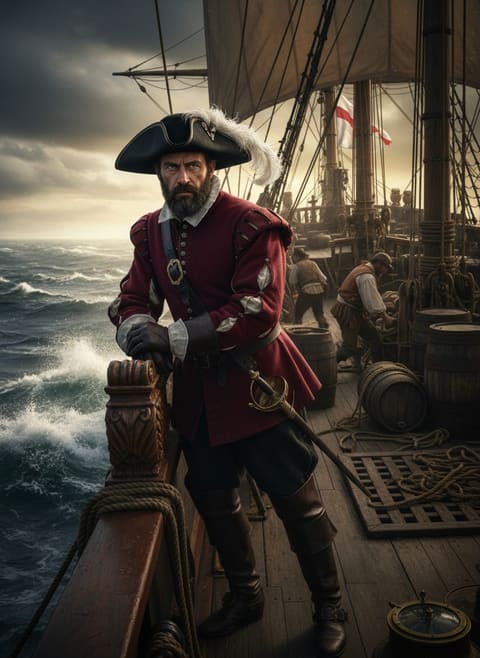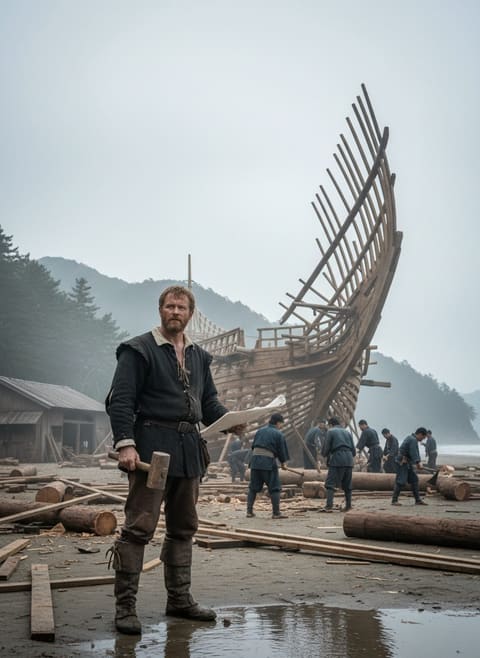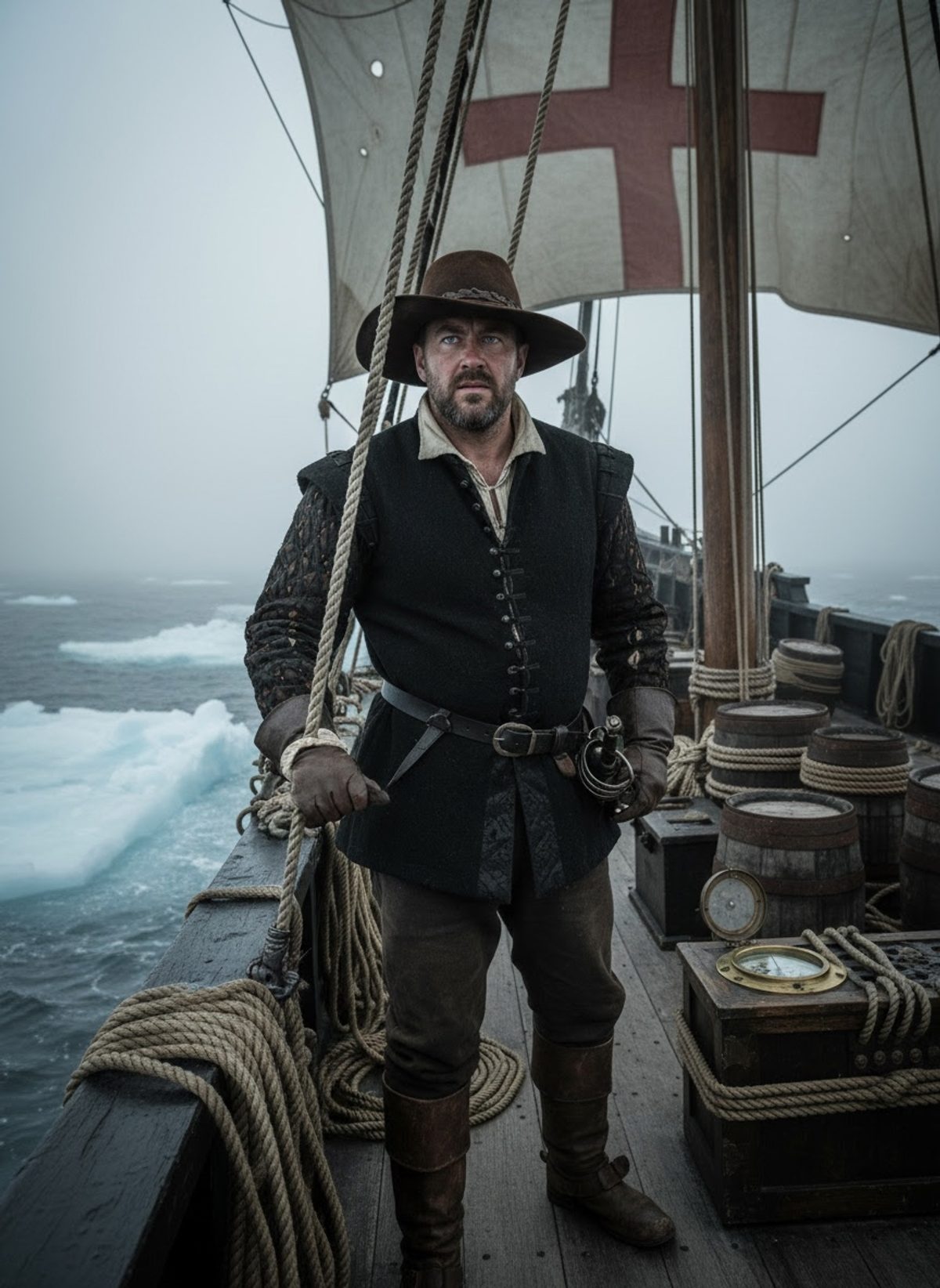
The sea was a razor's edge of steel-grey, its surface fractured by waves that mirrored the turbulent sky. Vast sheets of ice drifted silently, like ghostly ships haunting the chilled passageways of the Arctic. The bite of the cold was unforgiving, a constant companion to the wind that whipped mercilessly through the ship’s rigging.
In the summer of 1576, beneath this relentless northern chaos, a single small vessel cut its way into the unknown. It was led by Martin Frobisher, a man driven by England’s insatiable thirst for discovery. Ahead lay the uncharted wilderness of snow and sea ice, with the promise of glory and wealth, but it came at the peril of men’s lives and the very real threat of being swallowed by an indifferent sea.
The Lone Vessel
Set adrift from the southwestern coast of England, Martin Frobisher had initially set sail with high hopes, commanding a fleet of three ships. His mission was not only ambitious but risky. He was to chart a course through the icy labyrinth of the northern seas to find the fabled Northwest Passage—a route that promised a shortcut to the riches of the Orient. Yet, adversity soon became an unwelcome companion to this fledgling adventure.
Of the three ships, two had either turned back or been swallowed by the expansive seas, leaving Frobisher to continue with a single ship, the *Gabriel*. Manned by a mere eighteen men, this vessel carried the entire weight of England’s aspirations.
Read next: When Francis Drake Knelt Before the Mast at Deptford, 1581
But with each mile that brought them closer to the Arctic, the looming presence of ice fields grew, and the air turned colder, more biting. Frobisher's crew, seasoned though they were, began to feel the clutch of trepidation as their sail cut through waters no Englishman had surveyed before.
As the ship ploughed forward, the landscape transformed into a tableau of icebergs and frozen seas that yawned vast and inhospitable. The crewmen’s voices, which once shared stories of home and future riches, now grew silent, choked by an encroaching sense of dread. To them, it seemed as if the very world had narrowed, encapsulated by the ice barriers rising like walls on either side.
Yet, amidst this desolation, Martin Frobisher’s resolve shone through—a beacon set against the twilight pallor of the encroaching ice. A pulse of determination drove him. If England had staked her claim on the vast open seas, why not, Frobisher thought, the frozen realms as well?
Frobisher’s Resolve
Frobisher, Yorkshire-born and hardened by the sea, was no stranger to peril. His life, colored by maritime adventures and privateering, had bred an indomitable spirit. The course he charted into the Arctic maze on that fateful venture was part mad ambition, part a test of mettle. To turn back would not only mean failure but also a concession of the unknown to other European powers equally questing for dominance.
The ice-draped horizon held secrets; beneath its shifting veils lay untold riches and untamed lands. With every shudder of the deck and crack of ice against the hull, Frobisher’s persistent belief in his mission became akin to a stubborn pilgrimage.
There was sagacity behind his weather-scarred face, the glint in his eyes reflected his vision—not just of a passage, but of the expansion of an empire. Yet, his crew lamented, whispers rising ghostlike around the ship’s deck; this journey flirted too closely with death. Mutiny lingered not at the forefront, yet as a distant echo, driven back only by the respect they bore for their captain.
Despite the gnawing uncertainty and the crew's pleas to return, Frobisher’s course held firm. "North," he would insist, the word wrapping itself around the men like a promise. Driven onward, the ice walls threatened to close but receded each time as if testing the mariner’s resolve. The voyage stretched into a crucible where ambition battled folly in every gale and every nautical mile rounded Frick, the mythos grew—Frobisher, the Englishman who chased the north wind into its lair.
Among Ice and Adversity
The northern frontier they navigated was a purgatory of bitter frost and swirling storms. Frobisher’s men, caught in the limbo between allegiance and fear, often looked overboard to see their reflections against the jagged ice below. Their faces were weary, foreign even, carrying an echo of the vast empty coldness around them. Now and then, the creak of the wooden hull, shivering under the strain of the icy embrace, rattled their bones.
Read next: When John Davis Sailed Into the Ice and Refused to Turn Back, 1587
At night, the sky unfolded in an undulating dance of the aurora borealis, casting eerie hues across black waters. It was a spectacle few had ever witnessed; light joined darkness in a celestial theatre that spoke to the fearsome beauty of their quest. Here, in the embrace of the unknown, Frobisher’s solitary resolve seemed to ignite the heavens.
Into this land of ice, Frobisher planted England’s flag, an audacious move that spoke to a relentless ambition as cold and vast as the Arctic itself. It was a token of England’s claim, a symbol sown in a frozen land that lay foreign to both native and newcomer.
Confronted by scarce resources and increasing impatience among his men, Frobisher calculated the stakes with precision afforded only by desperation and hope. He had angled for a route to opulence, a land bridge to prosperity, but he found instead a living frontier—a reminder of the limits of man’s control over nature.
Frobisher’s expedition, forged through ice and uncertainty, serves as an enduring narrative of exploration’s dual nature. His journey northwards was more than a quest for passage; it was a metaphorical line drawn against oblivion itself, driven by a nation’s ambition to extend its reach beyond the temperate into the eternal ice.
In his wake, he left not just a plant of national pride but a tapestry sewn with fear, courage, and the unknown—an ice-forged legend that history may long scan yet never fully grasp.