January 22, 1879. Smoke rose in lazy spirals against the bright African sky.
The quiet mission station at Rorke’s Drift on the banks of the Buffalo River had become a fort of necessity. Its adobe walls, once a haven of healing and learning, now bristled with urgency and fear. Just hours before, news had rippled through the British camp faster than the river's current; the Zulu impi had overwhelmed the British forces at Isandlwana, leaving a trail of red-coated bodies upon South African soil. And now, the victorious warriors were turning their gaze towards Rorke’s Drift.
Lieutenant John Rouse Merriott Chard had been absent from the station when the first tremors of panic began, tasked with constructing a bridge several miles away. But by nightfall, he found himself standing shoulder to shoulder with another officer, Gonville Bromhead, preparing for a siege with only a sliver of the force needed to hold back the approaching storm. Where one might see Chard standing, an image of resolve tempered by necessity, few could have predicted the night's outcome.
The night pressed in, oppressive and slow, as if aware of its role as the host of an impending clash. Chard had fewer than 150 men to fend off the Zulu warriors—a host numbering close to 4,000. Inside the walls of the mission, the raw tension was palpable. Many of Chard's men were recuperating from ailments, their bodies weak but their spirits sharper than ever as the reality of their predicament crystallized.
Read next: When MI19 Wired the Walls and Poured the Drinks, 1940
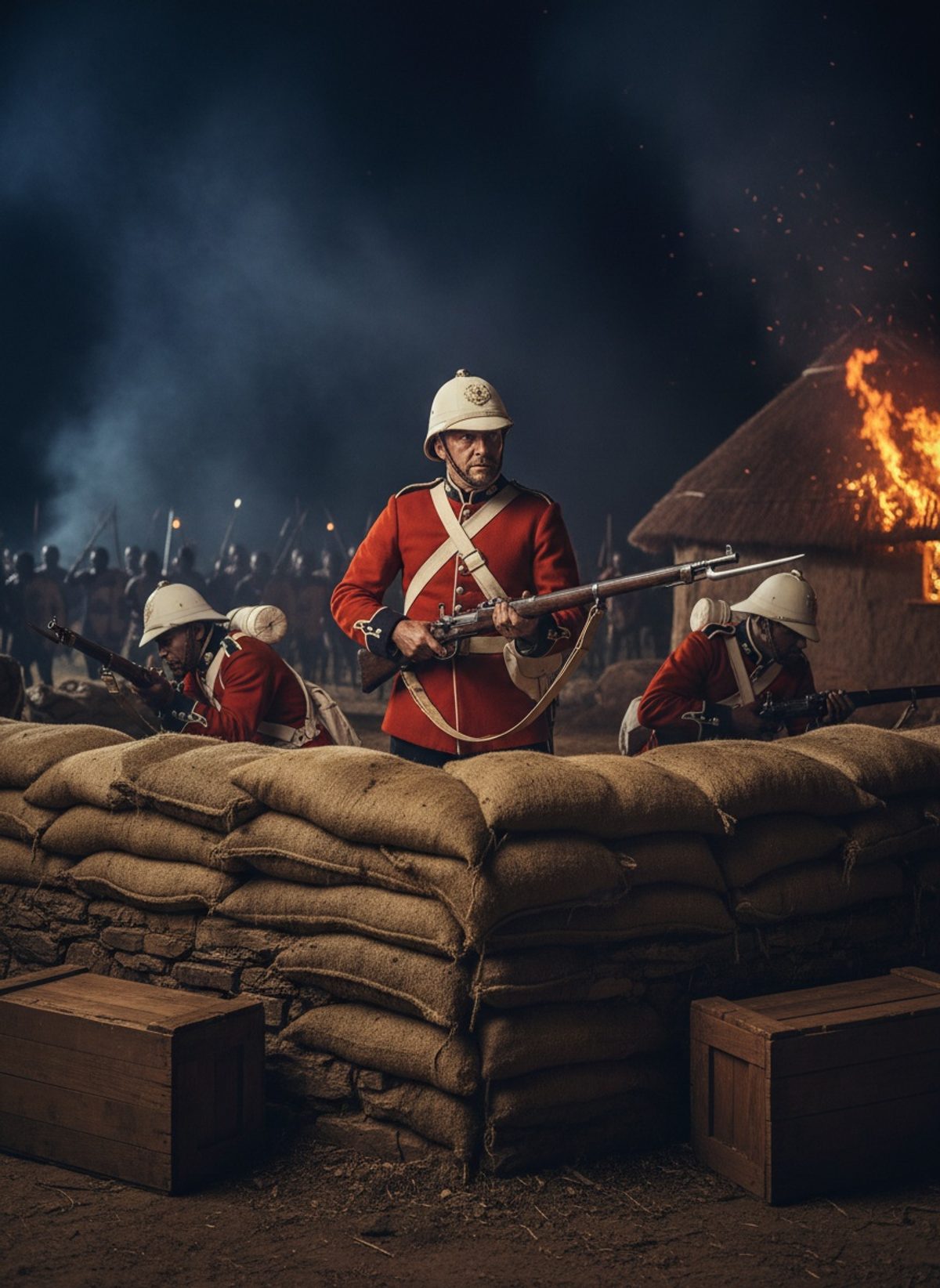
The mission's defenses were a hastily crafted arrangement of wagons and mealie bags. In an act of defiance against the inevitable, the defenders set about reinforcing their makeshift fortress. The raw determination within this scant defensive line was built upon grit and a touch of desperation. Nobody could have anticipated that this scattered collection of soldiers and hospital patients would mount such a legendary stand.
As the sun dipped behind the hills, a charged silence dominated. They waited. Everyone waited, muscle and mind taut, suffused with a mixture of terror and determination as time seemed to compress around the mission's walls. When the first Zulu war cries shattered the stillness, few could have anticipated the scale or ferocity of the impending assault.
The night exploded into chaos as wave after wave of Zulu warriors crashed against the defenses. The soldiers of Rorke's Drift found themselves in a relentless dance of defensive maneuvering and precision firing. The warriors came on in hordes, emerging from the darkness with an indomitable spirit, seeking to penetrate, overwhelm, and conquer.
The defenders, lighting torches against the encroaching night and fear, grimly held their line. Even the hospital patients took up arms or assisted as they could, repurposing the walls of their sanctuary into bulwarks against the invaders. Bullets whistled like harbingers of despair, but they were met with steadfast resolve.
Inside the hospital building, where walls became shields, the fight took on a savage intimacy. Men fought in tight corridors, time and again repelling Zulu warriors attempting to slip past the defenses. As fires began licking at the edges, the defenders found themselves navigating smoke-choked hallways where every step could be their last.
Throughout the night, Chard and Bromhead led their men with uncompromising courage, shuttling around the perimeter, rallying, firing, and fortifying. The Zulu warriors, armed with spears and raw courage, charged the walls again and again, climbing and clawing for openings, but never breaking the will of those before them.
The dawn's early light revealed a scene of almost unimaginable intensity. Bodies lay scattered across the ground, a testament to the brutal night's conflict. But the mission still stood. Incredibly, against insurmountable odds, the mission had held. As the day unfurled, the Zulu retreated, leaving behind an eerie quiet broken only by the murmurs of the wind and the groans of wounded men.
Rorke’s Drift had not just been defended; it had redefined valor. In the days that followed, tales of the gallantry displayed against overwhelming forces carried through the Empire. Honours flowed as if from the keening notes of some unseen laureate. Eleven Victoria Crosses would be awarded for acts of heroism in that night — the most ever for a single action in British military history.
In the years that followed, the defense of Rorke’s Drift was enshrined in legend, hailed as a saga of unwavering resolve and unlikely triumph. In a far-flung corner of the world, a disparate group stood firm, not for the ambition of conquest, but to protect their own, and each other. It's a story not just of military might, but of human spirit under duress, where the lines between victory and valiant endurance blur.
And so, from the depths of history, one can hear echoes of that fateful night on the Buffalo River, a legend that no textbook could ever fully capture. It reminds us always of what courage looks like when men bind together against the churning tide of fate, defying the odds that seemed to stand ready to engulf them. They weren't just defenders of a mission station; they were authors of a narrative that resonates through the annals of courage and history, holding fast against the night.