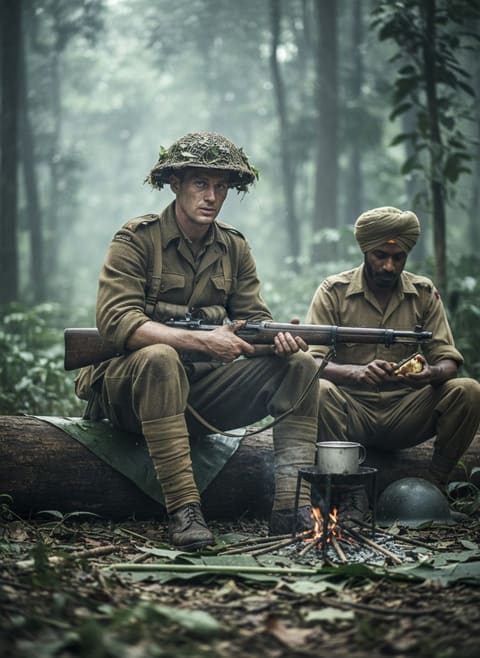
He was a soldier of the Gurkhas, yet he would never fire a shot on Mount William. It was his destiny not to fight, but to witness history unfold in a way even seasoned warriors could not have foretold.
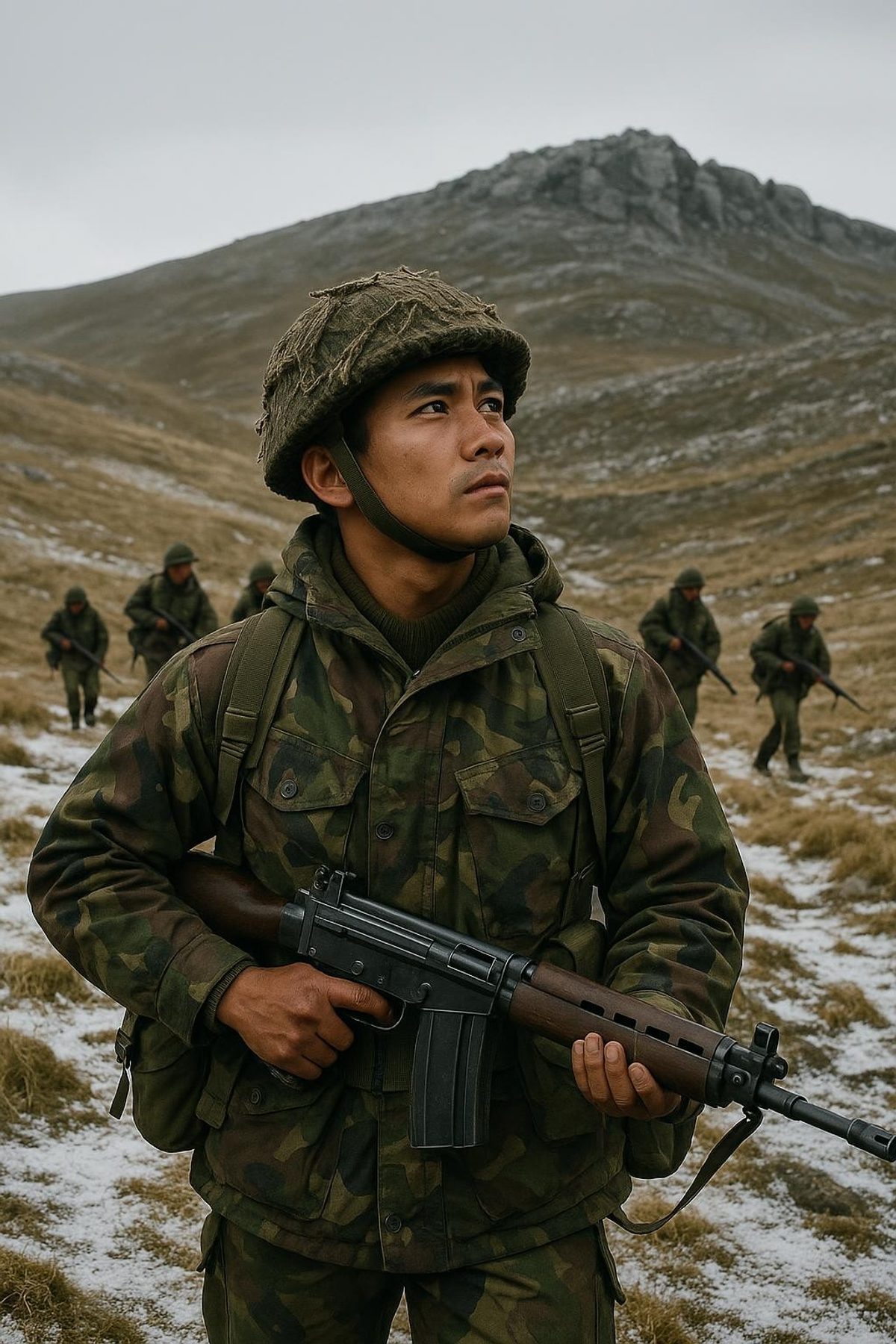
The morning of June 14, 1982, dawned over the rugged terrain of the Falkland Islands, casting the landscape in shades of determination and anticipation. The formidable 1st Battalion, 7th Duke of Edinburgh's Own Gurkha Rifles, seasoned by decades of storied service, had their orders. Advance. Conquer. Secure. Mount William was to be their battleground, a stark promontory serving as a sentinel over the beleaguered capital of Stanley. The Gurkhas, renowned for their bravery and discipline, were poised to execute what was meant to be a decisive thrust, securing Britain's hold over the Falkland Islands in a conflict that had simmered violently in the South Atlantic.
Yet, as they began their daylight ascent toward Mount William, the air brimming with the electric charge of anticipated combat, a different reality awaited at the summit. The crescendo of conflict dissolving into silence was both an unexpected relief and an anticlimax. Their Argentine adversaries had melted into the darkness of the previous night, leaving their positions starkly deserted. In a theater set for war, the players had vanished.
The Gurkhas' advance could hardly have taken place under more precarious conditions. The night battle for Mount Tumbledown, wrested from Argentine control after a withering engagement by the Scots Guards, had stretched beyond expectations—an unforgiving orchestration of rifle fire and resilience, extinguishing the last glimmers of darkness as dawn broke. With this hard-won victory, the stage was left for the Gurkhas. But daylight, unforgiving and uncompromising, flooded the landscape. The craggy saddle of bare rock separating Tumbledown from their target lay exposed under the morning sun.
Read next: When the Camel Corps Rode Into Khartoum Too Late, 1885
Argentina’s artillery fire was swift, and the Gurkhas, advancing in a visible formation, invited a barrage. Shells exploded with menacing regularity, shrapnel embedding itself in the determination of men who knew every step forward might be their last. Eight soldiers were wounded crossing the open ground, their injuries marking a courageous yet dangerous undertaking. Still, the Gurkhas pushed on, driven by honor, by duty—a lineage of valor leading all the way back through time to the jungles of Burma and the disciplined silence required of elite soldiers.
Materially, the weight of their journey southward had been less a burden and more a badge of purpose. Aboard the substantial silhouette of the Queen Elizabeth 2, they had come fully aware of the gravity ahead. As part of the 5th Infantry Brigade, their numbers infused with historical gravitas, the Gurkhas carried more than equipment when they disembarked amongst the desolate expanse of the Falklands. It was the obligation of a regiment that had endured, be it amid the ferocity of North Africa’s battles or the treacherous terrains of war-ridden Europe.
Reaching the top of Mount William, the Gurkhas found themselves peering into abandoned trenches, empty observation posts, vestiges of a retreated enemy. Their advance under artillery fire was a triumph of sorts, for how could the absence of bloodshed undermine the essence of courage they had collectively embraced? The abandonment by the Argentine forces signalled not just an evasion but an evolution of the conflict's dynamics. It was, unbeknownst at that moment, a silence preluding the end.
As the echo of warfare faded, the landscape spoke of peace won and vigilance maintained. Argentine forces formally surrendered in Stanley that very day, resounding a closure that had puzzled and relieved in equal measure. For the 7th Gurkhas, an entity of the British Army's revered Brigade of Gurkhas since post-India's partition, the capture of Mount William sealed a final honorable entry in their storied compilation of battle honors.
What unfolded post-victory presented its peculiar peril. The fields of Mount William were laden with mines, a latent danger left in the hurried retreat of Argentinean troops. Here, among the vestiges of potential destruction, the tragically brief post-script began. Corporal Krishnakumar Rai, alongside comrades, undertook the crucial yet perilous task of mine clearance, a grim violation of the stillness and safety they had only just achieved. It was in this silent, stealthy confrontation with the remnants of conflict that Corporal Rai met his end, a casualty of war’s lingering shadow when the guns had quieted.
Contrasting starkly, yet poignantly, a pilot from the 656 Squadron carried out an audacious mission amid these danger-zoned fields. His helicopter swooped perilously into a marked zone, extracting a wounded Gurkha and a Guardsman—acts of quiet heroism that resounded loud in the chronicles of courage, ultimately earning him the Distinguished Flying Cross. These moments illuminated the extraordinary spectrum of valor as the regiments cleared the remnants of a conflict that had, by all measures, already concluded.
For a regiment that stood as the first of its kind to guard the gates of Buckingham Palace, the Gurkhas’ narrative on the Falklands added yet another layer to their multifaceted history. Having traversed through times of peace and war alike—from Malaya’s dense jungles during the Emergency to Brunei’s rebellion-repelling escapades—their presence on the deceptively quiet cliffs of Mount William held significance belied by the emptiness they encountered.
Read next: When 2 Para Went Back Into Battle at Wireless Ridge, 1982
The amalgamation of the 1st Battalion, 7th Duke of Edinburgh's Own Gurkha Rifles into the Royal Gurkha Rifles in 1994 marked the end of an era. Yet, the memory and the merit of that June day in 1982 endure—etched amongst the jungles of Burma, the stories of Monte Cassino. Mount William carved its space, not as a site of raucous siege or celebrated storming, but as a testament to vigilance—a triumph of readiness and resolve when the landscape whispered more than it shouted.
The tale of the Gurkhas on Mount William is not merely a standalone vignette in the broader theater of the Falklands War. It is a lens through which the standpoint of martial dedication is reflected—where sometimes the greatest victories lie not in the battles fought, but in the unwavering readiness and resilience a regiment embodies. Even as the moment unfolds quietly in the silence of an empty battlefield, as the echoes of duty render it timeless, that whisper of history refuses to fade.
Last month, British paratroopers rehearsed a landing on the same islands.
Part 18 of 24: One Falklands story a day until Remembrance Sunday