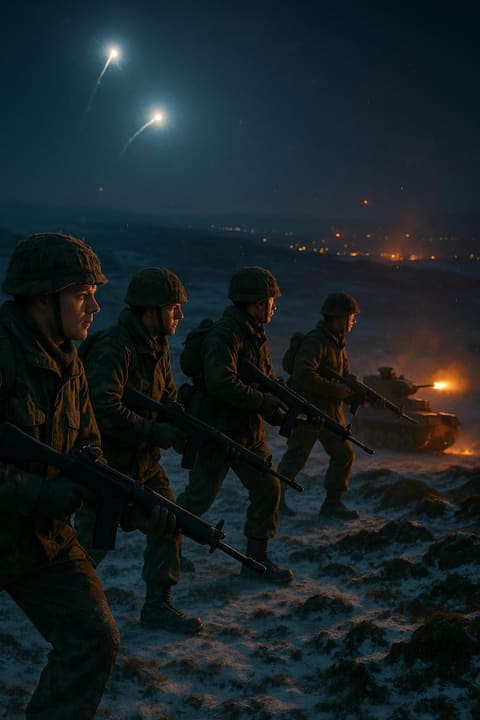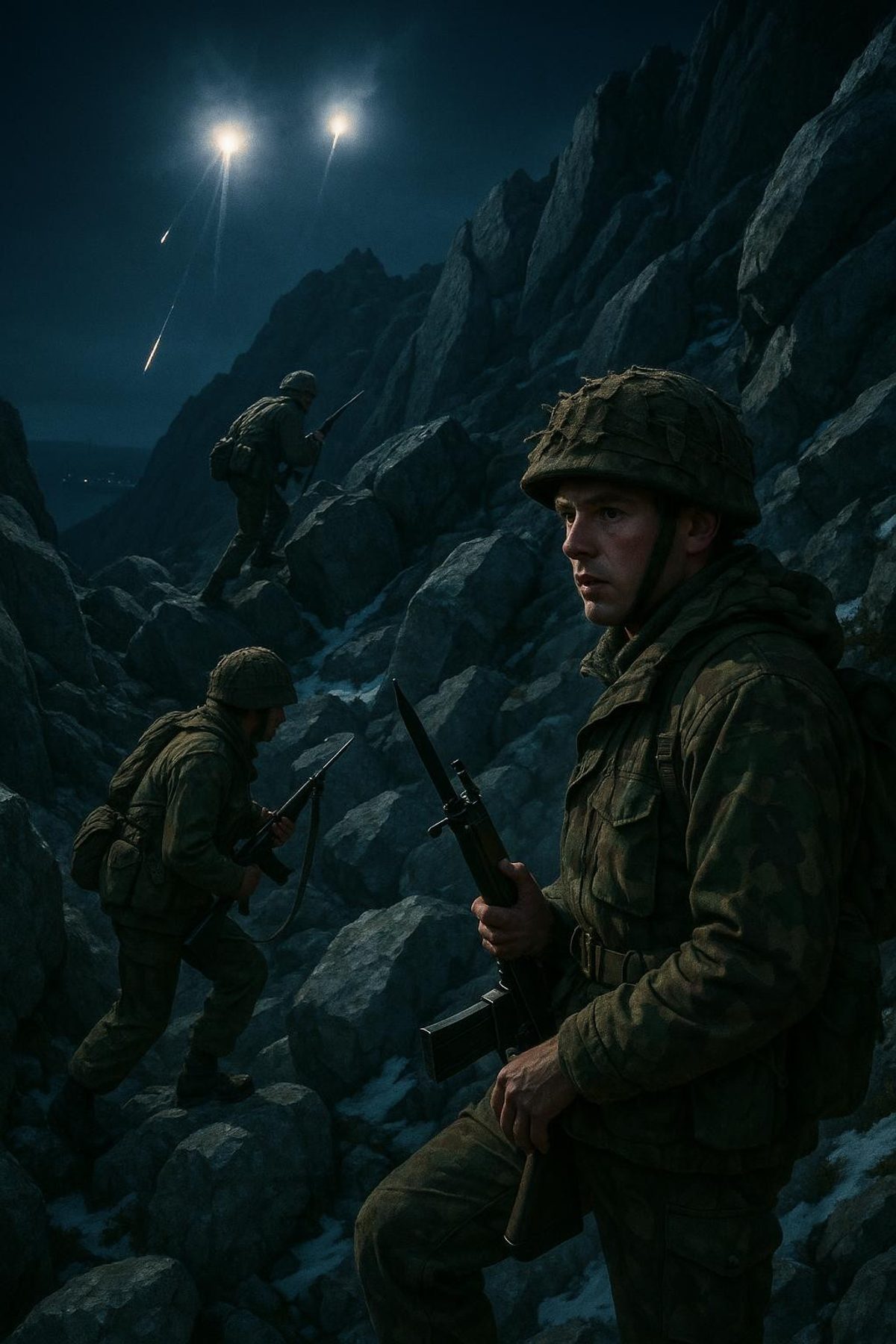
The night air was sharp and cold, biting the skin like ice-cold steel as it swept across the rugged peaks of Mount Tumbledown. Darkness cloaked the landscape, save for the occasional flicker of muzzle flash and the orange glow of distant artillery fire. Beneath the cloak of night, the stakes could not have been higher. It was the night of 13th June 1982, and the culmination of a ten-week war was about to unfold. For the men of the 2nd Battalion, Scots Guards, this would be a night forever etched in memory, one that would see them scale the formidable heights of Tumbledown and cast their eyes upon the lights of Port Stanley, the capital of the Falkland Islands.
The approach was treacherous, as Major John Kiszely and his men moved with a cautious but determined tread, every step fraught with peril. The location's formidable defenses were bolstered by the Argentine 5th Marine Infantry Battalion, cold-weather specialists with an intimate understanding of the harsh terrain they now defended. With machine gun nests cleverly concealed among the rocks, and with booby traps and minefields lying invisibly beneath the frostbitten earth, Mount Tumbledown was as formidable as any fortress. Yet, for the British forces, taking this mountain was the key to prying open the gates to Stanley.
Mount Tumbledown was one of the last heights before Stanley, and one of the last obstacles to retaking the Falkland Islands, which Argentina had occupied since April. As the Scots Guards poised themselves for the critical assault, a diversionary attack unfurled on the lower slopes of Mount William. Here, under the audacious leadership of Major Richard Bethell and bolstered by the battalion’s own Pipes and Drums platoon, its musicians fighting as infantry, the British infantry engaged in relentless combat with the Argentine Marine O Company. The clash was intense, lighting up the night with the fury of battle as the diversion drew focus away from the main assault.
Alongside them, the rhythmic roar of mortar fire from 42 Commando underscored the night, their shells blazing paths across the sky toward the enemy stronghold. The fierce precision of this bombardment offered an unsettling preamble to the horrors that would soon unfold on the rocks of Tumbledown. The position was secured, but at a cost. Drill Sergeant Daniel Wight and Lance-Corporal John Pashley were killed in the diversion.
Read next: When the Gurkhas Advanced on Mount William and Found It Empty, 1982
When Major Iain Dalzel-Job's G Company moved to try to secure the western end, they found scant resistance in their initial push. Later it came under shellfire, a warning of what lay ahead for Kiszely’s Left Flank. They had found an initial footing, but it was now time to move to the heart of the challenge. As Left Flank advanced, grappling onto the higher slopes, a maelstrom of Argentine gunfire fragmented the air. From behind the rocky fortifications and hidden blinds, the Argentine marines answered with mortars, grenades and small arms with enough force to check the British advance.
The dogged resistance had a human face; Marine Lieutenant Héctor Miño's 5th Platoon among others, stood grim and entrenched, entwined across the upper reaches of Tumbledown. Their resolve was as granite-hard as the stones they defended. Yet, through sheer determination, Kiszely and his Guardsmen pressed forward, their advance a painful grind punctuated by sacrifice, secrecy, and sudden death. Illuminating flares burst in the sky, revealing the rocky labyrinth only to plunge it back into darkness, a carousel of ephemeral luminescence cloaking the battlefield in an ever-shifting vision of chaos.
The challenges mounted as Lieutenant Colonel Michael Scott, overseeing the attack, considered pulling back, contemplating a fresh assault under the cover of darkness the following night. Instead, Kiszely led his Left Flank company forward. He was the first man into the Argentine position, and the Guardsmen fought their way up through the rocks, at times with fixed bayonets. After hours of grueling combat, Kiszely himself, alongside six stalwart Guardsmen, found their feet upon the summit.
The sight that awaited them was unforgettably surreal. Beneath the scattered sea of stars, the streetlights of Stanley glittered like a distant constellation. The top of the world had never felt more exhilarating, nor more dangerous. The stunned quiet of triumph was tinged with the solemnity of the sacrifices that paved this ascent. It was a scene both victorious and heart-wrenching, the crescendo of a ten-week campaign.
Read next: When VJ Day Came and Britain Held Its Breath, 1945
What followed may well have been inevitable; with Tumbledown lost, the Argentine marines were ordered to fall back. Within hours, with their lines broken, the possibility of prolonged resistance crumbled for the Argentine troops. Stanley fell that same day, 14 June, and the scars of war etched themselves deeper into the memory of those who lived through those turbulent days.
In the annals of military history, the Battle of Mount Tumbledown stands as a moment of profound import. Yet beneath the banners of triumph lies the textured tale of human endurance — a reminder that the distant echoes of empire ring clearly in the voices and actions of those who stood upon that mountain, carrying forth history on their shoulders. As the Scots Guards looked down upon the lights of Stanley, they glanced into the myriad complexities of what national identity, honor, and home truly mean, not just for them, but for the islands and the wider world enwrapped in the legacy of conflict. For them, the view from Tumbledown was more than just an end — it was a vortex of echoes, memories, and murmurs of empire, uneasy in its own descent.
Last month, British paratroopers rehearsed a landing on the same islands.
Part 19 of 24: One Falklands story a day until Remembrance Sunday