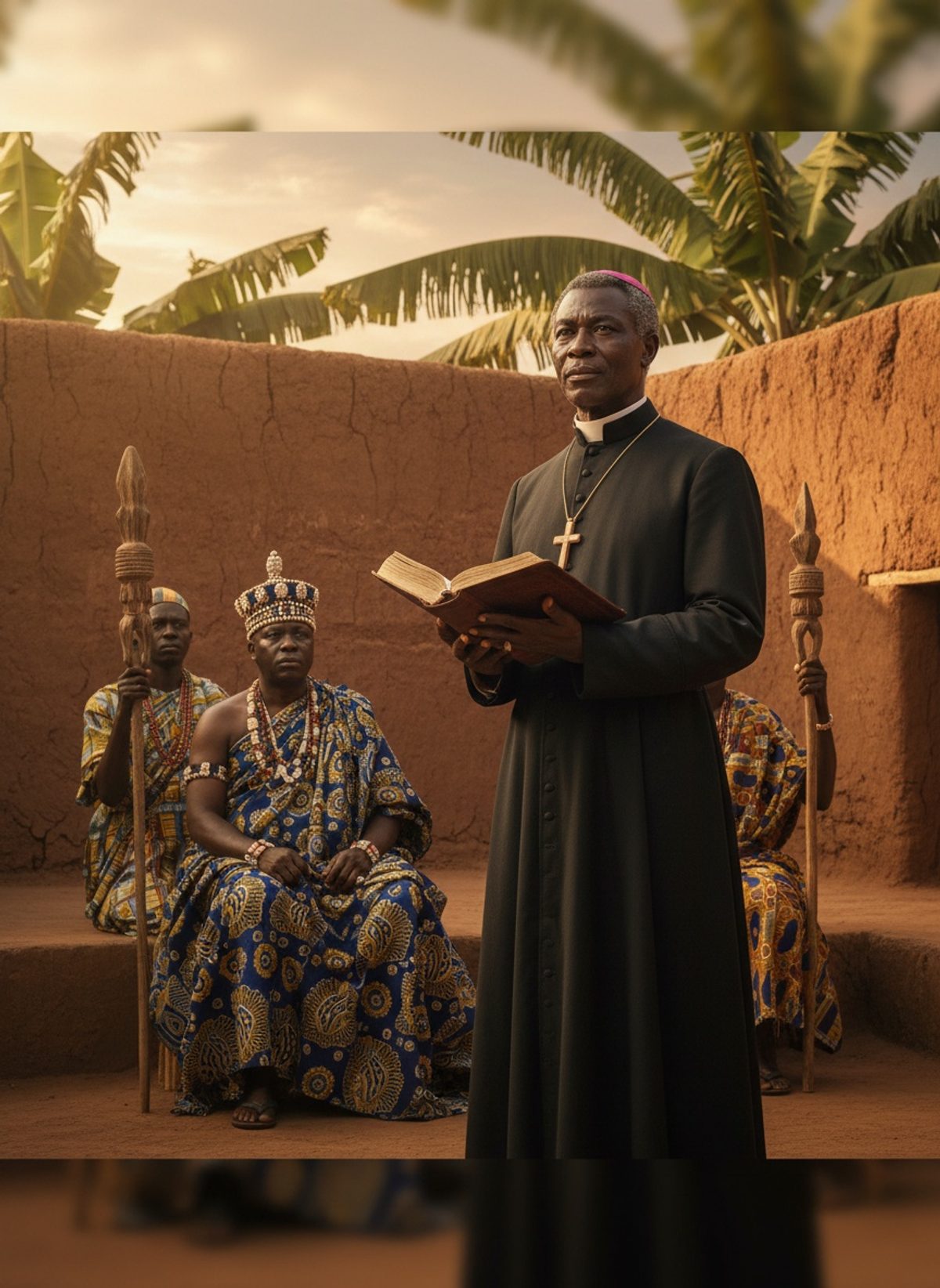
The room was thick with anticipation, the kind that seemed to hum in the air and prickle against the skin. The dim light flickered over faces that wore expressions of curiosity, skepticism, and tightly controlled reverence. Samuel Ajayi Crowther stood tall before the Oba of Abeokuta, his heart a steady drum in his chest. His robes, emblematic of his status as a bishop, fluttered gently, barely brushing the floor. As the Yoruba words rolled off his tongue — words that were once the music of his childhood and the whispers on the wind of his homeland — they carried with them a quiet but profound defiance.
From Chains to Freedom
Samuel Ajayi Crowther did not come to this grand hall as a stranger to hardship or to divine providence. His journey had begun in a manner that neither fate nor cruelty could have predicted. Torn from his home as a boy, his life in southwestern Nigeria was abruptly truncated by the brutal force of the Atlantic slave trade. Shackled and sold, Crowther knew intimately the taste of salt from tears mingling with the harsh ocean air, the clamor of captives who spoke in tones of despair. Yet, destiny would not abandon him to such a fate forever. Resilience was stitched into every fiber of his being.
In a twist of fate that reflected the tumultuous era of the early 19th century, British sailors intercepted the slave ship off the West African coast. Liberated from what many called a floating purgatory, Crowther found a new path under the strange skies of Sierra Leone, a colony emerging as a sanctuary for freed slaves. Here, his story took a transformative turn. Under the tutelage of the Christian Missionary Society, he learned the language of his captors — a second language that would become as mighty a sword as the original tongue of his childhood. It was here that faith took root, as solid as any baobab, growing into a mission that would take him into the very heart of an empire willing to both condemn and consecrate.
The Gospel Carried Home
Returning to Africa, Crowther wielded his newfound education not as a conqueror, but as a humble servant. When he became the first African consecrated as a bishop in the Church of England, it marked a poignant shift in the narrative of colonial and ecclesiastical history. The world at the time was one of empires in flux, borders being redrawn by hands unmindful of the cultures they cut through like scalpels. Yet Crowther moved through these rigid lines with a grace that seemed to render their rigidity obsolete.
Read next: When Yaa Asantewaa Raised the Golden Stool, 1900
On that fateful day in Abeokuta, standing before the Oba, Crowther embodied more than just a convergence of past and future — he represented a bridge. As he spoke, his voice meshed with the cadence of a people who listened with ears tuned for truth amidst the cacophony of foreign incursion. Here was a man who understood the code of the land, who spoke not the harsh dicta of colonial governance but the gentle reminders of shared humanity as rooted in the same soil. Across crowns and mitres, through the arches of dialogue, Crowther sought connection. This was not a sermon of dominion, but one of reunion.
A Resilient Legacy
The Oba of Abeokuta listened intently, his eyes catching the reflections of the assembled. Crowther's powerful sermon was more than just his story; it was the story of resilience, of the survival of culture and identity in the face of overwhelming odds. The stories of the enslaved are too often tales of erasure, but Crowther’s became one of rediscovery, as he translated the Bible into Yoruba, giving spiritual language back to the people. The reverberations of his words went beyond the walls of that throne room, echoing across a continent in the throes of colonial upheaval.
In choosing to immerse himself in both worlds — that of his Yoruba heritage and the Anglican Church — Crowther resisted the dichotomy so prevalent in Victorian-era Africa. His life's work defied the simplistic narrative of a continent carved up by foreign powers, instead weaving a tapestry of multitudes. This duality became his legacy, a quiet yet powerful rebuttal to those who saw only monoliths where there were many voices.
As history continues to unfold, Crowther's story serves as a steadfast reminder of the power of language and faith to transcend borders, both literal and metaphorical. At a time when the scramble for Africa threatened to silence voices like his, Crowther stood as a beacon of harmony, urging understanding over domination. That day, before the Oba and all gathered, was not just a moment for reflection but a clarion call for unity — a call that echoes still, waiting to be heard above the clamor of our own times.