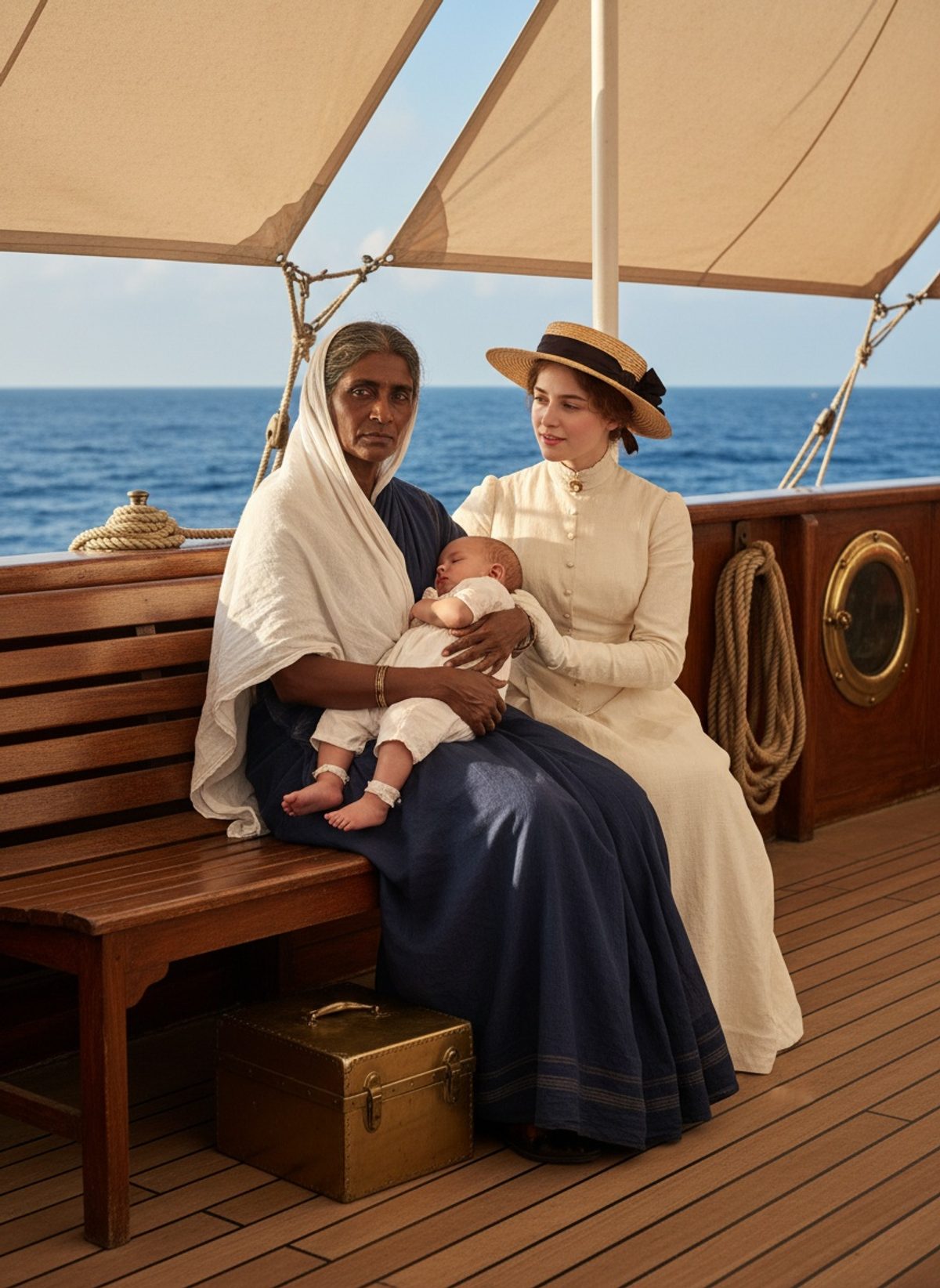
The deck pitched sideways under her feet, a familiar yet unnerving dance of wood and waves. The salty brine of the Arabian Sea clung to her skin, mingling with the sharp scent of coal smoke that billowed from the tall funnels of the P&O steamer. The ayah adjusted the child in her arms, a toddler with hair as downy as cotton, who stared up at her with the trusting eyes of one too young to understand the vast distance from home.
They had left the cold embrace of an English winter weeks ago, the ship carving a path from Southampton through the churning Channel, past the cliffs of Dover that faded into mist, and onward around the Cape of Good Hope. Each landmark was a step closer to the place she had left behind and would soon return to — Bombay, the bustling heart of British India. She stood on the threshold of worlds, bridging two empires with each journey she made across the kala pani, the sinister ‘black water’ that separated land from land and culture from culture.
By the time the steamer docked in Bombay's busy harbor, with its dense mist of monsoon-soaked air, she was ready. The ayah was more than the vessel she sailed on—she was a lifeline, a promise of safety and familiarity for the memsahib’s children, who would look to her when the strangeness of India threatened to overwhelm their senses. This journey had been no different, and her duty no less significant. Clad in a sari that fluttered like the sails above, she disembarked with the young ones, guiding them through the chaotic port with the quiet assurance of one who had done so many times before.
In Bombay's teeming streets, she slipped through crowds that surged like an unruly tide, her charges in tow. They passed merchants hawking spices whose pungent aromas clashed in the humid air, creating an olfactory symphony. The cacophony of carriages and foot traffic mingled with the distant clang of shipyards, an everyday sonnet of a city that never slept. She was a ghost in a vibrant tapestry, a shadow that few acknowledged yet depended upon without second thought.
Read next: When the Dak Runner Carried the Empire's Word, 1875
As the children found themselves once more in their parents’ arms, new faces mixing with familiar ones, the ayah stood quietly to the side. Her work here was done, and soon she would begin the journey back, alone but not empty—carrying with her the unspoken bonds that each voyage left embedded in her heart. For the children, she was both guide and comforter, a fleeting presence they would remember with warmth from their English homeland.
Each crossing was a test of endurance, fortitude, and hidden depths of patience. She navigated customs and storms, cared for feverish children, and mended torn frocks. Her expertise went unnoticed by many but recognized as indispensable by those whose children clung to her during turbulent nights. The empire relied on her silent consent to this regimen, capturing none of it in the registries or official documents. She was a trailblazer between two worlds that rarely acknowledged her passage but relied heavily upon her ability to traverse them.
Back on the steamer for her return journey, her feet felt the familiar rhythm of the vast ocean underneath. In the moments she had to herself, she would gaze across the endless expanse of water and measure her life in crossings, each voyage a chapter of stories untold. Though she had no formal recognition, each family she served had bestowed upon her a private legacy cemented in trust and gratitude.
In the shadow of the empire, ordinary women like her were forging connections that transcended the confines of race, class, and geography. Yet, as was the case with many women of the time, their stories often went unrecorded, save in the hearts of those they touched. The unspoken truth of the ayah's life was in the quiet dignity she maintained, the respect she commanded by action rather than decree.
When the ship docked again in England's fog-shrouded ports, she often found temporary lodging in boarding houses where no two ayahs shared the same tongue yet crafted a community through shared understanding. They would gather, exchanging stories of long voyages, the quirks of the children they cared for, and snippets of news from back home, comforting each other in their shared identity as wanderers between lands.
In modern times, as we sift through the pages of history, the tales of these ayahs demand a place of their own. They were the sinews connecting continents, their lives offering perspectives often missing in the grand narratives of empire. Their journeys remind us that history is not just the record of those who commanded ships or ruled territories, but also of those who crossed oceans in service and solidarity, quietly weaving the human fabric that bound the empire together.