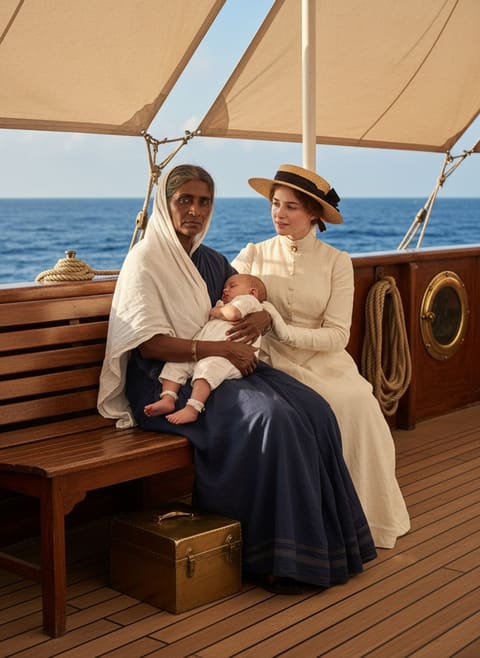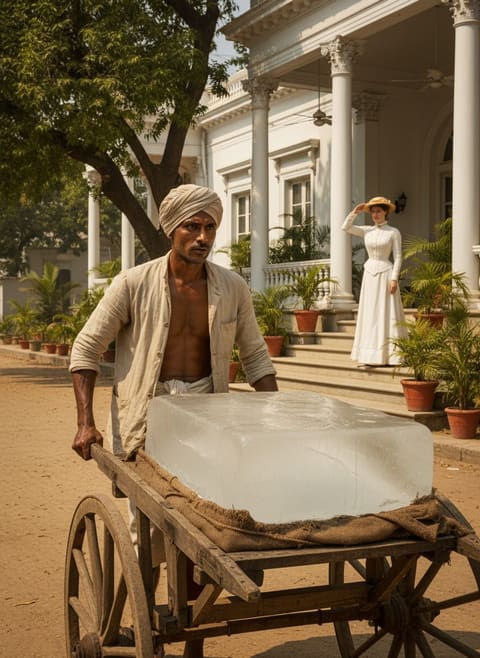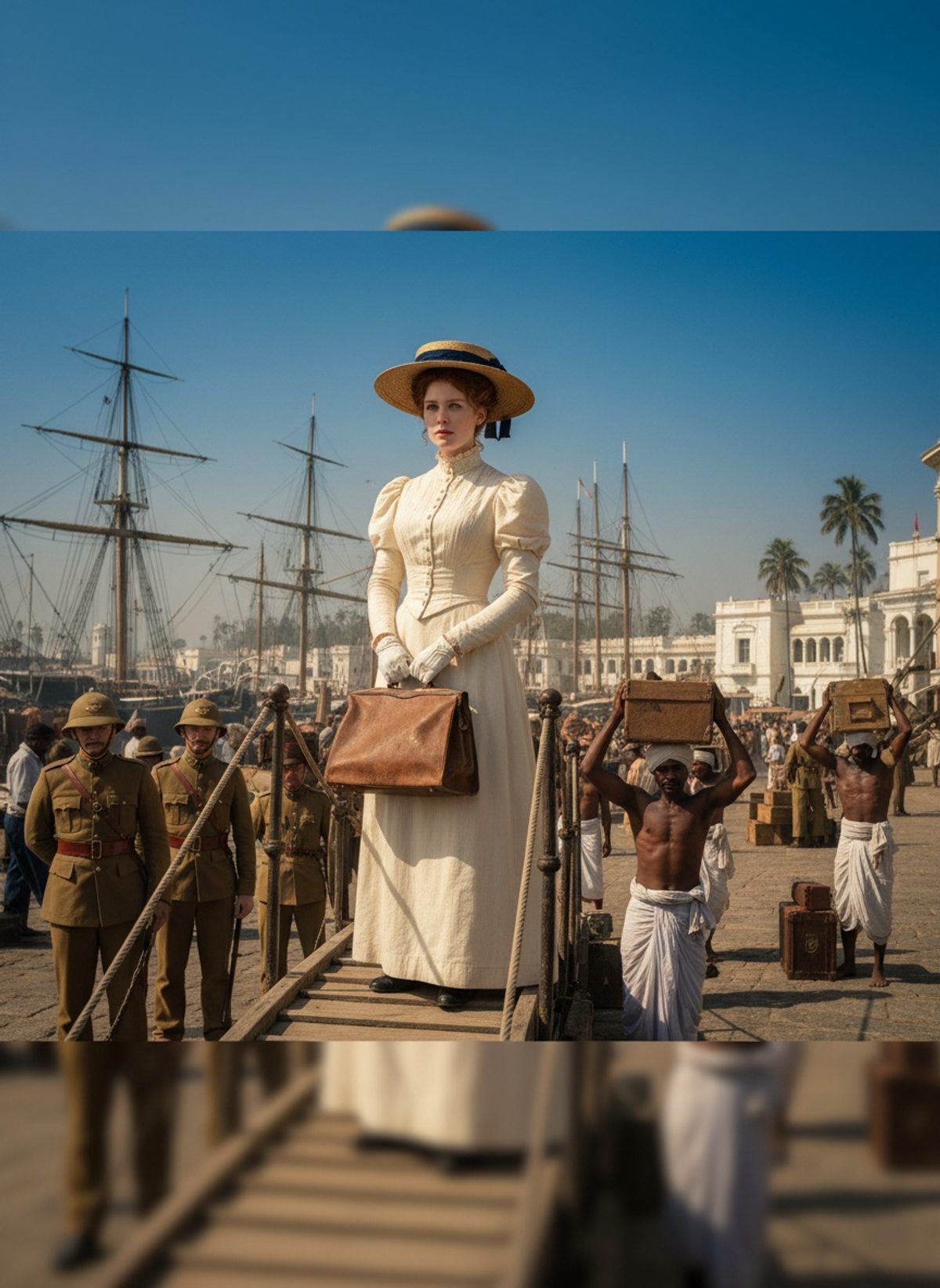
Her heart raced as the ship's horn bellowed against the hazy morning sky, its echo bouncing off the cloistered streets of Bombay like a herald of destiny. The waters of the harbour seemed to glisten with a promise as it rocked gently beneath their vessel, the SS Duckworth, a grand old ship with iron ribs and a soul forged by a thousand journeys. As she gripped the railing with one gloved hand, Flora Linwood — like many of the young women beside her — blinked at the sight of the city unfurling its exotic tapestry of sights and sounds before her. Her senses were assailed by the mingling aromas of spices and sea brine, the distant cacophony of voices as fisherwomen haggled and children cried, all merging into an overwhelming dissonance that marked her entry into this fabled land.
This was Bombay, the glittering gateway to a subcontinent bejeweled with both promise and peril. It was the winter of 1890, a year like those before it when the "Fishing Fleet" girls — as they were somewhat derisively known back home — arrived in search of prospects that England's rigid upper crust could not provide. Flora wore ambition like a coat of armor. She had been told tales of the necessary endurance and charm required to make this journey worthwhile, yet nothing could brace her entirely for the bricks of heat that struck her the moment she set foot on Indian soil.
Lining the dock, dressed in the white uniforms that denoted their rank above the mere mortals of the bustling street, were British officers fresh-faced from postings in distant parts of the Raj. They brandished binoculars with the eagerness of hunters and carried themselves with a posture of colonial assurance. Their presence was a comforting constant amid the maelstrom of what she saw as untamed wilderness. These men awaited them, each with the unspoken hope that among these new arrivals might be the woman who would match their fortunes and endure the Indian sun with a grace worthy of a memsahib.
Although Flora was prepared for the quotidian details of Indian life as explained by her sister's precious letters, nothing quite compared to the reality of the city itself. Bombay pulsed and breathed like a living entity. On the streets, chaos reigned supreme, demanding its rightful place alongside the disciplined order imposed by the Raj. Palatial edifices in the Gothic Revival style loomed over shanties and bazaars, where merchants hawked their wares in a Babel of tongues, and the air was thick with the scent of dried fish and incense, a perfume of the urban tropics incomprehensible back in Sussex.
Read next: When Mary Seacole Built a Hotel Behind the Front Line, 1855
In time, Flora and her companions were bundled into awaiting carriages, their wooden wheels clattering over cobblestoned paths towards the heart of the city's European quarter. Ahead lay a future animated by both color and shadows, a canvas too vast for anything but exploration through cautious brushstrokes. Here, social engagements were not merely domestic interruptions but opportunities conducted with the precision and regality of military maneuvers. Afternoon teas and evening dances at the Byculla Club were the stage upon which legacies could be shaped or shattered.
But this was India—a land not easily subdued by courteous intrigue alone. As the cool months gave way to the infernal cadence of monsoon rains, many of these young women, confronting climatic and cultural adversities, found themselves swept by troubling undercurrents. The divide between East and West, colonizer and colonized, was etched in every custom, each glance across a fabric of shared and strained coexistence.
For some, like Flora, whose adventures into the local bazaars soon turned into trips to secluded hill stations to escape the stifling summer heat, the allure of exploration wore thin against the often cruel realities of fever and fatigue. Others faced the pangs of unrequited affection or dashed hopes, judiciously overshadowed by triumphant matches and glittering wedding parades beneath the bougainvillea-draped vistas of English homes transplanted into Indian soil.
Yet, for every tale of disappointment, there were matches made that would survive beyond the pages of any diary. The partnerships born under the Bombay sun were often intensely pragmatic, somewhat cynically rooted in mutual need. Here, the women found their objectives undeniably influenced by a sense of adventure commingling with an honest desire to carve out a version of happiness in a world so detached from Britain's provincial life.
Read next: When the Dhobi Wallahs Kept the Empire's Armies Clean
Yet beyond the personal, they discovered a place where events undreamt of in the structured confines of late-Victorian society could unfold. That India was not simply a stage for European drama but a dominant narrative all its own became clearer with each fleeting encounter, whether through vibrant festivals or moments of silent retrospection on the verandas of their new homes. These women bore witness to the inequities and intricacies of a system expanding its rule over a diverse populace, finding themselves growing more aware of the costs hidden beneath the veneer of imperial certainty.
For many of the Fishing Fleet girls, their stories did not end at that dock or even on this patch of foreign soil. Some would travel further still, back to England or to other outposts of the Empire with stories spun between the spaces of triumph and tragedy. They brought back with them memories distilled through days of brilliant sunshine and humid nights, along with a new understanding of a broader world, both less romantic yet far richer than their visions at the outset.
A century later, as the sun continues to rise over the Gateway of Bombay — now Mumbai — their legacy carries a subtle yet enduring resonance. It whispers of courage and illusion, of the cultural kaleidoscope ignored by textbooks that focuses instead on politics and conquest. In their journey, the Fishing Fleet girls encapsulated a moment in time where aspiration crossed with adventure, a narrative of exploration both internal and external, both real and metaphoric, forever intertwined. And though their expedition into the heart of an empire may seem distant, the ripples of their stories stretch far into contemporary dialogues about identity and belonging, marking them as an intrinsic part of our shared history.