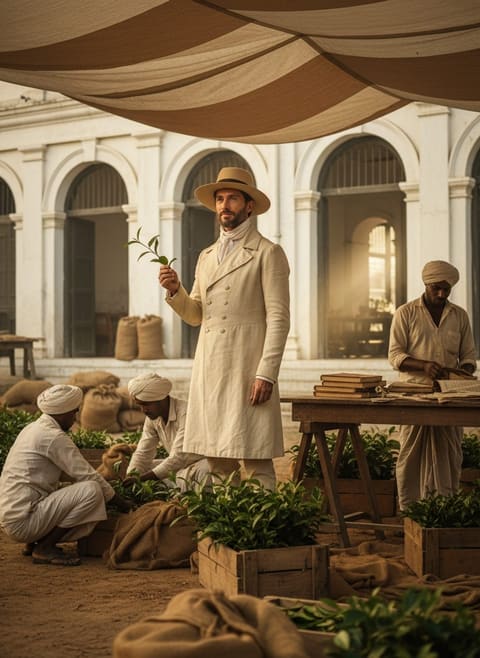
The man who changed the tea industry forever had never owned a tea plantation before. In fact, he had built his fortune on bacon.
Thomas Lipton was a Glaswegian grocer with a gift for seeing opportunity where others saw the bare edge of a ledge. By 1890, he had turned a humble grocery store into a chain with branches spanning Great Britain. Yet, even with this commercial success, his fascination with tea lay smouldering, waiting to burst into a business venture that would forever alter the fabric of British tea culture. His journey to Ceylon—modern-day Sri Lanka—was not merely a voyage across the seas but a radical transition into an industry fraught with tradition and middlemen.
Upon arriving in Ceylon, Lipton was confronted not by the lush, thriving tea estates of legend but by struggling plantations, remnants of a coffee industry devastated by blight. The locals and former coffee estate owners had ventured into tea cultivation as a desperate but often failing pivot. In this landscape of insolvency and decay, he saw the skeleton of a new empire. With the shrewdness of a seasoned businessman, he acquired an initial estate at a relatively low cost, guided less by the wreckage of what had been and more by the vision of what could be.
As if to the beat of his own drum, Lipton began acquiring additional estates, eventually owning twenty. But his true revolution was not in the fields; it was in his reconfiguration of the entire supply chain. Until then, the tea trade was heavily tiered, middlemen lurking in every shadowed nook. Brokers, auctioneers, and merchants controlled the flow and pricing of tea. Lipton cut this Gordian knot with a single stroke of genius: the transition from estate to kitchen without intermediary interference. He became not just a tea grower but a direct seller, and this made his venture both revolutionary and distinctly modern.
Read next: When Robert Fortune Shaved His Head and Stole China's Secret, 1848
Lipton's next stroke of brilliance lay in marketing—a masterstroke that brought his face into the homes of millions. He chose not just to market tea but to create an experience around it. His travels from the plantations to London were filled with spectacle and showmanship. The tea tins that reached Britain bore the now-familiar face of Thomas Lipton himself, a smiling emblem of quality and affordability. The personal touch of branding, combined with quality assurance, made "Lipton’s Tea" a household name, accessible even to the working classes, who had previously known only the bottom tier of tea varieties.
Yet, Lipton did not merely sell tea; he democratized it. At a time when tea was associated with genteel society—an afternoon affair within the parlors of the well-to-do—Lipton’s vision extended its appeal. The cost of a refreshing cup was no longer a symbol of class but a moment of daily luxury everyone could afford. By bringing the cost of production down and simplifying distribution, Lipton ensured that his tea could be sold at a price that married both quality and value, dismissing the notion that only the elite could enjoy good tea.
It wasn't just British homes that Lipton targeted with his innovative strategies. At the 1893 Chicago World Fair, Lipton's displays were an unqualified triumph, capturing American hearts and stomachs. His pavilion, with its tea plants imported straight from Ceylon, afforded visitors a tantalizing taste of the exotic, and before long, a new market opened across the Atlantic, rich with promise and demand.
Read next: When Josiah Wedgwood Undersold Every China Merchant in Europe
Back in Ceylon, the local economy benefited remarkably from Lipton’s ambition. His estates not only exported a burgeoning amount of tea but also prompted a rebirth of the island's plantation economy. Lipton introduced new agricultural practices and stable employment, altering the social fabric of the region in behind-the-scenes ways often overlooked in the glory of economic success. Villages grew around tea estates, schools and infrastructure improved, and Ceylonese tea began its ascent to global renown.
But what Lipton accomplished was about more than oneself’s ascent to wealth; it was an upheaval in a Victorian staple that presented a whole new outlook on commerce and social balance. Lipton’s model showed how significantly a single man’s vision could influence not only the industry but the society itself. His ability to enmesh the marketing of a simple product with a grand narrative foreshadowed the global marketing campaigns of the modern age. His legacy lives on, not simply in a cup of tea but in every venture that sees direct trade bring goods from farm to table.
The story of Thomas Lipton makes one ponder the real nature of success and change. He walked into Ceylon with nothing but his business acumen and determination, yet he left a transformation in the world of tea—a transformation that crafted a chain of influence felt far beyond his years. The face on those tins began as a practical choice; it ended as an emblem of the democracy of pleasure and commerce’s boundless potential. In each sip of tea, Lipton’s audacity rings clear, reminding us how the quiet revolutions often start with the unlikeliest of grocers.