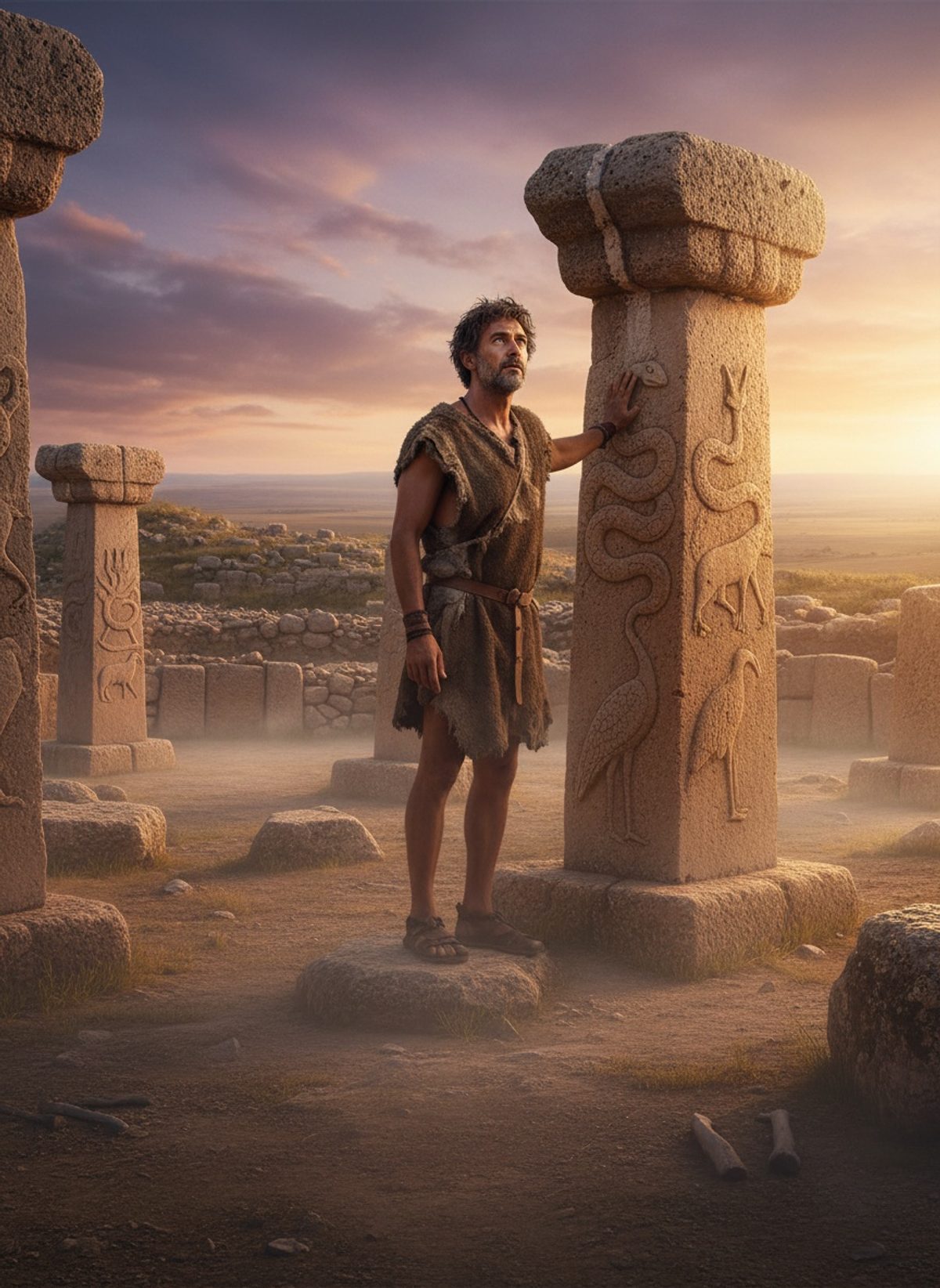
9500 BCE. The stone pillars stood silent on a rocky hilltop, their surfaces carved with the ancient emblems of wild beasts. In the muted dawn, as mist skimmed the ground, the shape of something monumental began to emerge.
A Monument Born of Stone and Necessity
The site of Göbekli Tepe in modern-day southern Turkey is a breathtaking archaeological enigma that has reshaped our understanding of prehistoric human life. Nestled in the foothills of the Taurus Mountains, the site comprises a landscape dominated by massive stone pillars, some reaching heights of up to 6 meters and weighing as much as 20 tonnes. This monument, crafted some 12,000 years ago, predates even the most ancient stone circles of Stonehenge by millennia. Yet, these towering edifices were not the handiwork of settled farmers or architects; they were the creation of nomadic hunter-gatherers who traversed the steppes of a world still in the grips of its last Ice Age.
Their decision to construct such a complex structure on a hilltop devoid of agricultural cultivation challenges conventional narratives of human history. Why would migratory bands, whose lives revolved around tracking game and gathering wild grains, invest so much effort into erecting monumental architecture? The answer lies buried in Göbekli Tepe’s layers of stone and earth, offering glimpses into the spiritual and social forces that stirred among early humans.
Carvings of Gods or Guardians?
One of the most compelling aspects of Göbekli Tepe is the artistry found on its stone pillars. These T-shaped megaliths are adorned with intricate reliefs depicting an array of animals: foxes, snakes, wild boars, and birds, each rendered with striking precision. The imagery is not merely decorative; it likely held profound symbolic significance. Some researchers propose that these carvings represent a pantheon of spirits or deities who watched over the ancient rituals conducted at the site.
Read next: Timgad: Rome Built a Perfect City in the Sahara — Then Vanished
Consider the pillar carvings of predatory beasts — lions, scorpions, and intimidating raptors. To the hunter-gatherers, these animals represented forces of nature to be revered and respected. Their presence could have signified both the threats and bounties of the world outside the sanctuary of Göbekli Tepe. Moreover, the anthropomorphic details etched into the stone raise intriguing questions. Could these carvings embody deified ancestors or legendary figures central to the mythology of these early communities? Such interpretations have fueled comparisons to the totemic poles of indigenous cultures, where animals are emblems of clan identity and cosmic order.
The Ceremonial Hill: A Testament to Collaboration
Crafting Göbekli Tepe was no solitary endeavor. The very act of building this monument required unprecedented collaboration and coordination. With stone tools as their only resource, workers quarried and transported these colossal stones from the nearby limestone plateau, a feat that must have necessitated extensive planning and social organization.
In the absence of agricultural surpluses, sustaining such a large workforce poses an intriguing puzzle. How were the laborers fed? Recent findings suggest a nascent form of cereal processing might have been in place — gathering wild einkorn, wheat, and barley from surrounding grasslands. However, without solid evidence of full-scale farming, scholars speculate that feasting events played a significant role. Such gatherings could have reinforced social bonds, redistributed resources, and cemented alliances among different groups, crucial elements for the successful execution of Göbekli Tepe’s construction.
Adding another layer to its mystery, the site's eventual burial goes against typical human patterns of habitation or abandonment. Over centuries, Göbekli Tepe was methodically covered with layers of earth and used debris, perhaps signifying a ceremonial closure or transformation of its spiritual role. Why the builders undertook this monumental act remains open to interpretation — was it a ritualistic farewell, or did emerging societal changes render the site obsolete?
Read next: Caral-Supe: The Oldest City in the Americas Predates Egypt's Pyramids
The Wider Lens: Context and Rediscovery
Beyond Göbekli Tepe itself, the site offers a window into broader Neolithic transitions across southwest Asia. Positioned near the headwaters of the Balikh River, a tributary of the mighty Euphrates, Göbekli Tepe strategically sits in a region that would later cradle the urban civilizations of Mesopotamia. Could the social dynamics that birthed this temple-like structure have spurred developments that eventually led to the rise of agriculture and permanent settlements?
Our journey to comprehend Göbekli Tepe took a significant leap forward in 1963 during an archaeological survey by Istanbul University and the University of Chicago. However, it wasn't until German archaeologist Klaus Schmidt recognized the site's potential in 1994, that full-scale excavations began. These efforts unveiled a treasure trove of Neolithic enigmas, with only about 10% of the area explored to date. Today, under the stewardship of Turkish scholars and international teams, Göbekli Tepe continues to yield secrets buried in time’s long shadows.
Göbekli Tepe stands as a reminder of the complexity and creativity of our prehistoric forebears. It prompts us to reconsider the forces that drive human communities to create, to worship, and eventually to change. As we piece together the stories of this ancient hilltop, Göbekli Tepe challenges us to reflect on what defines civilization. The monument’s legacy is as much about inquiry as it is about answers. Through the lens of this Neolithic wonder, we glimpse the roots of ritual and the dawn of collective human spirit, guiding us yet again to ponder the depths of our shared history.