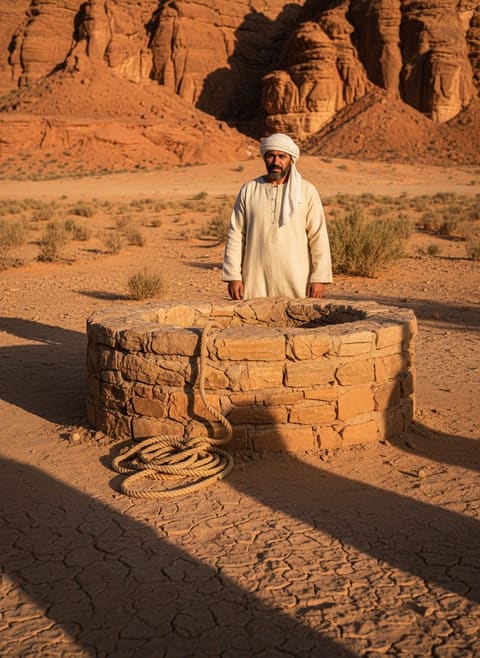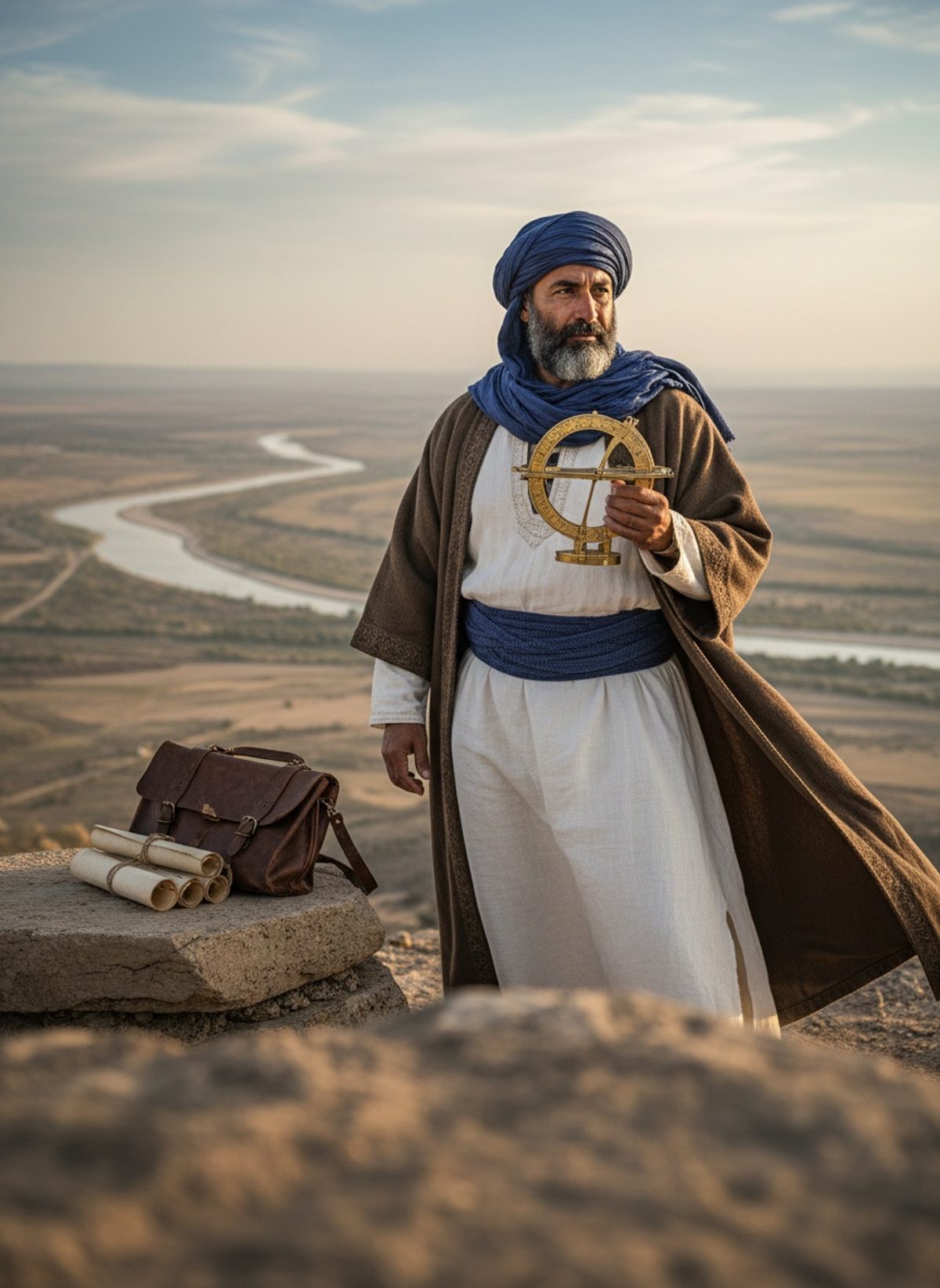
He stood at the edge of human understanding. Abu Rayhan al-Biruni, a scholar from the Islamic Golden Age, gazed from a hilltop, setting out to solve a problem as grand as the planet itself.
From the Outskirts of Khwarazm to the Heights of Knowledge
Abu Rayhan al-Biruni was born around 973 in Kath, Khwarazm, a place now located in Uzbekistan. The young al-Biruni, named after the Persian word bērūn meaning "outskirts," did not remain on society's periphery for long. By the time he was twenty-five, he had already amassed significant knowledge in fields as diverse as physics, astronomy, mathematics, and philosophy. Al-Biruni's keen intellect and insatiable curiosity pushed him beyond the confines of his homeland, embroiling him in the vibrant intellectual exchanges of Bukhara and the courts of various rulers, such as Qabus of Tabaristan. By 1017, he found himself in Ghazni, serving as a court astrologer under Mahmud of Ghazni. It was during Mahmud’s campaigns in the Indian subcontinent that al-Biruni's path took a pivotal turn, allowing him to immerse himself in Indian culture and sciences—a quest that would lead him to his revolutionary measurement of Earth's radius.
The Persian Polymath Ascends a Hill
In the year 1020, in what is now Pakistan, al-Biruni ascended a solitary hill armed with neither tools nor companions, but with an unyielding quest for truth. Standing high on this vantage point, he was set to measure the Earth unlike anyone before him. Earlier scholars had traversed landscapes to attempt this Herculean task, yet here al-Biruni was, a philosopher standing still, peering into the cosmos. He took a simple angle measurement of the horizon he observed and noted the hill's height, a seemingly mundane act that would change our understanding of the world.
It is said that al-Biruni relied heavily on his mathematical prowess during this undertaking. His understanding of trigonometry, inspired by Greek and Indian mathematics, enabled him to envision a formulaic path across the surface of our globe. By applying geometric principles, he deduced that the Earth's radius could be calculated through the combination of the hill's height and the angle of depression. This calculation heralded a period of scientific exploration that would echo across centuries.
Read next: Xu Xiake Walked Into the Wild. China Wrote Him Off.
Numbers from the Past: A Calculation Surprising the Future
The brilliance of al-Biruni's methodology rested in its simplicity and profound accuracy. Without ever traveling the world or relying on arduous surveying tasks, he accomplished what others deemed impossible. Al-Biruni concluded that the Earth's radius was 6,339.6 kilometers—a figure remarkable, given that modern science places the radius at approximately 6,371 kilometers. This minor deviation of less than 1 percent boggles the mind, attesting to the capabilities of a millennium-old calculation. The singular vision of this scholar, reduced to numbers on a parchment, spoke of an Earth much wider and grander than most could fathom in his era.
Beyond Borders: Cultural Exchange and Intellectual Prowess
Al-Biruni was much more than just a mathematician; he was the world's first anthropologist and an ardent cultural scholar. His time in the Indian subcontinent brought him into contact with the region's rich intellectual traditions. Fluent in Khwarezmian, Persian, Arabic, Sanskrit, and several other languages, al-Biruni represented a bridge between worlds—a polymath whose works like Tārīkh al-Hind explored the cultural tapestries of India with remarkable impartiality.
Read next: Xu Youren Held the Edict. He Fed the Dying Instead.
His studies went beyond chronicling customs. They immersed him in the mathematics and astronomy that the Indian scholars had long developed. With careful consideration and meticulous documentation, al-Biruni harnessed these foreign insights, weaving them intricately into his own scientific endeavors back in the Islamic world. Through him, knowledge trudged no borders, manifesting instead as a shared treasure among humankind.
The Scholar’s Legacy in the Shadow of a Hill
As we gaze upon al-Biruni's story, we're reminded of humanity's relentless pursuit of understanding. This tale of a solitary scholar achieving groundbreaking results with little more than a panoramic view inspires awe, revealing an era where science, exploration, and learning paved paths toward modernity. In the shadow of that ancient hill on which al-Biruni once stood, we find a symbol of humanity's ability to unearth cosmic truths with nothing more than the mind’s eye.
His calculations resonate today, prompting us to consider how one man's willingness to peer beyond the horizon altered our collective grasp of the planet. Al-Biruni reminds us that the quest for knowledge need not transpire across grand journeys but can unfold from a single, well-chosen vantage point. In a world continually seeking to chart new territories, this Persian polymath shows us the monumental power of an inquisitive mind, able to reach the stars while firmly planted on Earth.