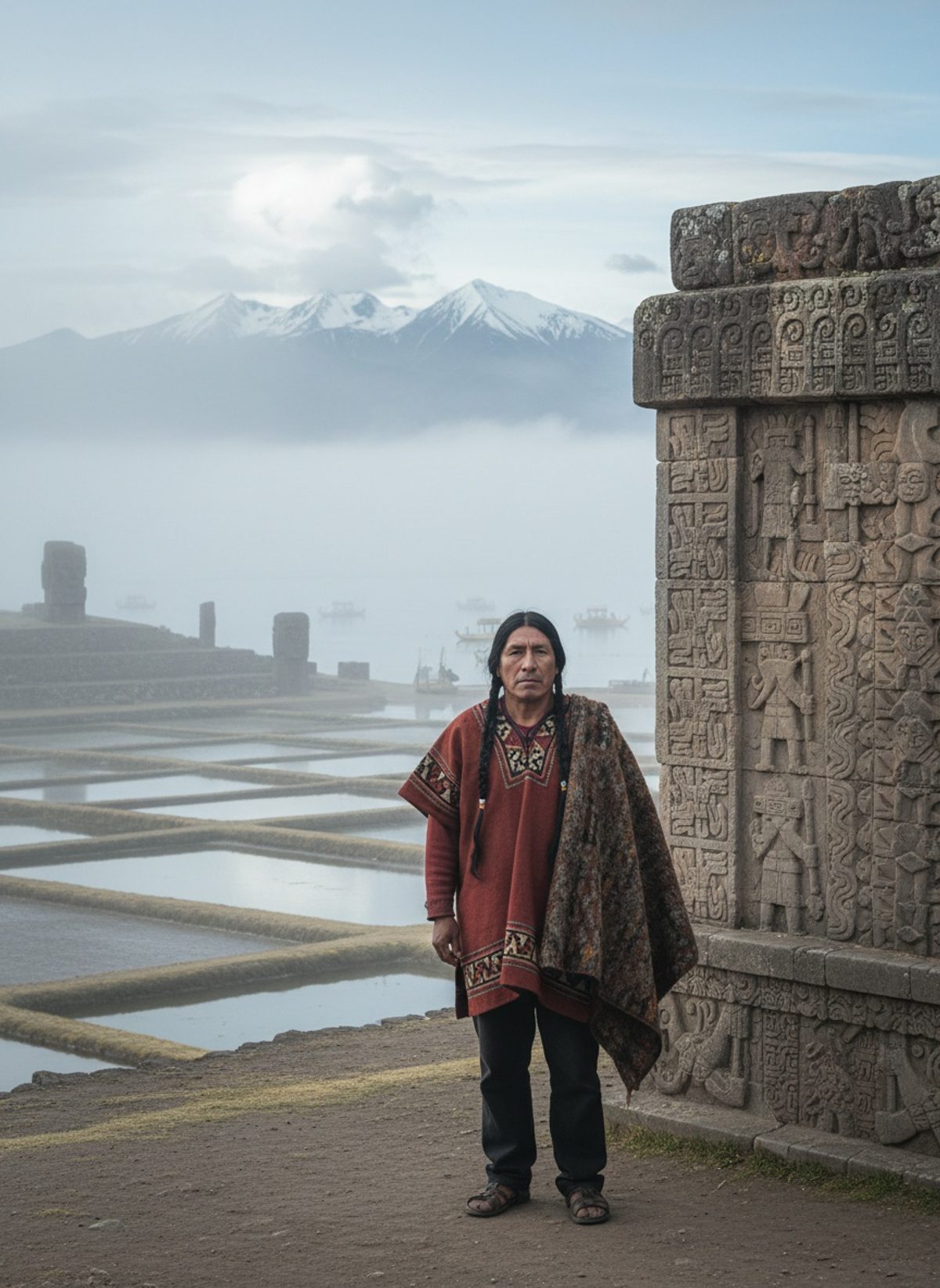
At an altitude of nearly 13,000 feet, where most assume only the hardy survive, Tiwanaku was more than just surviving. It was a thriving urban center. With no rivers or abundant rainfall, this pre-Columbian civilization achieved a feat of agricultural genius high in the Bolivian Andes.
Ingenious Agriculture Amidst Impossibility
Tiwanaku, known in the Aymara language as taypiqala or "stone in the center", was a marvel of human ingenuity. Nestled near Lake Titicaca, in an environment where frost snags the land every month, the engineers of Tiwanaku devised methods to cultivate crops against the odds. The site, now a sprawling archaeological wonder covering some 4 square kilometers, was once a bustling city home to anywhere between 10,000 to 20,000 people.
These highland agronomists unlocked the potential of the earth with astonishing innovation. They developed a system of raised fields, known as suka kollus, which turned the edge of an inhospitable lake into a fertile mantle. By creating elevated platforms with channels surrounding them, they trapped solar heat during the day. This trapped heat then mitigated the nightly frost, protecting the crops. The channels also provided irrigation and prevented flooding, thus ensuring that the crops could flourish even with minimal rainfall.
Such was the sophistication of their agricultural system that it was capable of sustaining a population of a million beyond the city itself. The Tiwanaku civilization had devised an ecosystem that could cater to their burgeoning empire’s needs, adding another layer to their impressive array of skills — logistics and resource management on a grand scale.
Read next: Timgad: Rome Built a Perfect City in the Sahara — Then Vanished
Empires and Exchanges: A Network Shared with the Wari
During the city's peak between AD 500 and 600, Tiwanaku expanded its influence throughout the Titicaca basin, an era corresponding with the rise of its contemporary, the Wari Empire. These two powerful cultures, although distinctive, likely shared a symbiotic relationship. Known as the "Southern Andean Iconographic Series", shared art motifs indicate a cultural exchange or perhaps a trade-based or military alliance.
The link between Tiwanaku and the Wari provides a broader view of the region's sociopolitical landscape. This relationship could have been foundational to the expansive reach of both empires. Notably, the Wari stumbled upon similar infrastructural elements in architecture and urban design, elements possibly inspired directly by the innovations seen in Tiwanaku.
Moreover, the Inca civilization, which rose later in the Andes, also borrowed from their cultural predecessors. Striking parallels can be found in the architectural styles, primarily characterized by meticulously laid stonework. Tiwanaku's influence extended far beyond its high-altitude borders, suggesting its pivotal role in the Andean cultural continuum.
Monumental Achievements and Mysterious Artifacts
Today, the remaining stone monuments of Tiwanaku stand as silent witnesses to this once-great civilization. The site is replete with megalithic structures, complex sculptures, and intricate ceramics, each echoing stories of a bygone era. Notable amongst these is the Ponce Monolith — a towering statue that hints at the craftsmanship and religious practices that defined the city.
An air of mystery shrouds these archaeological treasures. The ancient inhabitants of Tiwanaku left no written records, a puzzling gap in our understanding of their culture. Scholars have yet to decipher the full meaning of their iconography, though it hints heavily at religious and cosmological beliefs deeply intertwined with daily life.
Read next: Caral-Supe: The Oldest City in the Americas Predates Egypt's Pyramids
The enduring enigma of the Puquina language — believed to be spoken in Tiwanaku — remains another captivating aspect of their culture. This language, like so many others shrouded by the mists of time, has left barely a trace but for its quiet echoes in place names and locally-held traditions.
The Vanishing of a Civilization
By AD 1000, Tiwanaku’s resilient empire began to falter. Geological studies suggest a drastic increase in aridity, a climate shift deadly enough to unravel their sophisticated agricultural systems. As the rains ceased and water sources dwindled, the foundation of this society began to crack. The people of Tiwanaku, once masters of their rugged altitude, began to disperse.
The reasons for Tiwanaku’s decline are topics of ongoing debate among historians. While the changing climate undeniably played a significant role, it is plausible that political strife or external pressures exacerbated the city’s fall. In swift succession, a city that had defied natural obstacles to thrive for centuries diminished and then vanished.
Tiwanaku's story is one of human innovation and resilience in the face of an unforgiving environment. Their architectural and agricultural ingenuity serves as a testament to human adaptability and resourcefulness. As we continue to uncover their legacy, Tiwanaku challenges us to reflect on the delicate balance between nature’s rhythms and societal progress—a balance that remains critical in our world today. Though their civilization vanished, their monumental achievements persist, inviting us to learn, marvel, and caution from the past.