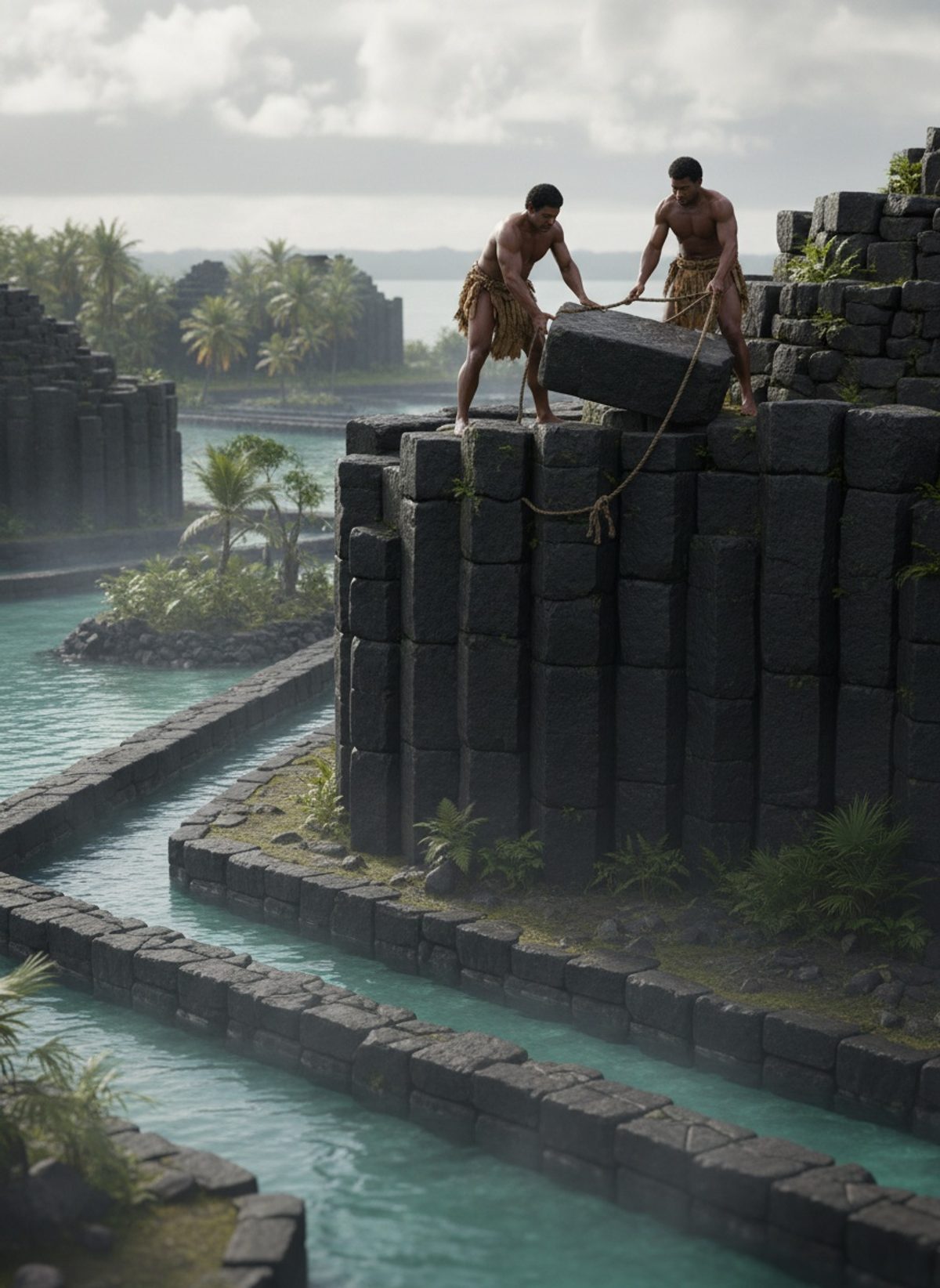
Nan Madol sits in isolation, almost invisible across the vast Pacific expanse. Yet, this mesmerizing city on Pohnpei island is one of history's grandest yet least understood achievements.
The Story Bound in Stone
Off the eastern shore of Pohnpei, now part of the Federated States of Micronesia, lies a marvel not easily categorized or explained. The skeletal remains of a once-great city, Nan Madol was carved from the sea by a civilization without the wheel, without metal, and without the beasts of burden many associate with grand construction feats. These are the ruins of the Saudeleur Dynasty, rulers from approximately 1100 to 1628 AD. The known history of Nan Madol begins in whispers and legends as early as the first or second century AD, but it wasn’t until the 8th or 9th century that the construction of this coral city began in earnest. This tangled web of canals, whose name fittingly means "within the intervals," rose to prominence under the deft hands of its builders, the Pohnpeians.
By the end of the 12th century, a megalithic city spanned a sprawling 1.5 by 0.5 kilometers. Here, on 92 artificial islets woven together by a network of cobblestone pathways and waterways, the heart of the Saudeleur Dynasty pulsed. A coral city known as the "Venice of the Pacific" emerged meticulously from volcanic rock, its stones stacked into palaces, temples, and sacred tombs. Each basalt pillar held together not by mortar but by an unyielding ingenuity that defies the logical confinements of its era.
Myths of Mysticism and Magic
Legends, passed from one generation of Pohnpeians to the next, dance at the edges of Nan Madol's history. They speak not of ordinary builders, but of twin sorcerers, Olisihpa and Olosohpa, hailing from a mythical land called Katau. It was these brothers who, after several failed attempts, established the altar to Nahnisohn Sahpw, the god of agriculture, on an unpretentious reef. Tradition did not stop at human endeavor; it leaped into the supernatural when claiming these stones were not moved by mortal hand, but rather levitated across the sea by a dragon gifted in flight.
Read next: Caral-Supe: The Oldest City in the Americas Predates Egypt's Pyramids
Olosohpa, surviving his brother Olisihpa, became the inaugural Saudeleur. He married into the people of Pohnpei and birthed a dynasty that stretched across centuries and 12 generations until Isokelekel arrived. This enigmatic figure upended the reigning order, yet Nan Madol continued to stand, a silent observer to the ebbs and flows of power.
The Pulse of Power
Nestled within Nan Madol were the Saudeleur palaces where political machinations intertwined with religious solemnity. The elite center was the beating heart of this oceanic empire—a peculiar convergence where nobility welcomed both the living and the deceased. Priests presided over mortuary rituals in Madol Powe, the city’s northeastern sector that housed 58 islets dedicated to the interred.
Living in Nan Madol was not a privilege extended to all. A strategic enclave for the nobility, the site accommodated chiefs and high-ranking leaders, numbered perhaps under 1,000, though estimates suggest the population might have been closer to half that. It was here in the city’s embrace that leaders were gathered, observed, and controlled, yearning eyes attentive to whispering plots far removed from the home districts they once commanded.
A Silent Testament
European encounters, like those of the Polish ethnographer John Stanislaw Kubary in 1874, brought renewed curiosity to this magnificent place. Marveling at the structures that seemed to greet the ocean waves effortlessly, outsiders recorded their impressions. However, the chronicle of Nan Madol remained incomplete, fragments of a text written in stone without the accompanying script. Radiocarbon dating techniques have revealed Nan Madol's influence, countering claims of other ancient sites, such as Leluh on Kosrae, as its predecessors.
Read next: Shen Chong Was Condemned. One Official Refused to Sign.
Yet, beyond hard numbers and measurements, Nan Madol remains enshrined in its mystique. Was it a city built to intimidate, a guardianship of silence against intrusive forces? Or was it an sacred center, where the seeds of Pohnpei’s continuity were cultivated and maintained? With every possibility dangling just out of reach, this place evokes a stony gaze back through time, defying conclusiveness while inviting exploration.
Whispers of Humanity
The echoes of Nan Madol are not just relics of a bygone age; they are vital seams threading the story of human ingenuity. This coral city invites reflection on the nature of civilization, the whispers of ancestral prowess against the roaring waves of oblivion. Whether born of mythical magicians or seasoned generations of skilled builders, Nan Madol presses the perennial question of what it means to create beyond one's reach, leaving a mark so deeply etched in the tapestry of time.
Its stones may not tell all, yet they prompt us to ponder the enormity of human potential when faced with limitations, inviting continuous discovery. Nan Madol stands—not just as a mark of what once was—but as an enduring enigma, challenging the boundaries of history, inviting each visitor to listen closely to the Pacific winds that dance through its silent corridors.