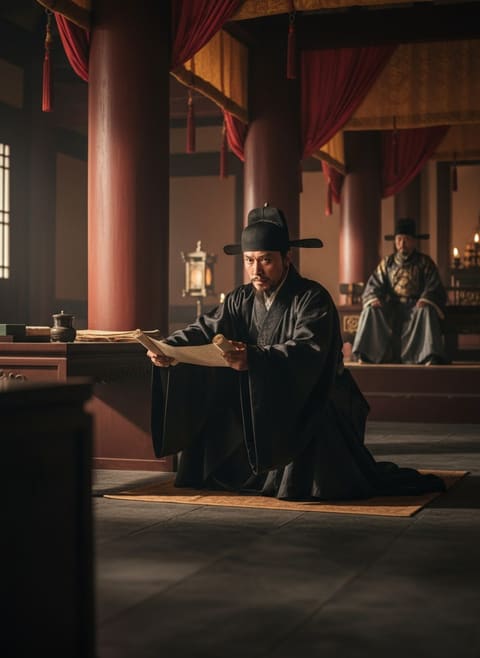
Pei Du’s steps echoed loudly in the grand hallway as he made his way back towards the imperial court, his mind set like steel. The heavy air of the Tang Dynasty’s seat of power hummed with tension, a hundred unspoken thoughts filling the gaps between the whispers of silken robes and the flutter of inked papers. He gripped the petition tighter, the one he refused to sign, and prepared himself to do what no other would dare.
The Valleys of Deception
It was the year 830 AD, a time when the Tang Dynasty was both a beacon of cultural enlightenment and a cauldron of political machination. At its heart was the emperor, the Son of Heaven, surrounded by an elaborate tapestry of ministers and advisors whose power hung precariously on a thread of favor. In such a precarious world, the life of a scholar named Shen Chong became a pivotal point of contention, a test of the very values upon which the empire rested.
The accusations against Shen Chong were grave, with charges of treason and conspiracy lurking like serpents in the recesses of courtly gossip. What had initially been a mere rumor had unfurled into a full-fledged indictment. Ministers, seeking to cement their own positions by parading their loyalty, rallied for his condemnation. In a system where dissent could mean death, each minister bent their knee and dedicated their brush stroke, sealing Shen Chong's fate with calligraphic finality. Observers noted with unease how quickly the men of learning had bent beneath the weight of untruths, deliberately blind to the gaping holes in the accusations.
Every official fell in step—every official but one. Pei Du, a veteran of political storms, a man who had survived and thrived while others faltered, hesitated as his colleagues walked away. Perhaps he lingered longer than necessary, or perhaps the ghosts of the past haunted him then, debts unpaid to lives unjustly extinguished. He did not sign. When he turned away from the throng of nodding agreement, he knew crossing back through that hall might cost him everything; a drop of ink could signify a life exchanged, and Pei Du chose to sign his defiance in silence for now.
Read next: Sima Guang Defied the Emperor. He Did It in Writing.
Voices of Courage
Pei Du's return to the emperor's court was a gamble known only to men of conviction, and it came with a tangible, rippling undercurrent—a wave of whispers and sidelong glances that peeled the chamber’s veneer of unquestioned dominance. Weaving through the whispers was Pei's reputation; he had served the emperors well, in times of famine and foreign threat, when wise counsel was worth its weight in gold. His defiance was not the play of an impulsive newcomer; it was the calculated act of a master statesman.
Taking a stand before the Emperor in the Tang court required more than resolve; it required the kind of prestige Pei Du carried—a shield forged through years of strategic dexterity and unyielding service. He stood as an ally to truth, armed with a determination as unyielding as iron, softly reiterating the innocence of Shen Chong, the fractures in the evidence, and the fabrications designed to maintain gilded harmony at the cost of a man’s soul.
The chamber held its breath. For a moment, the entire amalgam of politics and tradition seemed to waver, as if the structure cemented by lies had begun to crack under the defiant voice of dissent. It was a stir that had not erupted into a riotous upheaval but instead fell into profound silence—one that demanded attention. Here was Pei Du, unbroken, uncloaked—a single voice cutting through layers of crafted deceit with the scalpel of reason.
Read next: Xu Xiake Walked Into the Wild. China Wrote Him Off.
Echoes Across Time
History has a tendency to exalt the victors and silence the whispers of valor. Yet within the halls of ancient China, Pei Du stands eternal. His act was not one destined for immediate glory or heroic song; the real triumph lay in the ripples of change—small and steady—that altered the course of justice ever so slightly toward that of righteousness. Shen Chong’s life was spared, perhaps not immediately, but enough wheels had shifted to tip the scales, and in doing so, undercurrents of reform began to spread.
In reflection, the story of Shen Chong and Pei Du is more than historical curiosity; it is an enduring lesson in courage and integrity. It resonates in cycles through time, reminding us that power, though vast and often impenetrable, is never truly silent against the piercing blade of truth. History, etched in the ink of chroniclers and the parchment of archives, aligns with those whose principles, though quietly asserted, are unwavering.
Today, as we wander through the passages of time and uncover stories like that of Pei Du, we grasp a mosaic of lessons. These stories compel us to question what will linger when we fade—what echoes will remain of our own choices and the stances we dared to take when it became imperative to stand alone.