In August 1939, President Franklin D. Roosevelt told reporters at Campobello Island that he was moving Thanksgiving. Not by a day. By a whole week. "I have been hearing from a great many people for the last six years," he said, "complaints that Thanksgiving Day came too close to Christmas."
Soon the country was arguing about turkey.
The fifth Thursday
For decades, presidents had set Thanksgiving on the last Thursday of November. In 1939 that Thursday fell on the 30th, leaving a very short shopping season before Christmas. The country was still struggling with the Depression, and retailers were nervous.
Wikipedia says Fred Lazarus Jr., the head of Federated Department Stores, urged the President to move the date. At that time, it adds, there were only 24 shopping days between Thanksgiving and Christmas. The FDR Foundation says the Retail Dry Goods Association had warned the government that a late date would hurt sales.
Read next: Tisquantum: Kidnapped to Spain, He Sailed Home to an Empty Village
He had been asked before
Roosevelt had been here before. In 1933, Thanksgiving also fell on 30 November. The National Archives says business interests flooded the White House that year with letters and telegrams asking for an earlier date, including one from Bullock's department store in Los Angeles.
The date stayed where it was. Six years later, Roosevelt changed his mind, and the new date became Thursday 23 November.
"Franksgiving"
The reaction was immediate. Roosevelt's Republican opponent from 1936, Alf Landon, called the change "another illustration of the confusion which [Roosevelt's] impulsiveness has caused so frequently during his administration".
Football teams had scheduled their big rivalry games for the 30th. Calendar makers and college registrars had problems too. Some retailers were pleased, but smaller businesses complained they would lose trade to larger stores. Even Plymouth, Massachusetts, home of the Pilgrims, objected.
Wikipedia says a late 1939 Gallup poll indicated that Americans overall opposed the change 62% to 38%. Wikipedia says the mocking name "Franksgiving" was coined by Charles D. White, the mayor of Atlantic City.
Two Thanksgivings
The President's proclamation was not binding. Wikipedia explains that each state government could decide for itself when to cancel work. It counts 23 states and the District of Columbia on the new date and 22 on the old one. Colorado, Mississippi and Texas gave holidays in both weeks.
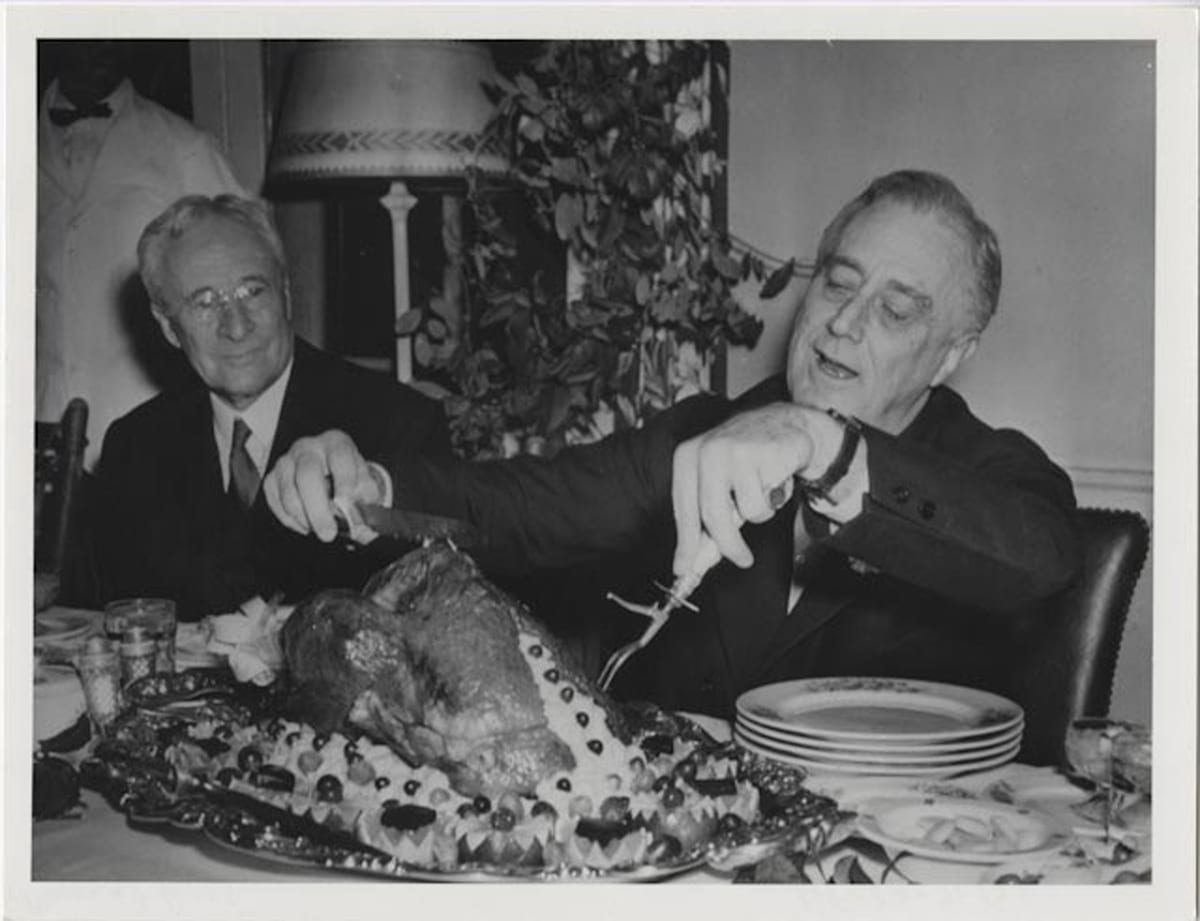
The numbers were disputed even then. A National Archives photo caption says over half the governors set a different date. The photograph shows Roosevelt carving a turkey at Warm Springs, Georgia, on 23 November 1939, seated between Eleanor Roosevelt and a paralysis patient.
Read next: Tang Dynasty Silkworm Farmers Raised Worms in Their Bedrooms
An experiment that did not work
Roosevelt kept the earlier date in 1940 and 1941. In 1940, Wikipedia says, 32 states observed it on 21 November, while 16 chose what some called the "Republican" Thanksgiving on the 28th.
A 1941 Commerce Department survey found no significant expansion of retail sales. In May 1941, the National Archives says, Roosevelt told reporters the experiment "did not work".
Congress settles it
In late 1941, Congress approved a resolution fixing Thanksgiving on the fourth Thursday of November. The National Archives says Roosevelt signed it on 26 December 1941. From 1942 the fourth Thursday was the legal date.
Since the fourth-Thursday rule, Thanksgiving can fall only between 22 and 28 November, and a single week of shopping once nearly split the country in two.