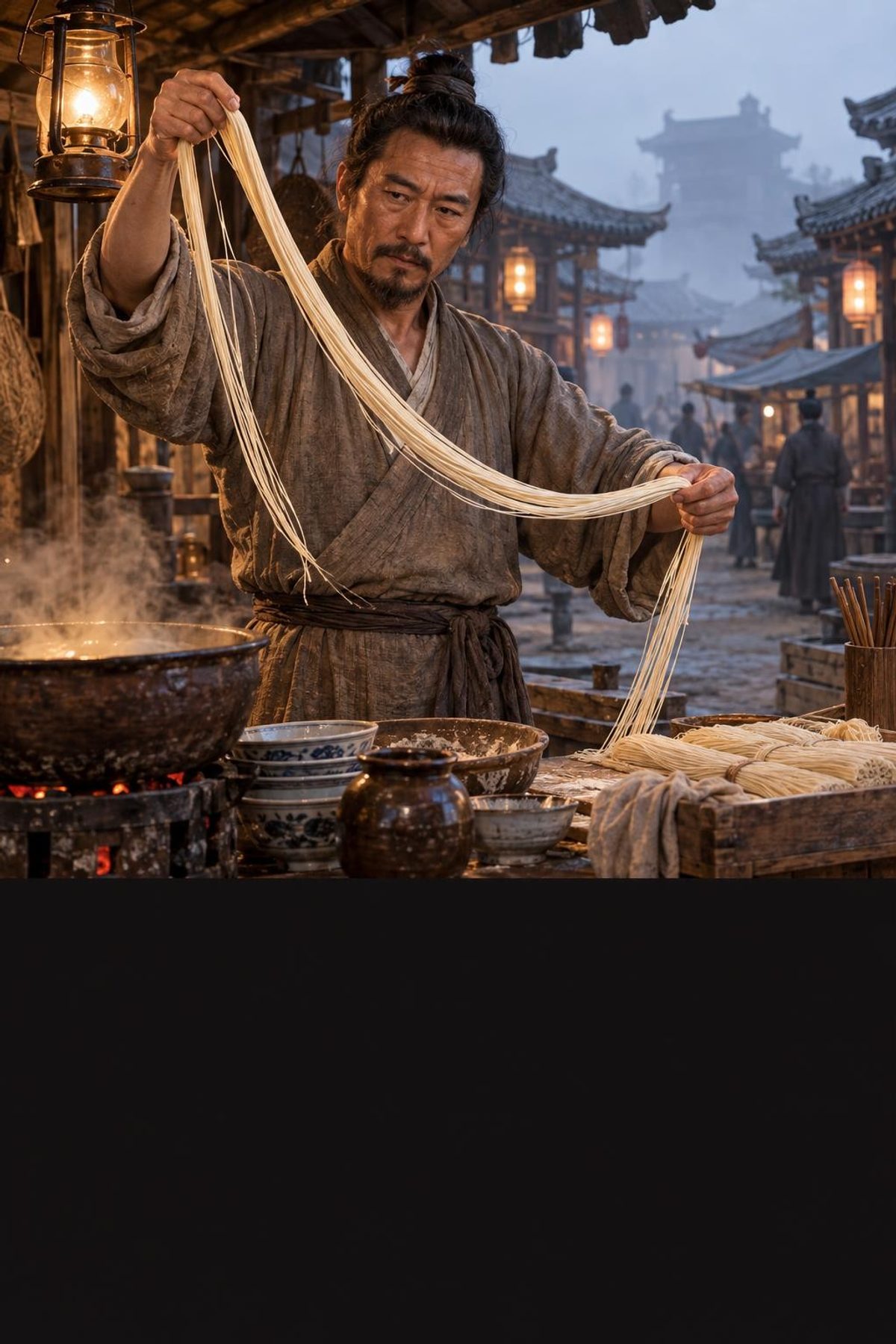
Noodles are a staple of modern Chinese cuisine. Yet, in the bustling streets of 800 AD Chang'an, their creation was an art form performed without blades or machines, utilizing nothing more than the dexterous dance of a noodle maker's fingers.
The Pre-Dawn Ritual
In the heart of the Tang Dynasty, Chang'an — today's Xi'an — was the beating heart of Chinese culture and a testimony to imperial grandeur. The city, renowned as the most populous in the world, awakened each day to the rhythm of its markets.
And before the first rays of dawn kissed the palace gates, one could hear the gentle murmurs of street vendors preparing their stalls. Among them were the noodle makers, artisans of lamian, whose morning ritual began with the alchemy of flour, water, and sheer skill.
As stars still clung to the sky, a noodle maker would rise with the resolve of a musician preparing for an opus. The craft was an exclusive performance: a single mass of dough transformed into a cascade of silk-fine strands.
Read next: Tang Dynasty Doctors Who Diagnosed Illness From the Tongue
This daily miracle was no haphazard affair. Each pull and fold of the dough bore a touch of inherited knowledge, perfected over generations. With each repetition, the gluten strands expanded and softened, transforming an inanimate lump into a living network of delicate threads.
Beyond a Meal: A Cultural Expression
The culture of Tang China reverberated with intellectual and artistic achievements. The courts sang with the verses of poets like Li Bai and Du Fu, while the streets echoed with the vitality of culinary innovation.
In this era, hand-pulled noodles were more than a meal; they were a cultural expression, written about in both the humble diaries of the working class and the esteemed records of the court. Far from being a simple street food, these noodles symbolized the intersection of art and sustenance, of precision and passion.
The noodle-making process was as much about performance as it was about food. Spectators gathered to watch the artisan pull a single, cohesive dough into 128 strands, each with the same finesse as an acrobat balancing on a tightrope. Poetry itself found parallel in the movements of the noodle maker's skilled hands, providing nourishment to the populace while embodying the era's penchant for sophistication.
Read next: Song Dynasty Inkmakers Burned Pine Soot for 40 Days to Write
Nourishing an Empire
The Tang capital was not just a hub of culture but a center of governance and trade, where ideas and cuisines from across Asia intermingled. Despite the bustling internationalism, the city's heart was Chinese, and its soul was found in street-side stalls. Here, the passing merchants, scholars, and citizens alleviated their hunger with bowls of lamian, using chopsticks to dance the noodles into their mouths, savoring each delicious strand.
From dawn until noon, noodle makers dedicated themselves to sustaining the empire. Their stalls became havens amid the chaos, feeding not just stomachs but a cultural appetite. Each artisan carried the responsibility of maintaining an unwritten culinary tradition as they served a thousand people before lunch. A single morning saw as many as eight batches prepared, with each handful of dough starting another ritualistic cycle.
The Noodles of the Future
The tale of the Tang noodle makers might have slipped through the pages of history had it not been captured in the vivid writings and poems of the era. These documented moments continue to feed the imaginations of those who cherish the overlooked stories of culinary heritage. Today, hand-pulled noodles are celebrated in kitchens worldwide, tracing a lineage to those bustling streets of Chang'an.
Understanding this history matters. It reveals how culinary practices are not merely pastimes but threads that weave through the fabric of society, holding cultures together across centuries. In appreciating the story of Tang Dynasty noodle makers, we connect to a time when sustenance was fused with art and necessity coexisted with beauty. These ancient streets whisper to modern ears, reminding us that the everyday can be a canvas for creativity and a vessel for shared human experience.