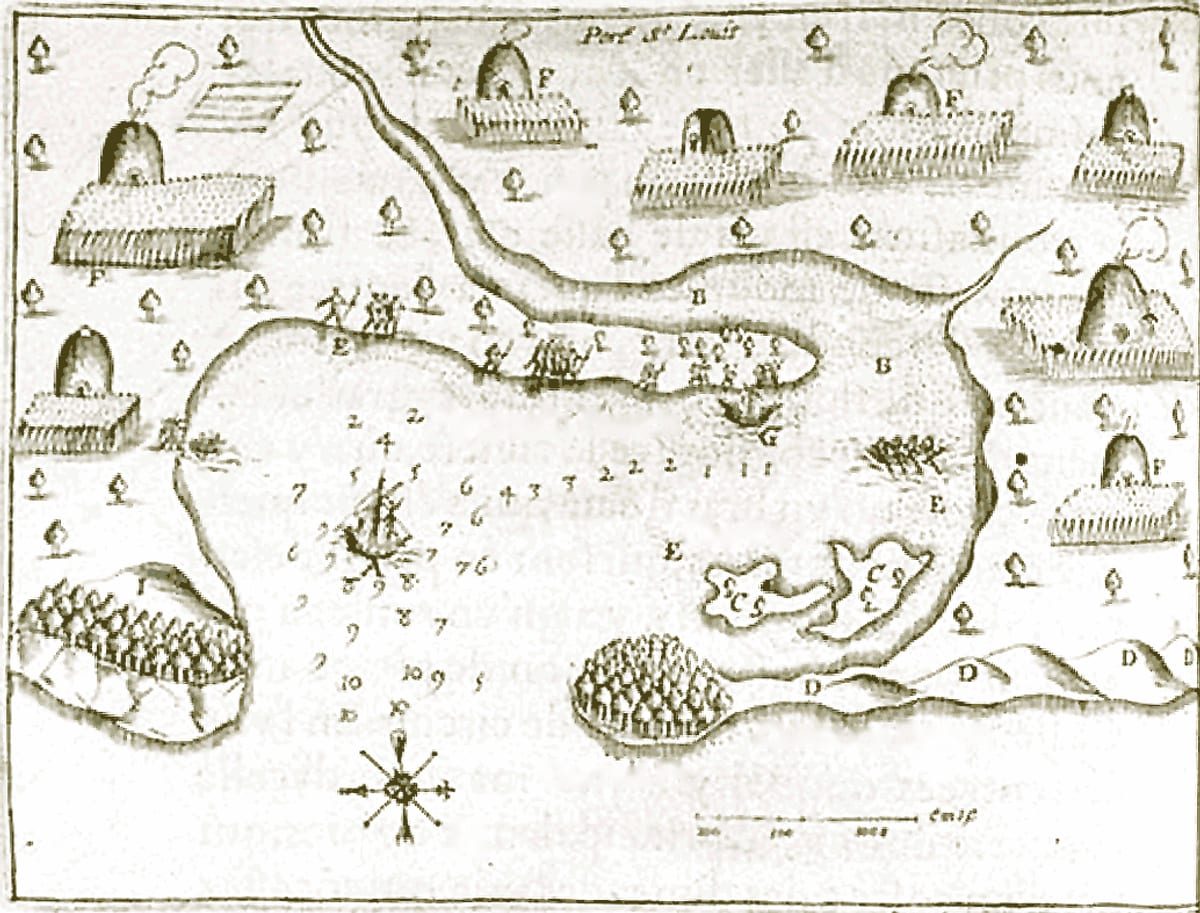
In 1605, a French ship ran aground on the coast of what is now Massachusetts. While Samuel de Champlain waited for the tide, he sketched what he saw: a shoreline dotted with Wampanoag houses and cultivated fields. Canoes came out to meet him, their crews fishing for cod. The place was called Patuxet, and one of the men who lived there would one day help the Pilgrims survive.
A village of about 2,000
The Pilgrim Hall Museum says about 2,000 people lived at Patuxet when Champlain drew his map. His sketch, published in Paris in 1613, is the only contemporary image of the village before an epidemic known as the "Great Dying" emptied it. Champlain never returned to New England.
The man history remembers as Squanto was born at Patuxet. His name was Tisquantum.
Taken by a trader
In 1614, an English captain named Thomas Hunt sailed to the coast and tricked a group of Wampanoag men and boys aboard his ship. He took them across the Atlantic and sold them as slaves in Spain. Wikipedia says Hunt trafficked Tisquantum to Málaga, and that he and other captives were said to have been ransomed by local Franciscan friars.
Read next: Tang Dynasty Noodle Makers Pulled Dough Into Silk-Fine Strands by Hand
The sources are thin on what happened next. The Pilgrim Hall Museum says Tisquantum was freed by intermediaries and ended up in England, where he became the servant of a London merchant called John Slany. There he learned to speak English.
A village with no one left
Tisquantum made his way back across the Atlantic. In 1619 he finally reached home, and found that nearly everyone from his village had died in a great pandemic. He had been kidnapped, enslaved and taken to London, only to return to a place with almost no one left in it.
In 1620 the Pilgrims arrived and settled on the site of Patuxet. In March 1621, a man named Samoset walked boldly into their settlement and greeted them in English. He even asked for beer. He later introduced the colonists to Tisquantum.
A treaty and a harvest
The Pilgrim Hall Museum says that soon after Samoset's first visit, the Wampanoag leader Massasoit, whose Wampanoag name was Ousamequin, arrived with an impressive group of 60 men. That meeting ended in a formal alliance.
Tisquantum, who spoke English, played a crucial role in these early meetings. Wikipedia says he then lived with the Pilgrims for 20 months as an interpreter, guide and adviser. He taught them how to sow and fertilise native crops, which mattered because most of the seeds they had brought from England had failed.
The Pilgrim Hall Museum quotes William Bradford: "Squanto continued with them and was their interpreter and was a special instrument sent of God for their good beyond their expectation".
Read next: Song Dynasty Inkstick Makers Ground Pine Soot for Forty Days
A man caught between two sides
The story is less comfortable than the one in schoolbooks. The Pilgrim Hall Museum says the Wampanoag had cause to distrust Tisquantum. It says he manipulated translations for his own advantage and lost Ousamequin's favour when his attempts to create a personal power base were exposed.
Ousamequin demanded that the Pilgrims return Tisquantum, citing the terms of the 1621 treaty. Bradford was reluctant to comply, and the dispute caused a rupture.
The end
In 1622, before the quarrel went further, Tisquantum died of illness. Wikipedia says he was helping Bradford on a trading expedition around Cape Cod when he caught what Bradford called an "Indian fever". Bradford stayed with him for several days until he died, and described his death as a "great loss".
Tisquantum had been kidnapped, sold in Spain, taken to London and then made his way home to a village almost empty of its people. Champlain's rough map is the only picture we have of the place he came from while it was still full of people.