Most people have never heard of Qin Liangyu. They should have.
From Scholar's Child to Warrior Woman
In the late 16th century, during a time when women were seldom seen on the frontlines of history, Qin Liangyu was not only present, she actively shaped it. Born in 1574 in Zhongzhou, present-day Zhong County in Chongqing, Qin Liangyu was the daughter of Qin Kui, a man ahead of his time who believed that girls deserved the education typically reserved for boys. Instead of limiting her to domestic skills, he schooled her in history, the Confucian classics, and martial arts, planting the seeds for a future that none could predict. She excelled in archery and horsemanship, skills that would one day bolster entire armies.
It wasn't just her martial prowess that set Qin apart; she was equally gifted in the art of words. Her poetry, reflective of both serenity and strength, resonated with the learned minds of the era. But destiny had battle plans laid out for her, not just verses. In 1595, Qin married Ma Qiancheng, a tusi and the xuanfushi, or "Announcing and Pacifying Commissioner," of Shizhu County. Her strategic acumen made her a trusted advisor to her husband, and soon, her talents would serve the broader Ming Empire. Together, they quashed local warlord rebellions, showcasing not just armed strength but leadership mettle.
The Crusade of the White Cavalry
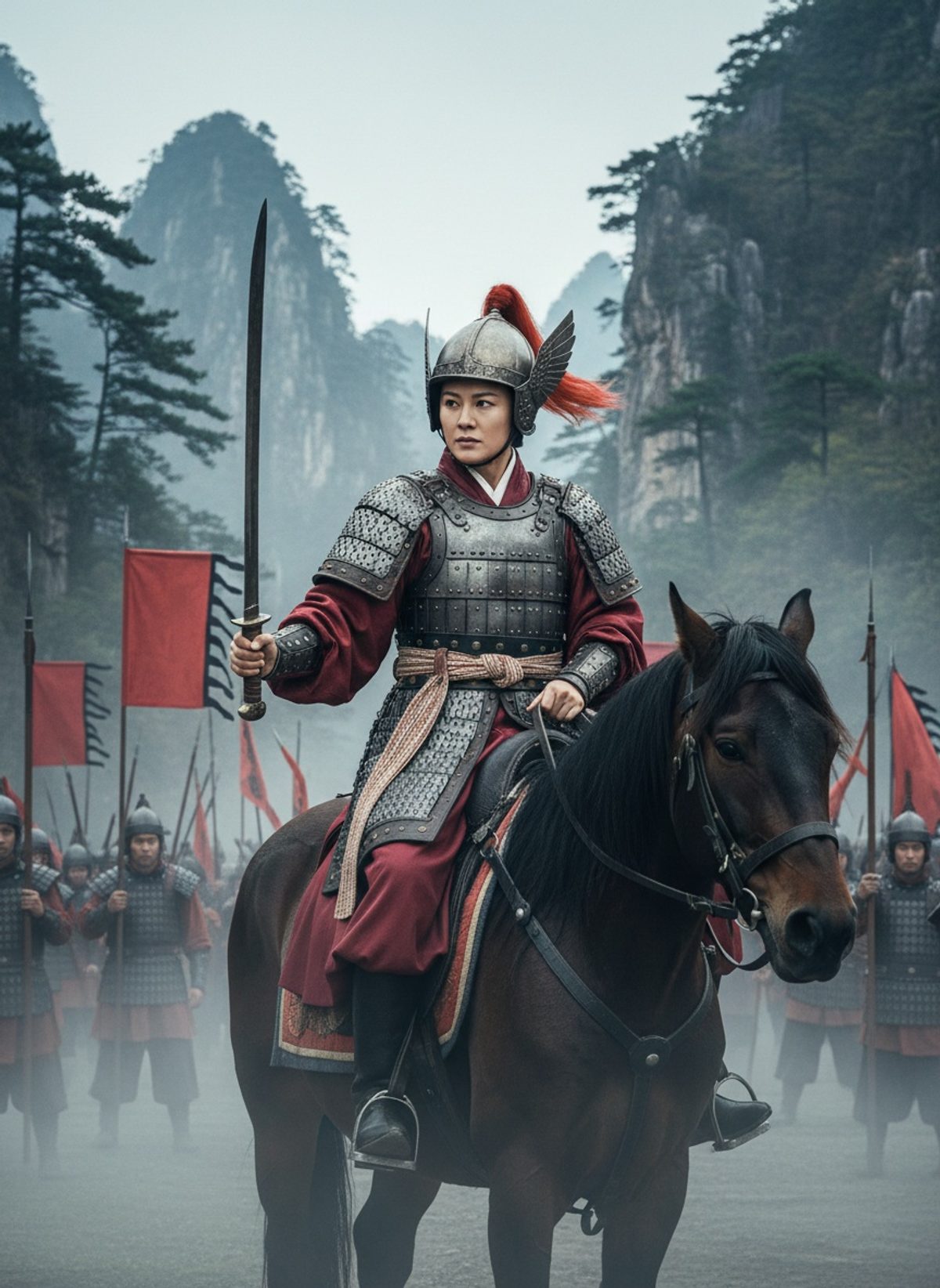
Qin Liangyu’s journey from supportive wife to self-reliant protector of the Ming dynasty unfolded under dire circumstances. In 1613, when court politics turned on her husband, Ma Qiancheng found himself imprisoned and ultimately died incarcerated. Not one to retreat or mourn in solitude, Qin Liangyu succeeded him as the xuanfushi of Shizhu County. With this title, she inherited not just her husband’s responsibilities, but also the command of a special force known as the White Cavalry—3,000 formidable soldiers trained in swift and decisive battle tactics.
Read next: He Stood Before the Court. He Freed Himself With Words.
In 1620, during the turbulent period when the Ming Empire was beset on multiple fronts, her elder brother, Qin Bangping, led the White Cavalry to the northeastern front of Liaodong. There, the Manchu-backed Later Jin forces loomed threateningly at the boundaries of the Ming Empire. Qin Bangping didn’t live to see victory; he fell at the Battle of Hun River. Yet, it was Qin Liangyu’s strategic genius and unyielding self-financed campaigns that became the bulwark against the encroaching frontier forces.
Holding the Line and the Emperor’s Esteem
No sooner had Qin Liangyu shouldered her brother’s mantle, than she was thrust into the carnage of the She-An Rebellion, led by dissidents She Chongming and An Bangyan. The years 1623 and 1624 witnessed Qin aligning with Ming forces against insurgents chaotic enough to cause ripples across Sichuan and Guizhou. But her losses were keenly personal too — An Bangyan's forces took yet another brother, Qin Minping, from her.
Her skills were too essential to be confined to her home region. In 1630, as the chilling northern winds carried Later Jin forces toward Beijing, Qin led her troops in a valiant march from Sichuan to reinforce the Ming capital. As she passed through Beijing, the Chongzhen Emperor himself composed four poems in her honor, recognizing her gallantry and fortification of his beleaguered reign. These poetic tributes were meant to immortalize her heroics in memory and verse—but history, fickle and forgetful, nearly let her slip through its pages.
Unearthly Resilience Amidst Conflicts
The decade that followed saw Qin Liangyu embroiled in tumultuous conflicts within and beyond her fortified lines. In 1634, famously resisting rebel leader Zhang Xianzhong, she and her son, Ma Xianglin, rescued the once-lost grounds of Kuizhou (modern Fengjie County, Chongqing). They pushed back, determined at every juncture against odds stacked higher than perhaps even Ming architecture could boast.
Read next: He Stood Before the Emperor. He Spoke for the Conquered.
By 1640, her resolve led to the decimation of Luo Rucai's rebel forces in Kuizhou and Wushan. Echoing with thanks, the emperor elevated her to the position of the Crown Prince's Guardian, conferring upon her the honorary title of "Marquis Zhongzhen," a mark of her loyalty and chastity.
The Shadows of the Southern Ming
The stories of the valiant often echo loudest amidst the collapse of empires. The Ming dynasty saw its final days in 1644, overthrow resonated with the rebel cries of Li Zicheng, later succeeded by the burgeoning Qing dynasty. Nevertheless, amidst the ashes of imperial China, Qin's unwavering spirit shone. The Southern Ming's brief life flickered in the south, where the Longwu Emperor recognized her inexhaustible loyalty with another marquis title. Her struggles against Zhang Xianzhong’s renewed incursions in Sichuan in those twilight years maintain their place within China's labyrinthine battle annals.
Imagine historical perception as an uneven canvas, where women's stories like Qin Liangyu’s barely touch the cold daylight. Yet, her story emerges not simply as a footnote to male-centric narratives, but as a reminder of unyielding strength in adversity's face. When borders burn and kingdoms crumble, history is kept by those who dare to steer its course. Her life twists our understanding of heroism, underpinning the quiet certainty that sometimes, overlooked voices, though veiled in time, are the ones worth uncovering. Qin Liangyu’s narrative offers not only a mirror into a tumultuous era, but into our own—reminding us of courage often found where we least expect it.