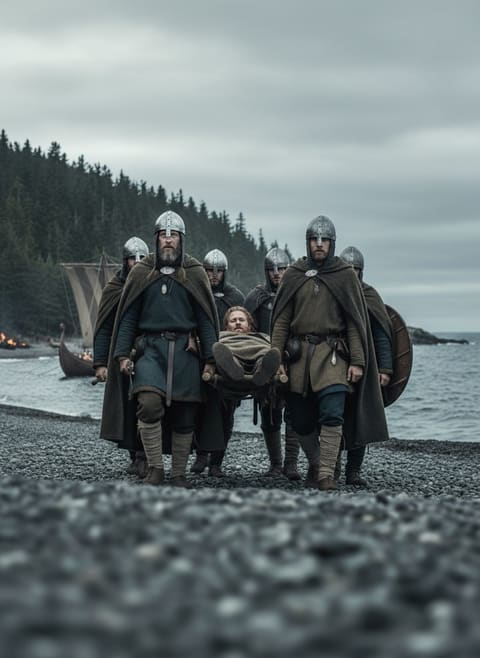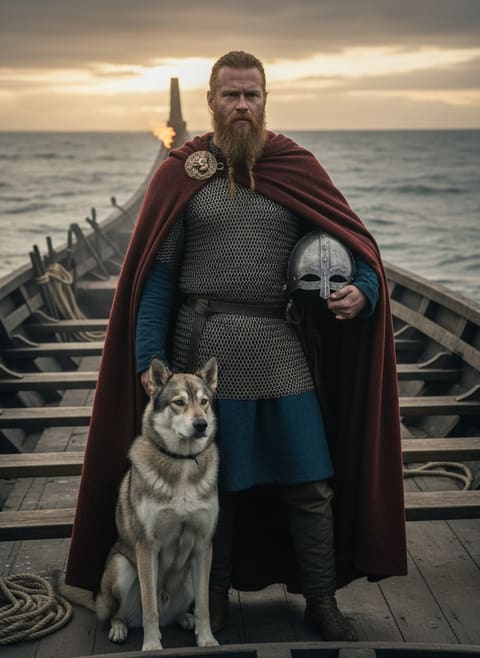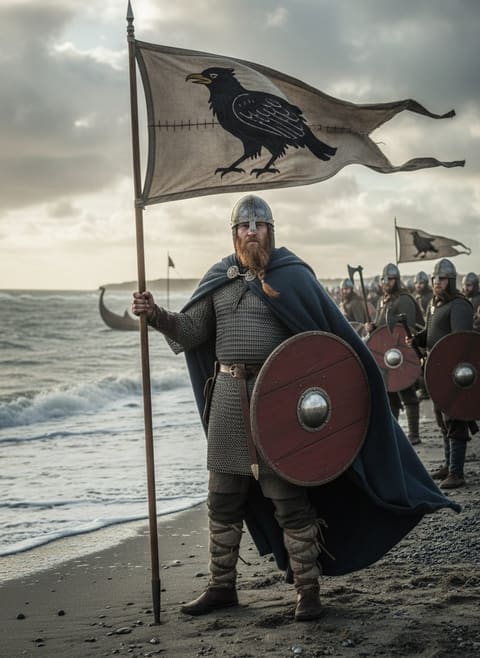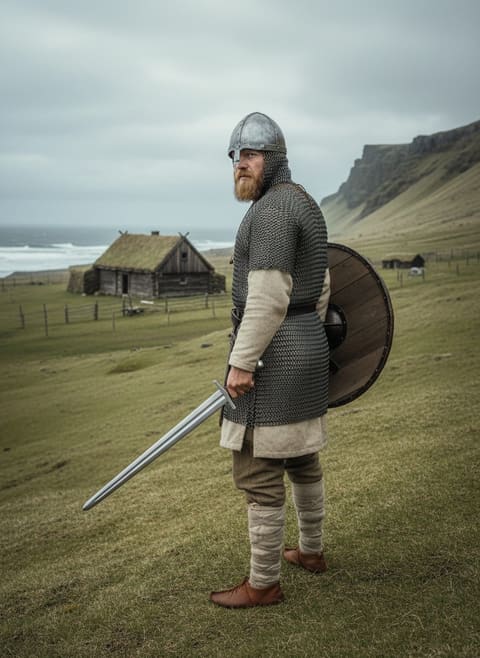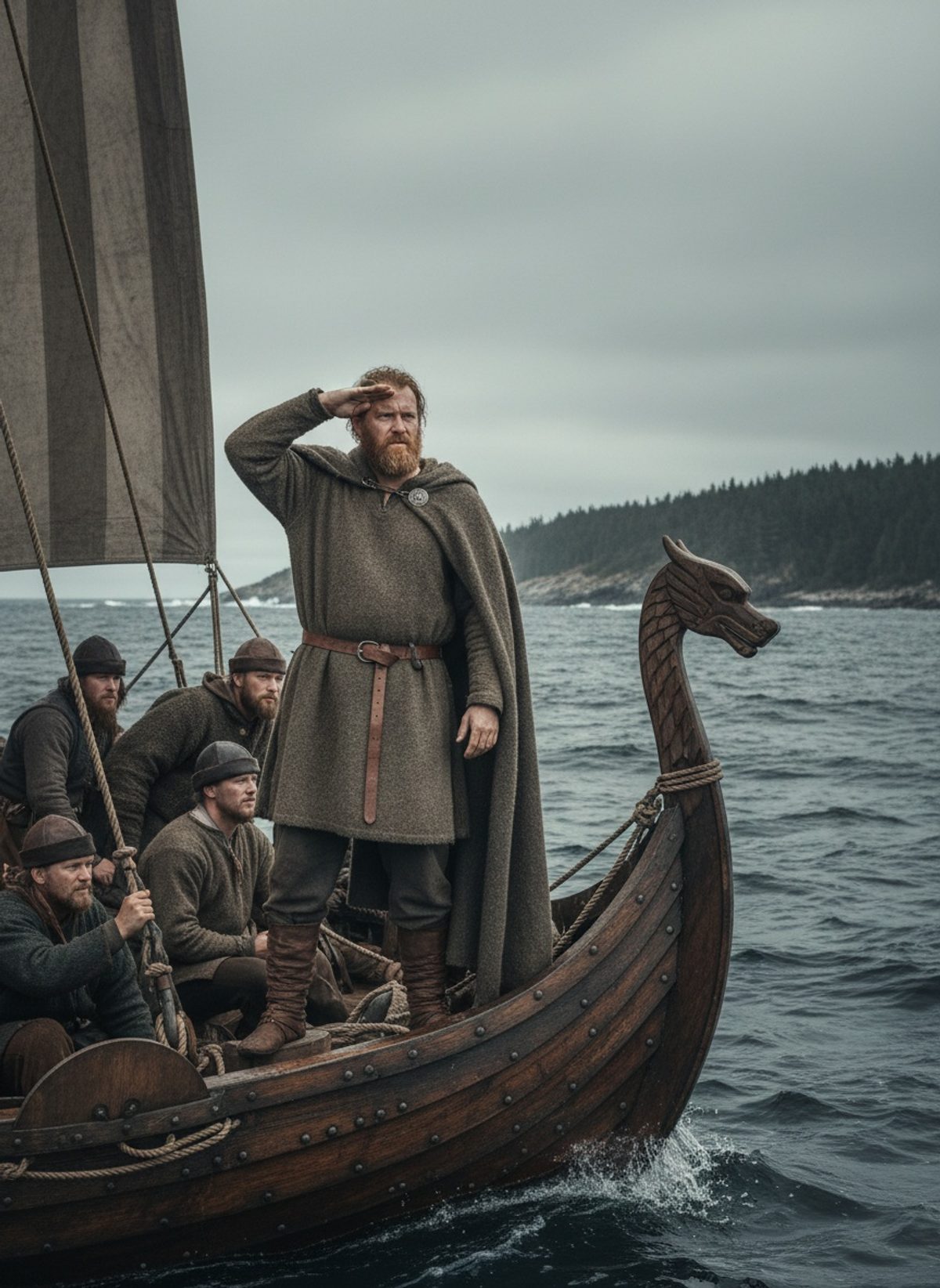
The summer of 986 unfurls its cloak of thunderous gray skies and jagged streaks of lightning as the North Atlantic roars beneath. Waves crash against a lone Viking ship battling the storm’s fury, the wind carrying salty spray across the determined, weathered faces of its crew.
Lost in these inhospitable waters, Bjarni Herjólfsson guides his ship through the violent dance of nature, not knowing that he stands on the brink of a discovery that few, if any, Europeans could have dreamt of.
Longing to reunite with his father in Greenland, Herjólfsson suddenly sights land where no land should be — a low-lying, forest-clad coastline, stretching peacefully against the oceanic tumult. It is a glimpse of an uncharted world that could change the very map of the known world.
The Cautious Voyager
Born in Iceland to Herjólfr Bárdisson and Thorgerdr, Bjarni Herjólfsson grew to embody the restless spirit of the Viking age. As a merchant captain based in Norway, he routinely sailed the seas to visit his father in Iceland — a journey that became a ritual navigated by skill rather than compass.
Read next: Egil Skallagrímsson Faced the Axe. He Wrote His Way Free.
However, in that fateful year, upon reaching Iceland, Bjarni found that his father had already left with Erik the Red for the distant shores of Greenland. Undeterred, Bjarni set his gaze westward, determined to find his father in this new world.
A sea storm, however, had other plans for Bjarni. It veered his course away from the familiar towards lands unreachable on any map known to Norsemen. On this unintended voyage, islands cloaked in pines and undulating hills arose through the thick mist — what we now believe to be the eastern shore of North America.
Despite the intrigue of these virgin landscapes, Bjarni’s heart remained tethered to his familial ties. Over the protests of his crew, eager to explore, he pressed onward without setting foot upon these mysterious lands.
Upon reaching Greenland, Bjarni settled at Herjolfsnes with his father, sharing tales of his oceanic odyssey. Yet, his eyes held no gleam of conquest; there was no itch to chart new regions.
His reticence to investigate the lands drew sharp criticism from contemporaries, notably Earl Eric, who fancied Bjarni’s discovery half-baked due to his lack of exploration. Nevertheless, his accounts circulated and ignited curiosity across the Norse settlements. These tales would eventually catch the ear of Leif Eriksson, sowing the seeds for a more groundbreaking expedition.
Leif the Adventurer
News of Bjarni’s sighting percolated through the Norse community, enchanting the imaginations of adventurers starved for new horizons. Wood, rare and prized in Greenland, formed a tantalizing image of the resource-rich lands Bjarni had described.
It was this allure that captivated Leif Eriksson, the son of Erik the Red, who longed to see the lands his father and others had yet to claim. Seizing an opportunity to fulfill this exploratory yearning, Leif purchased Bjarni’s ship and recruited a crew of 35 daring men. The stage was set to retrace what Bjarni had only seen from afar.
Leif’s journey took him across the same tumultuous seas, where he eventually reached Labrador, followed the coastline south to discover Baffin Island, and finally landed in what is now Newfoundland. It was here that Leif established the Norse settlement at L’Anse aux Meadows, proving the existence of the continent Bjarni had glimpsed.
Read next: Olaf Haraldsson Baptised His Kingdom With an Iron Fist
This settlement, painstakingly reconstructed piece by piece, revealed the brave and curious heart of Viking exploration, a tangible mark of Europe’s first permanent foothold in the Americas long before the age of Columbus.
The land of Vinland, as Leif would name it, offered abundant timber, rich pastures, and grapevines — a sharp contrast to the barren Greenland. While the settlement was eventually abandoned, likely due to harsh winters or strained relations with native peoples, it signaled the beginning of the Norse sagas in the New World. Leif's voyage wasn’t just a personal triumph but a beacon lighting the way for stories and legends that would echo through centuries, inspiring future generations.
Bjarni Herjólfsson, often overshadowed by the famous exploits of Leif Eriksson, stands in history as an enigma. His cautious nature allowed him to encounter a new world, yet his prudence prevented deeper exploration. It is this paradox that renders him both a forgotten figure and a pioneer.
While history often celebrates those who plant flags on new lands, it is important to remember that sighting new horizons can hold its own kind of power.
Bjarni’s unanticipated encounter reminds us that discoveries can occur in the unlikeliest of circumstances, and sometimes the mere act of seeing differently can set the stage for future leaps into the unknown. His story is a quiet testament to the fact that even seemingly small decisions can ripple through time, inspiring others to venture further and dream bigger.