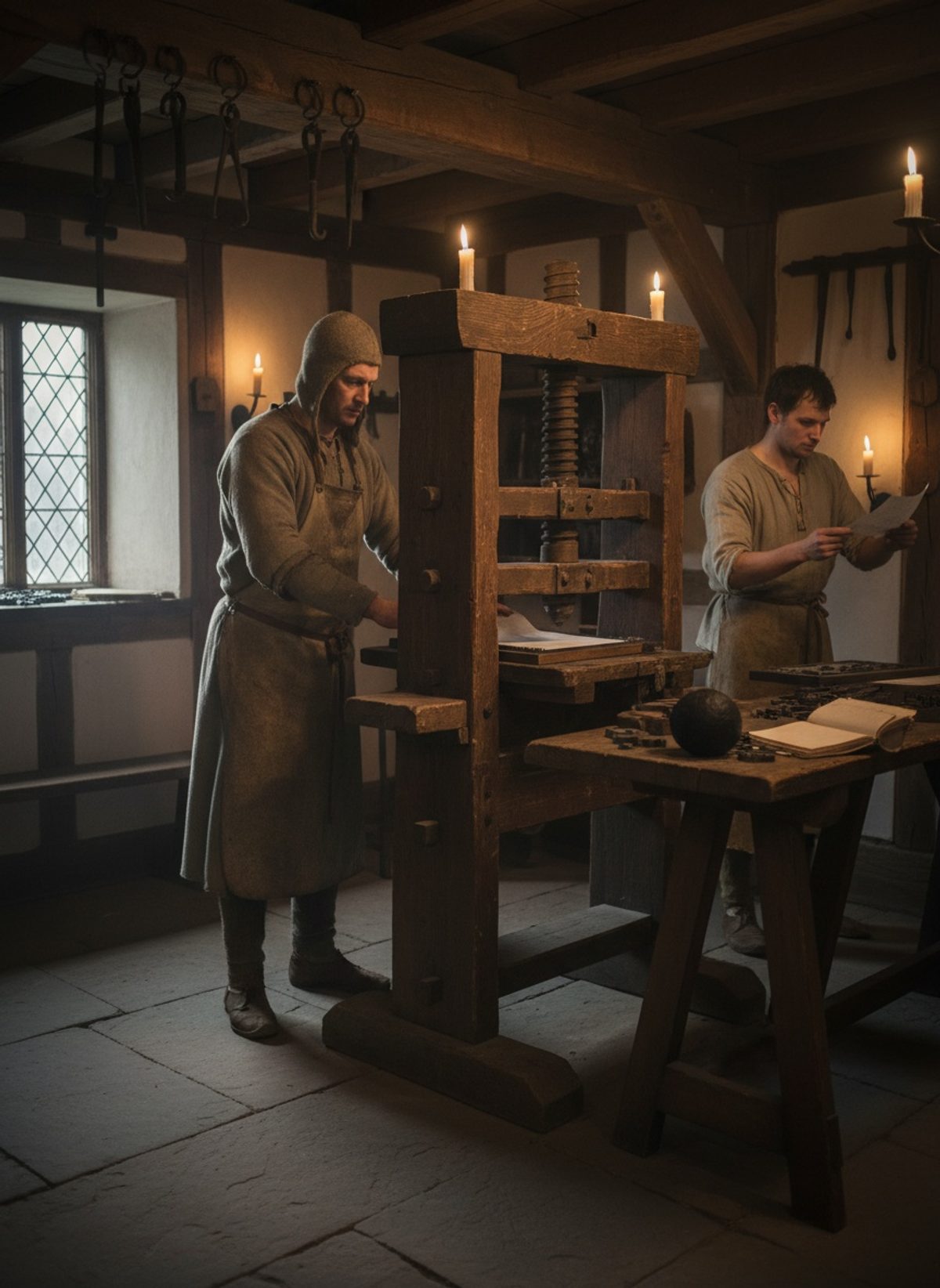
The clatter of wooden blocks echoed through the dimly lit workshop, mingling with the pungent tang of ink and fresh parchment. William Caxton paused to inspect the glossy black lettering on the page, the familiar symbols now ordered and replicated with startling efficiency.
Each printed sheet marked the dawn of a new age, as lines of text marched forth, uniform and unerring, from his humble press in Westminster. This was no ordinary workshop; this was the birthplace of England’s printed word.
The Merchant’s Vision
Before Caxton's wooden press began its work in 1476, the world of books was one of laborious toil. Every piece of writing from illuminated manuscripts to humble texts was painstakingly copied by hand.
One monk or scribe could spend months, sometimes years, bent over a single book, crafting each letter with meticulous care. In this hallowed tradition, knowledge trickled slowly, exclusively to those with the means to capture it. But Caxton, a pragmatic merchant from Kent, dreamed of something more revolutionary.
Read next: The Monks Who Built England's Greatest Timber Cathedral
Having honed his craft in the bustling trade hubs of Bruges, Caxton returned to England with an idea that seemed fantastical and yet inevitable — a printing press that could do in days what used to take years. He envisioned a future where books were accessible, standardised, and widespread. Located in the shadow of Westminster Abbey, Caxton’s press began to turn, heralding the end of an era of handwritten exclusivity with a clatter as sharp as a clarion call.
Caxton was more than just a printer; he was a curator of culture, selecting works that spoke to the spirit of his time. His first printed text, "The Recuyell of the Histories of Troye," was not only a technological marvel; it was a gateway to stories that had previously dwelt in monastic and aristocratic confines. With every pull of the press, Caxton was redefining who had access to these tales.
Letters and Legends
Caxton's workshop was alive with the hum of industry and hope, a vibrant microcosm of an England on the cusp of transformation. The books born here were not just replications; they offered a chance to consolidate and standardise the chaotic sea of regional dialects and spellings that fragmented the English language.
Until now, spoken English was a patchwork quilt of variations and inconsistencies, each region clinging to its own peculiarities. With each book he printed, Caxton stitched these patches together with the threads of a commonality.
By standardising spelling and grammar, Caxton played an unwitting role in shaping a collective English identity, one letter at a time. This quiet unification would ripple outward through the centuries, easing the way for future scholars, writers, and everyday folk alike. Where once a body of text could be obfuscated entirely by dialectical quirks, now there was a growing steadiness, a shared understanding.
Caxton's shrewd selection of texts included not only popular romances but practical books on grammar and law, ensuring that what emerged from his press was a mixture of entertainment and education. This dual focus meant that his works found eager homes not only in the libraries of the wealthy but also amongst fledgling scholars and tradesmen eager to wield the power of the printed word in their personal and professional lives.
The Mantle of Change
By the time of Caxton's death in 1492, his humble presses had produced over a hundred titles, a staggering achievement when considering the constraints of the era. He had not just ushered in a revolution of literacy but laid the groundwork for future change-makers. The ripples of Caxton’s labors were felt across continents and ages, influencing not just literature but also politics, trade, and theology.
Read next: The Day a Welsh Prince Bowed and Broke England's Heart
This accessibility to printed works paved the path for the English Renaissance, sowing seeds of enlightenment that would bloom for centuries. As his books circulated, they exerted an influence that was at once profound and subtle, embedding themselves into the very fabric of daily life. Caxton’s titles became common touchstones, catalysing dialogues across class lines and slowly eroding the barriers that had once siloed knowledge to a privileged few.
The artistry contained on those densely inked pages was the harbinger of a new epoch, where knowledge was not only preserved but proliferated. Scholars could build upon the words of past masters without the risk of transcription error, and thinkers could engage with ideas free from the constraints of geography and privilege.
A Legacy of Words
The resonance of Caxton’s work continues to echo into the present day, and his press in Westminster stands as a symbol of the power of the written word to transcend borders and time. As the letters spilled from his press, they carried with them a promise of a more interconnected and literate society. Today, as we tap, type, and scroll through screens, it is easy to forget the monumental shift that began in that modest workshop.
Caxton’s efforts were more than mere mechanical ingenuity; they were a declaration that stories, knowledge, and ideas deserved to reach new ears and eyes. By democratizing access to the written word, he laid a foundation that continues to support an ever-evolving world.
As we ponder the opportunities afforded by our own digital age, we can look to the clatter of Caxton’s press as not just a pivotal moment in history but a timeless inspiration for the potential of human ingenuity and innovation.