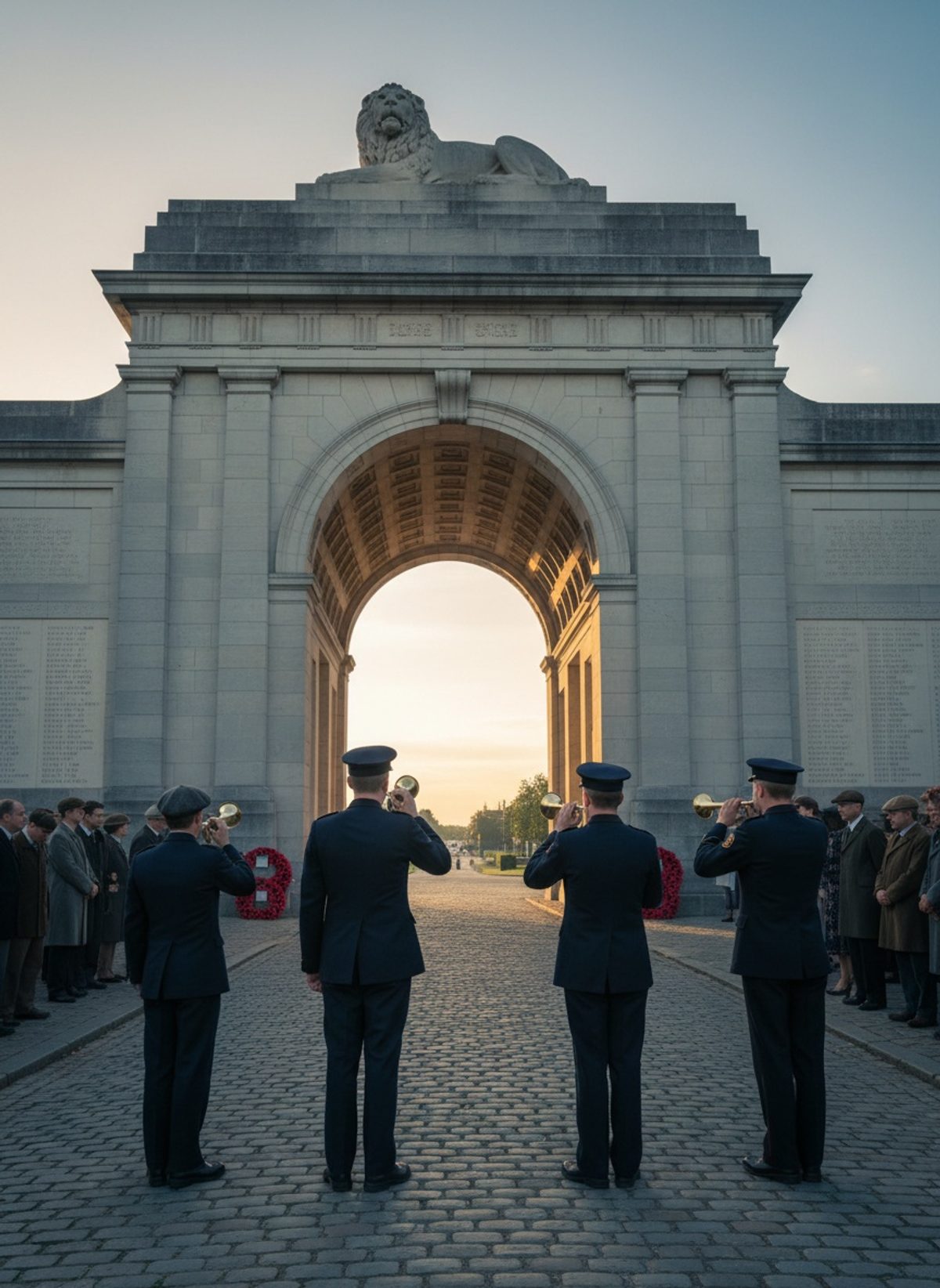
The cobbled ground of Ypres is cool underfoot, and the evening sky hangs like a silken shroud, deepening from indigo to pitch as dusk transforms into night. Streetlamps cast long shadows among the ancient stones of this storied town, whose heart beats to the solemn rhythm of memory. At precisely eight o'clock, the hustle of the day fades into silence as buglers in the uniform of the town’s volunteer fire brigade raise their instruments beneath the Menin Gate. This enduring ritual honors the 54,395 British and Commonwealth soldiers who vanished into the mire of the Ypres Salient during the Great War, leaving nothing but their names carved on the memorial’s stone panels. Here, amidst shadow and silence, the Last Post echoes not just through Ypres, but through the corridors of history.
The Birth of a Beacon
The Menin Gate, or Menenpoort, rose from the ashes of a war-torn landscape as a stark emblem of remembrance. Its construction, designed by Sir Reginald Blomfield, was commissioned by the Imperial War Graves Commission, now known as the Commonwealth War Graves Commission. Unveiled on July 24, 1927, the monument stands at the town's eastern exit, a departure point from which countless troops, in their unfathomable numbers, marched towards the relentless front lines. With its grand archways, the Menin Gate symbolizes both the physical and symbolic passage of soldiers into the maelstrom of conflict.
Ypres was a linchpin in the theater of war, a strategic hub due to its road network and unyielding Allied hold during the German advance of 1914. The town, surrounded on three sides by enemy forces, resisted with unwavering tenacity through multiple battles, including the notable Second Battle of Ypres in 1915. The very earth of Ypres was a silent witness to the tremendous toll exacted by war—over 300,000 Allied lives were claimed by the Ypres Salient, nearly a third of whom remain missing. The Gate serves as their cenotaph, a solemn canvas bearing the undying legacy of those who never returned.
The citizens of Ypres wanted to express their gratitude to those who had given their lives for Belgium’s freedom. On 2 July 1928 local buglers began to sound the Last Post beneath the arch—a bugle call long associated with military funerals and commemorations. This poignant ritual swiftly grew into a nightly vigil, rooting the Menin Gate firmly within the global consciousness as a site of perpetual homage.
Read next: Reckless: The Mare Who Hauled 9,000 Pounds Under Fire at Outpost Vegas
The Ritual Interruptus and a Triumphant Return
The Second World War cast its long shadow over Ypres, as Nazi forces occupied the town in May 1940. Yet, even as they seized control, the ceremony of the Last Post did not falter—it simply found a new home across the Channel. Throughout the occupation, these rites of remembrance were temporarily conducted at Brookwood Military Cemetery in Surrey, England, where they continued to honor the memory of those lost in the Great War amidst the verdant calm of British soil.
This somber interlude only served to reaffirm the importance of the ceremony. On September 6, 1944, as the town of Ypres was liberated by Polish troops nearing the end of the Second World War, the buglers returned, their triumphant notes ringing once more beneath the Menin Gate's arches to reunite the ritual with its rightful harbor. The resumption of the ceremony marked not just a geographical return, but an emotional restoration—a symbolic victory over adversity and division.
Apart from the years of the German occupation, the ceremony has been held every evening since 1928. It is organised by the Last Post Association, an independent voluntary body, and bands, choirs and military units from around the world apply to take part.
Read next: Khalid ibn al-Walid Pivoted 40,000 Men Mid-Battle at Walaja
A Nightly Call to Remember
While the Menin Gate itself has displayed resilience through the years, its role remains unchanged—a place of unwavering remembrance. Its grand limestone façade stands in solemn witness as a silent congregation gathers each evening. The ceremony, steeped in tradition, involves not only Belgian buglers but attracts visitors worldwide, forging an ever-expanding community of memory and solidarity. Today, passersby might catch glimpses of medals glinting under the soft glow of streetlamps as the buglers of the Last Post Association take their places.
The ritual of the Last Post demands silence and reflection, transcending boundaries and generations. Its simple, haunting melody transforms into a universal language, speaking to the essence of sacrifice, valor, and loss. Each note weaves a tapestry of remembrance, binding together the threads of countless stories—of triumphs and tragedies, of the unyielding human spirit amidst the devastating echoes of conflict.
In understanding the Menin Gate and its buglers, we engage not only with history but with a profound human narrative that bridges the past with the present. Through this nightly tribute, we find a unifying force, a testament to our enduring capacity to remember and honor—even when the truth of these sacrifices was never part of the curriculum in school. Amidst the silence before the first bugle call, there's a palpable sense of unity, an unwritten command that reaches beyond the temporal span of wars, quietly urging us to ask: what will we do with the peace that was purchased at such a great cost?