He possessed an unyielding tactical brilliance. Yet few could have predicted his swift battlefield transformations.
The Tactical Flash of Khalid ibn al-Walid
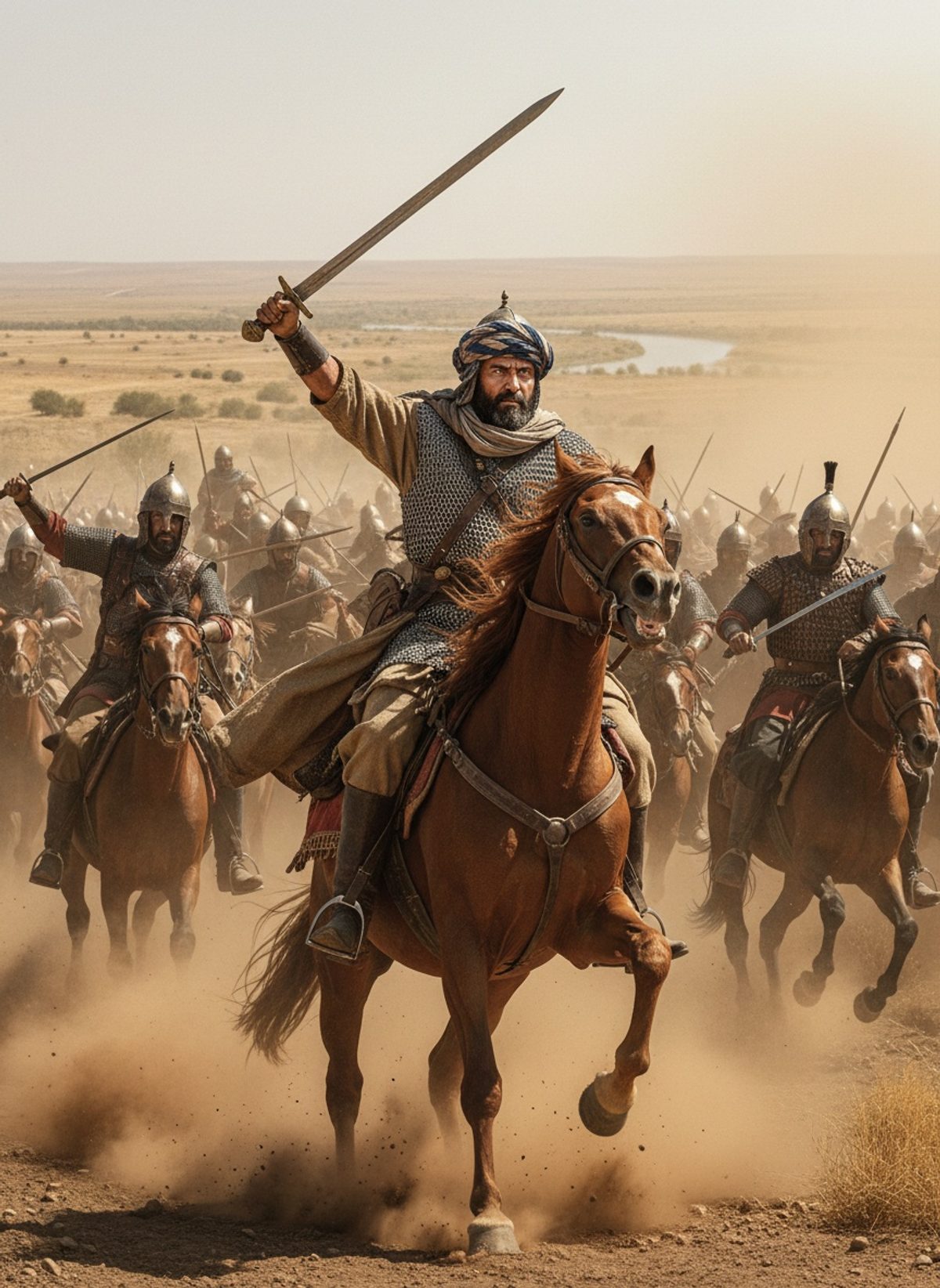
Amidst the sands and sweltering heat of the Arabian Peninsula, Khalid ibn al-Walid, often known as the "Sword of Allah," etched his name into military lore. In May 633 CE, near the river Walaja, Khalid faced what appeared to be insurmountable odds against the formidable Persian Empire—a force feared across continents. Despite being heavily outnumbered, Khalid was a commander who understood the art of war in a way that transcended mere arithmetic. His audacious strategy at the Battle of Walaja would echo through the ages, showcasing military finesse reminiscent of Hannibal's tactics at Cannae.
The battlefield lay in Mesopotamia, an area steeped in conflict and conquest. Here, Khalid's force of approximately 18,000 men met the superior Persian numbers head-on. Knowing the Persians' tendency to use their numbers to overwhelm, Khalid harnessed an ancient tactic previously employed by history’s greatest generals: the double envelopment. This method involved the enemy being drawn into the center of the army as hidden flanks enveloped them on both sides, creating a deadly trap.
Unbeknownst to the Persian commanders, Khalid had split his cavalry into two hidden wings, skillfully concealed behind the undulating terrain. He deliberately allowed the Persian forces to believe they had the upper hand. As the battle commenced, Khalid’s troops in the center appeared to falter, encouraging Persian forces to advance more aggressively into what was, unbeknownst to them, a trap. The hidden wings of Khalid's cavalry suddenly swung out like the jaws of a predator, closing in on the Persian ranks. The encircling movement was not just an attack but a suffocating grip—chaos ensued within the Persian lines as both confusion and fear spread.
Read next: Howard Lutnick Lost 658 Colleagues on 9/11 and Rebuilt Them All
The Execution of a Battle Plan
Khalid’s strategic genius lay not only in the planning but in the execution under the pressures of combat. His men, drilled into precision, followed their orders with a trust in their leader that bordered on reverence. As the Persian forces realized the extent of the trap, panic began to take its toll. The chaos grew, and the once-formidable Persian army found itself helplessly encircled. From position to position, Khalid coordinated the movements, ensuring no openings remained in his envelopment. His presence on the battlefield was magnetic; he inspired fierce loyalty and remarkable discipline among his troops.
The battle rapidly turned into a rout with Persian soldiers being cut down in droves. The fluidity with which Khalid controlled the battlefield was mesmerizing—what could have descended into a mere slaughter became an orchestrated annihilation. It was during carnage like this that Khalid earned his reputation. Unlike many of his contemporaries, Khalid viewed warfare not just as chaos but as a complex dance of tactics and timing. His ability to adapt and exploit even the smallest of advantages was crucial in battles where numbers were not on his side.
When the dust finally settled on that fateful day at Walaja, Khalid's army stood victorious, having inflicted devastating casualties on the Persians. The victory was comprehensive, with many Persian commanders either captured or killed, and it solidified Khalid's status as one of the great military tacticians of his age. Walaja was not just a battle won; it was a testament to the strategic brilliance of a man confronting the might of an empire.
Read next: Narses: The Eunuch General Who Crushed the Goths at Age 74
The Ripple Through History
Khalid ibn al-Walid’s victory at Walaja resonates through military history as a lesson in leadership, strategy, and human ingenuity. It wasn’t merely the swords and spears that won the battle, but the mind that orchestrated their use. The historical significance of the battle goes beyond the territory it helped secure; it was a turning point in the early Islamic conquests and showcased the formidable military capabilities of emerging Islamic forces. Khalid's actions did not just conquer lands but also hearts, inspiring commanders and warriors long after the echoes of battle had faded from the sands.
The brilliance of Khalid’s strategy at Walaja is frequently compared to Hannibal's famed envelopment of Roman forces at Cannae, despite the centuries that lay between them. Both battles serve as studies in the importance of foresight and execution in military engagements. For students of history and military tactics enthusiasts, Khalid’s handling of the Battle of Walaja is a masterclass in the effective use of terrain, psychology, and above all, patience.
In modern parlance, Khalid’s tactics at Walaja might be equated to an act of strategic art, an innovative masterpiece that turned discipline and deception into instruments of war. His victory stands as a vivid reminder that, often, it is not the size of the force in the fight, but the strategy and resolve behind it. Khalid ibn al-Walid’s achievements continue to inspire those who strive to dissect the nature of warfare. The lessons lived at Walaja leave one contemplating how human intellect can alter the tides of history, defining not just battles but the very essence of cultures.