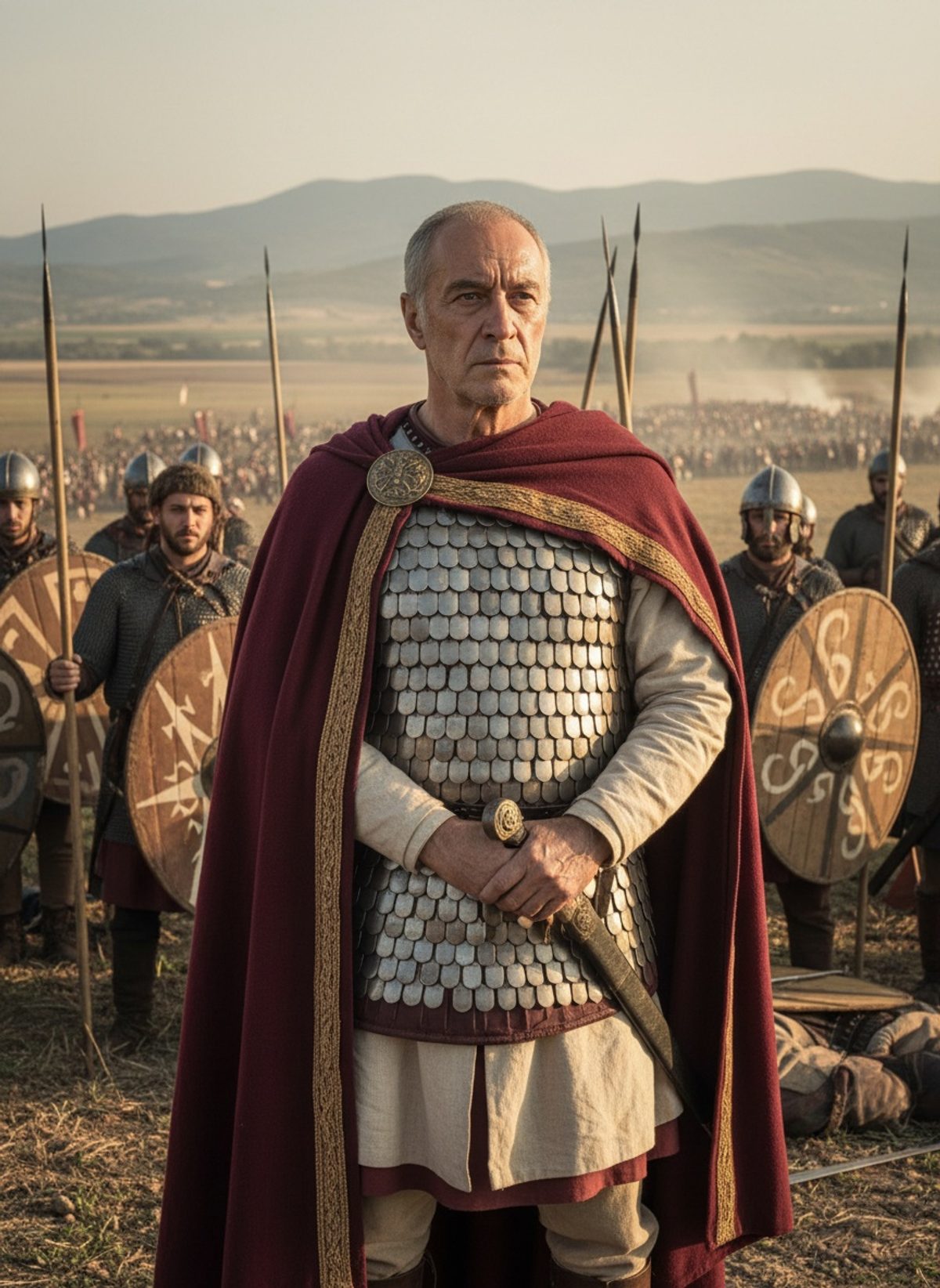
July 8, 552. The Alpine mountains loomed with their rugged peaks, shrouded in mist.
The Unlikely Commander
In the waning years of the Western Roman Empire, a remarkable transformation was underway. Under the astute leadership of Emperor Justinian I, the Byzantines were resolved to restore the glory of Rome. But as the Gothic War dragged on, a fresh strategy was called for. Enter Narses — a slight, seasoned court official who seemed an unlikely military savior of the Italian peninsula. Born in 478 in Persarmenia, Narses was of Armenian descent, a region that had become a melting pot of cultures and religions amid the shifting tides of empires. Little is known about his early life, but by the time he emerged onto the historical scene, Narses had already navigated the intricate corridors of power in the Byzantine court successfully.
What made Narses stand out, aside from his heritage, was his status as a eunuch. This unusual characteristic, often seen as both a limitation and a mark of dedication, afforded him a unique position close to imperial power. Perceived as loyal and without ambition for familial power, eunuchs like Narses served in capacities close to the emperor. By 530, he was serving as the steward (cubicularius) for Justinian. Yet, despite his lack of formal military training and an existence largely lived among the Byzantine elite, Narses had already shown a flair for strategy and leadership. He had helped quash the Nika riots in Constantinople in 532, not through brute force, but through his keen understanding of human motivations and skillful use of diplomacy.
When Justinian needed reinforcements in Italy, to reclaim territories lost to the Ostrogoths during the ongoing Gothic War, it was Narses who was entrusted with the supreme command. At the age of 74, Narses brought with him not just Byzantine soldiers but a multi-ethnic force echoing the complexity and expanse of the empire itself. His army comprised Heruli, Gepids, Lombards, and others, unified under his command by the promise of glory and bounty. As he prepared for the campaign that would lead him across the harsh, unforgiving terrain of the Alps, history was about to witness an unprecedented military endeavor.
Read next: Cao Cao Had Him Surrounded. He Rode Out Alone.
The Battle of Busta Gallorum
In striking contrast to his contemporaries, Narses orchestrated his military campaigns with a blend of cunning and patience. His most celebrated strategic triumph occurred at the Battle of Busta Gallorum also known as the Battle of Taginae. This decisive confrontation with the Ostrogoths was set against a backdrop of a war-torn Italy, longing for stability. The Goths, led by their audacious king, Totila, were a formidable force, and tottered on the brink of solidifying their power in Italy. Totila had recaptured significant parts of the peninsula from the Byzantines and was considered a thorn in Justinian's pursuit of western restoration.
As Narses advanced, the Gothic army maneuvered to confront him. Despite being an outsider on the battlefield, Narses exhibited an exceptional aptitude for warfare tactics. He ingeniously deployed his troops in a narrower valley, forcing the numerically superior Gothic forces into unfavorable positions. With high-spirited energy defying his age and petite appearance, he issued a flank charge with his cavalry, a tactic as bold as it was effective. The ensuing chaos turned the tide irrevocably in favor of the Byzantines. The Goths were not just defeated; they were unequivocally crushed, with Totila himself perishing amidst the turmoil.
This victory at Busta Gallorum didn't only break the immediate might of the Gothic kingdom; it magnificently demonstrated how Narses outclassed his adversaries through intellect and adaptability. Famously pious, Narses was believed to have sought divine guidance in battle, a symbiosis of faith and action that resonated with his troops. After his stunning victory, the way to Rome lay open. But Narses did not rest on his laurels; he carried forth his success with sustained sieges and campaigns that laid the foundations for Byzantine dominance in the region, culminating with the Battle of Mons Lactarius the following year which snuffed out the last embers of Gothic resistance.
Read next: Guo Ziyi Rode Alone Into the Enemy Camp
The Enduring Legacy of Narses
Narses' remarkable achievements went beyond mere military conquests. At the remarkable age of 74, he not only led men to victory but redefined what it meant to lead. In the twilight of his career, he exemplified how strategic thinking could outmatch brute strength, reshaping the dynamics of power in Italy. His final years were spent not in satisfying ambitions of power but in a more spiritual pursuit—he built a church and a monastery in Cappadocia, reflecting his inner convictions and maybe hinting at his plans for retirement.
Despite the enigma surrounding his early life, the impact of Narses’ later achievements speak volumes. His story is a narrative of resilience, intellect, and faith—a formula few would expect from a figure dismissed by rivals as a minor court official. Narses’ command might have seemed improbable in theory but unfolded as a masterclass in strategic execution and effective multilateral command on the battlefield. Through adept diplomacy and insightful war tactics, he left a Byzantine legacy that echoed past its realm, becoming a tale of an unexpected hero who didn’t just fit the mould but reshaped it entirely.
While the names and titles of many ancient generals have faded into obscurity, Narses stands distinctively apart. His life serves as a poignant illustration that the greatest impacts are sometimes made not by those who seek power, but by those who are entrusted with it unexpectedly. The victory over the Goths at the sunset of his life immortalized him as a symbol of Byzantine resilience and ingenuity. More importantly, Narses showed history that age and origin need not hinder destiny, and that sometimes, the voice of the unexpected whispers most clearly in the corridors of time.