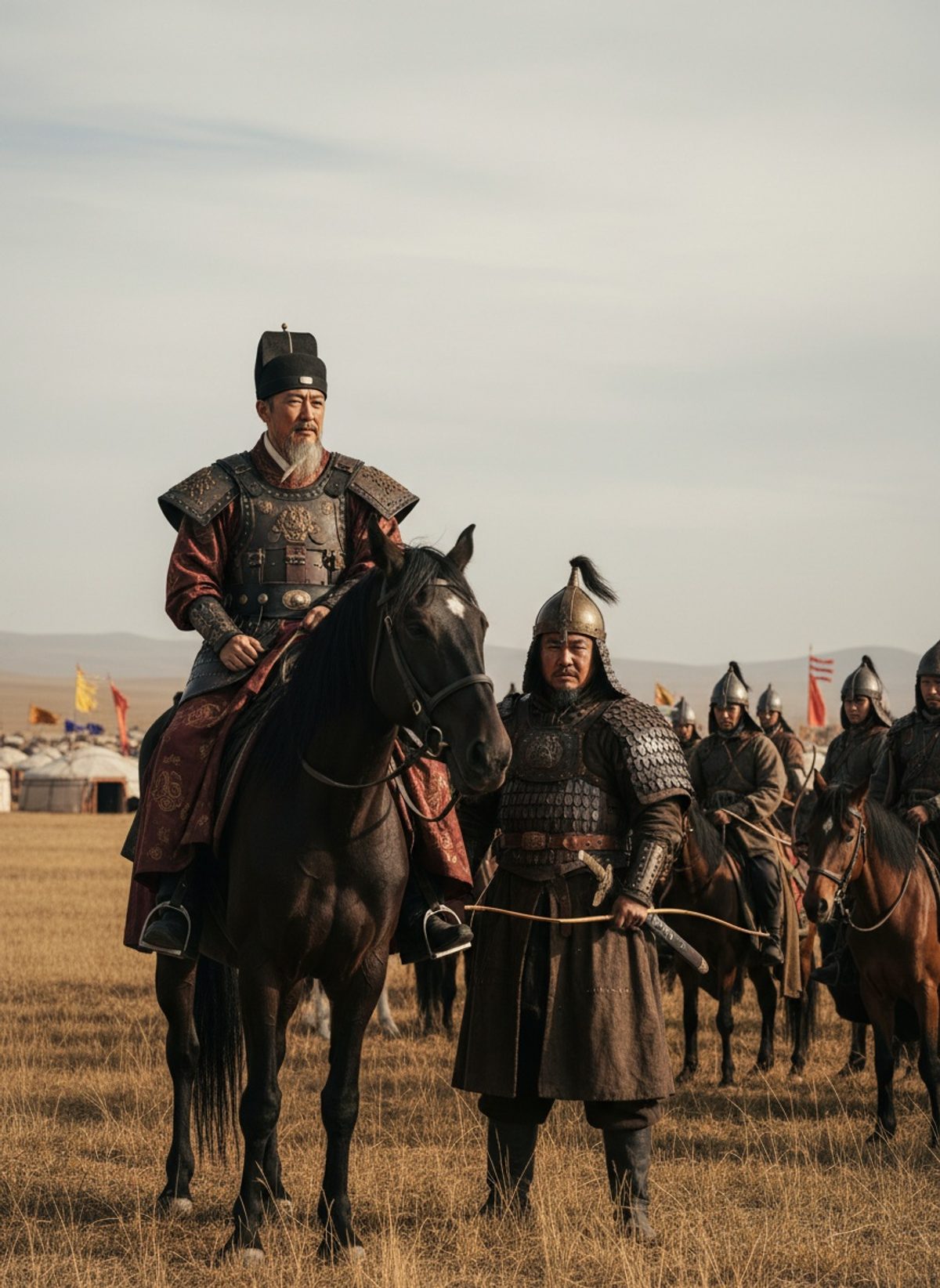
The ground trembled as the thundering hooves of a hundred thousand horses kicked up a storm of dust along the horizon. In stark contrast, Guo Ziyi sat composed atop his solitary steed. The aged yet formidable general of Tang China rode with a single purpose, unarmed and alone, toward the encampment of the Uyghur Khan. Each step of his horse brought him closer to the potential end of his life, yet each heartbeat echoed with unwavering resolve. The fate of a dynasty rested upon the words he would soon speak.
Enemies at the Gate
In 757 CE, Tang Dynasty China teetered on the brink of annihilation. The empire, once towering in might and cultural prowess, was reeling from the turmoil of the An Lushan Rebellion, which had erupted two years prior. Rebel forces, led by the insurgent general An Lushan and later Shi Siming, had seized control of the capital, Chang'an, forcing Emperor Xuanzong to flee under dire circumstances, leaving behind a fractured nation.
As if the rebellion wasn’t enough, a new threat loomed large over the fragile state: the Uyghur Khanate. Their arrival was initially as allies, yet their army, 100,000 strong, now camped on Chinese soil, demanded the right to plunder the empire's beleaguered capital. It was a demand that could not be met without catastrophic consequences. Amidst the chaos, while political machinations and chaos reigned in the upper echelons of power, it was Guo Ziyi, an emblem of Tang loyalty and military acumen, who would stand unwavering.
A Soldier and a Sage
Guo Ziyi’s journey from a middle-class background to the upper echelons of military hierarchy was as remarkable as the man himself. Born in 697 CE in Hua Prefecture, he cut his teeth not on scholarly pursuits as many of his peers, but through the rugged crucible of military examinations. His early career was rife with peril, including a near court martial from which he was saved by the poet Li Bai's intervention. This chance encounter set him on a path that would eventually culminate in legendary heroics during the An Lushan Rebellion.
Read next: He Had One Order. He Ignored It. Thousands Lived.
Despite being heavily outnumbered, Guo Ziyi proved his prowess by outmaneuvering the rebels, earning victory at the Battle of Qingbi. His strategic genius was soon recognized, and he quickly rose to become a pivotal asset to the Tang military. Despite his tactical brilliance, it was Guo’s humanity and dignity that truly defined him—a man who valued the lives of his soldiers and civilians alike.
The Courage to Confront
As the Uyghurs cast their eyes hungrily toward Chang’an, Guo Ziyi embarked on a solitary mission that seemed destined for disaster. The gravity of his feat finds little parallel in military history: a lone general daring to enter the heart of an enemy camp unarmed. Upon arrival, he dismounted and approached the Uyghur Khan with calm humility, a spectacle so audaciously brave that its ripples could be felt across the centuries.
Standing before the Khan in an arena of potential hostility, Guo Ziyi's words were not those of desperation or fear, but of honor and righteousness. He appealed to the Khan's nobility and reason, invoking the bonds of genuine alliance rather than intimidation or deceit. He reminded them that the Uyghurs had come not as conquerors, but as allies. This was not a battle of swords and spears, but one of respect and integrity—a different kind of engagement that tested the mettle of leaders.
Read next: Lincoln Chose the Sword. His Reach Did the Rest.
Turning the Tide
The power of Guo Ziyi’s speech was such that it dissolved the ambitions of the Uyghur horde, persuading the Khan to desist from attacking the capital. In an instant that defied the nature of warfare, the army turned around. It was a decision that reverberated with newfound camaraderie and preserved the integrity of the Tang Empire at a time when its collapse seemed imminent.
Guo Ziyi returned to Tang lands celebrated not just as a warrior or general but as a sage whose wisdom transcended the immediacy of battle. His confrontation with the Uyghurs has since become an emblematic tale of courage wrought from foresighted diplomacy rather than sheer military might. This episode remains a sterling testament to the potency of peacekeeping through dialogue, illuminating the path of harmonious resolution amidst the clangor of impending war.
Why does this story resonate still today? It is perhaps because Guo Ziyi’s legacy challenges our preconceptions of power and courage. Real strength, as his solitary ride into the enemy camp reminds us, often lies not in a show of force, but in diplomacy, humility, and the wisdom to seek understanding. It is a lesson not merely etched in the annals of a single century but one that echoes with timeless relevance, urging us to discern the noble path even in our most tumultuous moments.