The morning air in Stuttgart in the summer of 1907 was thick with anticipation. The sun climbed slowly, casting a warm glow over the city. Inside a cavernous hall, hundreds of delegates from around the world gathered, the room vibrating with the quiet hum of animated conversations. Outside, leaves fluttered in a gentle breeze. Inside, the air was tense with the weight of the moment—an act of defiance that would reverberate across continents.
Across the Distance: An Indian Voice in a Foreign Land
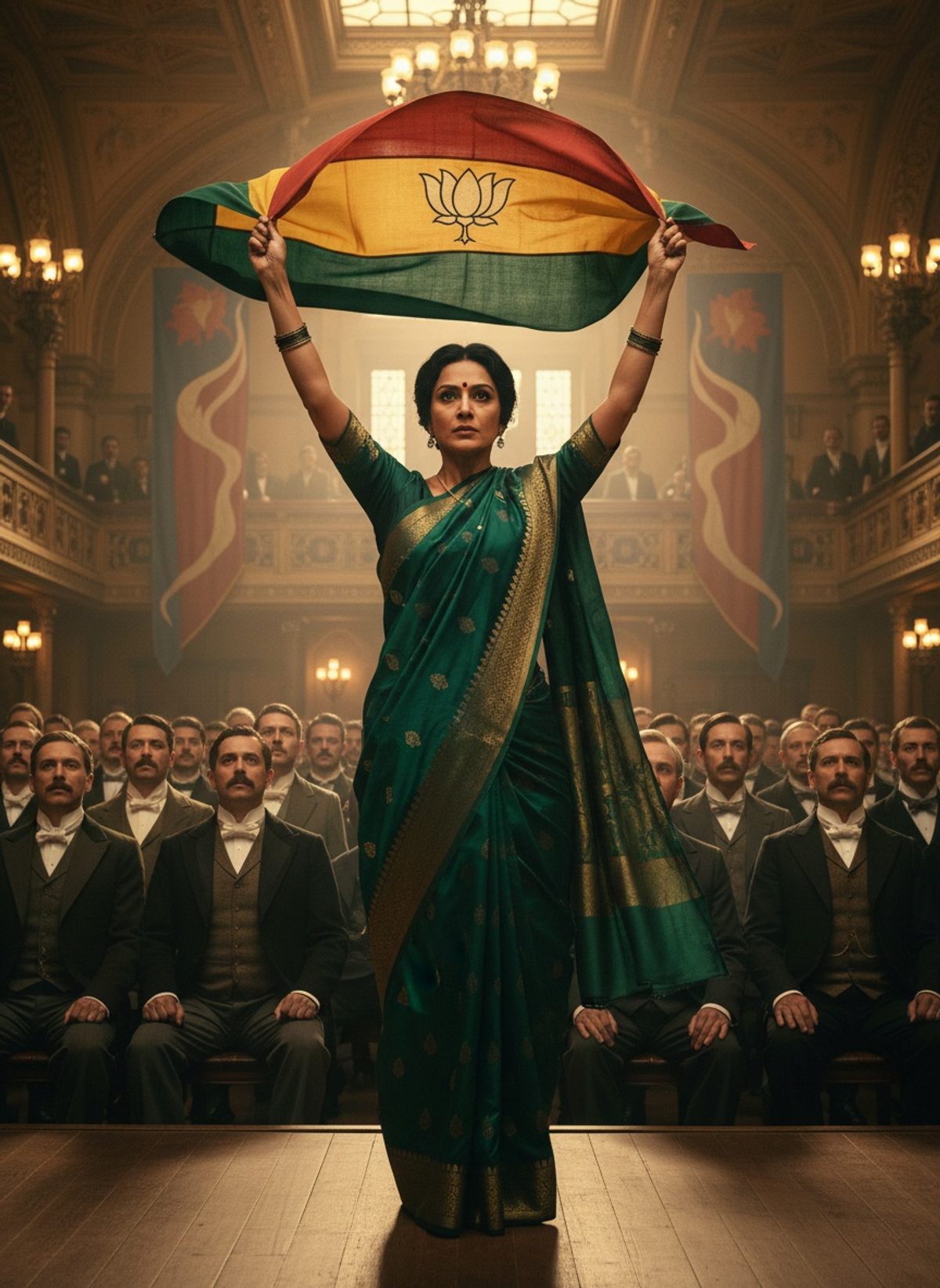
In this charged atmosphere, a small silhouette stepped forward. Her sari, flowing gracefully around her, shimmered under the dim lights. This was Bhikaji Cama, an Indian woman standing in a hall filled with socialists from every corner of the globe. Her presence alone was a bold statement—a woman of color standing amidst predominantly European attendees.
Cama’s journey to Stuttgart was not merely a physical one; it represented the crossing of boundaries imposed by an empire. She had left behind a land draped in the chain of British rule, carrying with her the silent voices of millions yearning for freedom. Her mission was clear: to give voice to the voiceless and to reveal the simmering unrest brewing in India under colonial oppression.
The Flag That Dared to Dream
With a steady hand, Bhikaji Cama held aloft a flag—a vision of the future she believed was within reach. This was no ordinary piece of cloth. It was woven with the threads of hope and resistance, a prototype of what would become the flag of Independent India many decades later. It bore new colors, free from the shadow of the Union Jack.
Read next: When Mau Mau Prisoners Sang Into the Dark, Kenya 1952
The hall quieted, the weight of her audacity settling over the audience. Here, against the backdrop of the Edwardian Empire, she unfurled this emblem of rebellion, declaring it the banner of a nation yet to be born. For a world accustomed to the sun never setting on British territories, this was a moment of awakening to the cracks in imperial power.
A Symbolic Manifestation of Independence
Cama's gesture was far more than symbolic; it was a clarion call to the international community. She urged those gathered to reflect on the ideals of freedom and social justice that transcended borders. Her words, echoing through the hallowed space, spoke not only of the struggles in India but of universal aspirations for dignity and equality.
As the Congress convened, Bhikaji Cama’s flag inspired many who dreamed of a world free from oppression. Her message was simple yet profound: every citizen deserves sovereignty, and every territory must have the right to self-determine. The summit, intended as a platform for socialist ideals, had become a stage for Indian nationalism, much to the consternation of empire loyalists.
The Stirring Aftermath: Ripples Through History
After Stuttgart, the image of Bhikaji Cama’s bold defiance embroidered itself into the collective consciousness of those who yearned for change. The event ignited a renewed spirit amongst the Indian diaspora, influencing movements for sovereignty. Back in India, whispers of her courage circulated, bolstering the resolve of revolutionaries and inspiring future leaders.
Read next: When Birsa Munda's Arrows Stopped an Empire, 1900
Although Cama’s flag was initially dismissed by Indian and British authorities as an impractical fantasy, over time, it came to symbolize an unyielding resolve. Even beyond India's borders, it sparked a dialogue about the legitimacy and morality of colonial domination, contributing to the growing discourse on human rights worldwide.
Echoes of a Pivotal Moment
The actions of Bhikaji Cama in 1907 continue to resonate as a poignant example of how a lone voice can challenge the status quo and inspire a movement. She demonstrated that the spirit of rebellion does not always roar; sometimes, it unfolds quietly across a hall, fronting a dangerous truth to the face of power.
Her legacy, much like the flag she raised, is woven into the very fabric of India’s history—a constant reminder that the desire for freedom cannot be quelled. Bhikaji Cama unfurled more than just a flag that day; she unfurled a dream that has motivated generations to seek liberty, reminding us that it is often the actions deemed irrelevant by authority that ignite the most profound change.